OVERVIEW
Fresh watermelons are among the most iconic summer fruits, but behind their refreshing simplicity lies a highly structured global market. From Mediterranean fields to North American supermarkets, this product travels thousands of kilometers through an efficient and increasingly competitive supply chain.
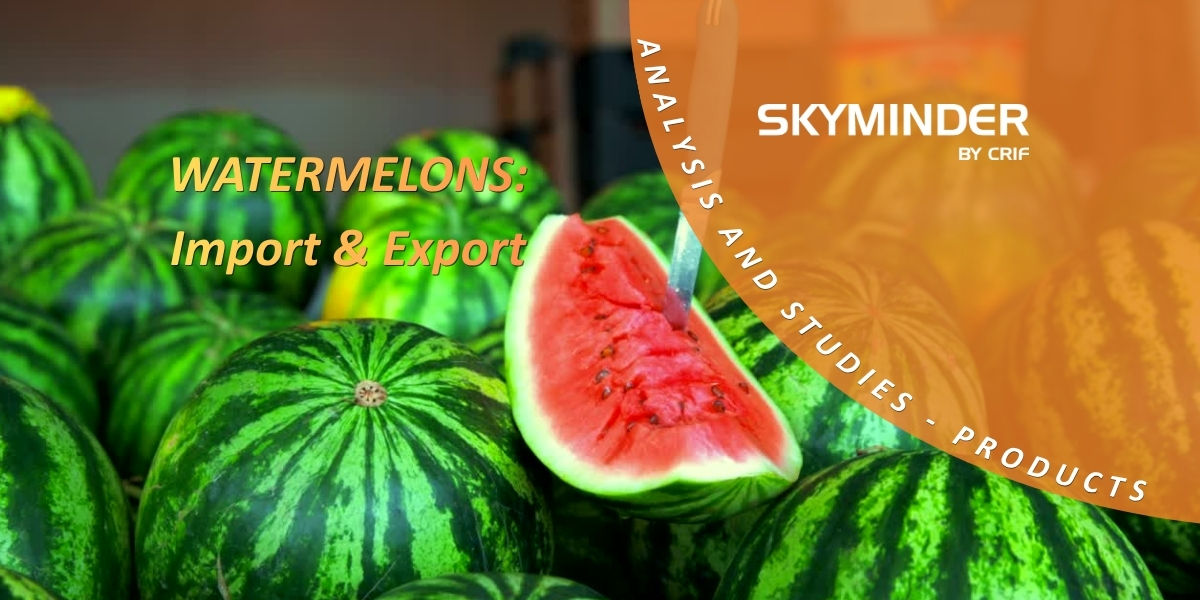
Today, the international trade of fresh watermelons exceeds $2.2 billion, making it a solid segment within the global fresh fruit industry.
Despite being cultivated in many regions, the market is shaped by a few dominant exporters and highly concentrated demand hubs, creating a system where geography and logistics play a crucial role.
GLOBAL EXPORT DYNAMICS
At first glance, watermelons seem widely available, yet global exports are far from evenly distributed.
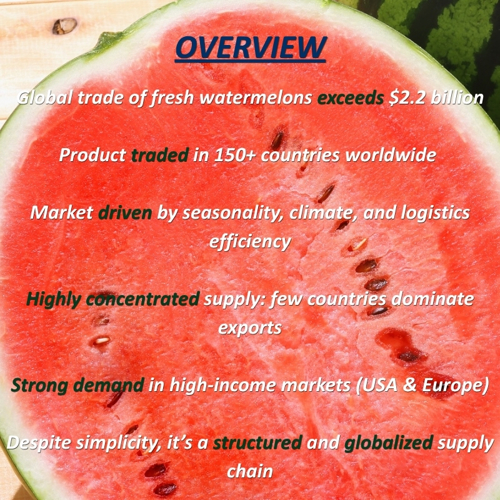
A small group of countries controls the majority of international trade:
• The top 5 exporters account for over 60% of global exports
• Spain leads with around 23–25% of total exports
• Mexico follows with roughly 14–17%
• Italy, the United States, and the Netherlands each contribute between 6% and 8%
This level of concentration highlights how production advantages, such as climate, infrastructure, and proximity to key markets, translate directly into trade dominance.
From a regional perspective, the export landscape is even clearer:
• Europe accounts for over 50% of global export value
• North America contributes about 21%
• Asia around 11%
• Remaining shares are split among Latin America and Africa
In particular, Mediterranean countries such as Spain and Italy benefit from ideal growing conditions and efficient access to European consumers, reinforcing their leading role year after year.
IMPORT MARKETS: WHERE DEMAND IS CONCENTRATED
While supply is concentrated, demand is even more polarized.
A few large economies dominate global imports, driven by strong purchasing power and the need to ensure year-round availability.
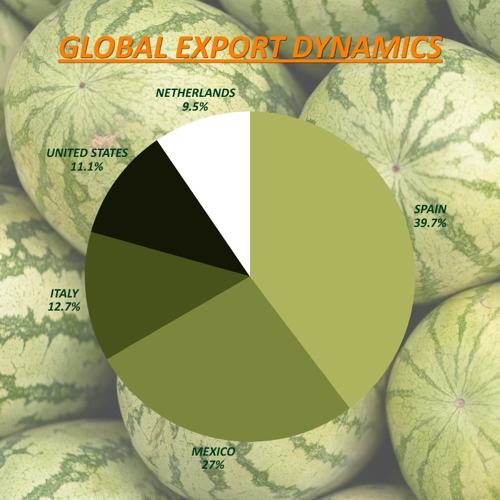
• The United States is the world’s largest importer, with imports approaching $900 million within the broader melon category
• Europe forms another major demand block, with countries like:
o Germany
o France
o United Kingdom
o Netherlands
among the leading importers
Looking at volumes helps understand the scale:
• The U.S. imports over 1.3 billion kg annually
• Germany exceeds 600 million kg
• France and the UK each surpass 300 million kg
These figures show how consumption is concentrated in mature markets with advanced retail systems and consistent demand, even outside domestic growing seasons.
TRADE FLOWS AND LOGISTICS: THE BACKBONE OF THE MARKET
The watermelon trade is highly regional and efficiency-driven. Because the fruit is perishable, supply chains are optimized to minimize time and cost.
Some of the most important global trade corridors include:
• Mexico → United States
One of the largest flows globally, accounting for a significant share of exports
• Spain → European Union (Germany, France)
The backbone of intra-European trade
• Morocco → Southern Europe
A growing route thanks to geographic proximity and competitive pricing
Certain trade flows can represent double-digit shares of total global exports, highlighting how concentrated and structured the market is.
MARKET TRENDS AND EMERGING PLAYERS
Although the market is dominated by a few key exporters, new players are gradually gaining relevance.
Some countries have recorded strong expansion trends:
• Turkey: over +250% growth in export activity
• Costa Rica: +60% growth
• Brazil: +50% growth
At the same time, global trade has maintained a steady upward trajectory, growing at an average rate of around 3% annually over recent years.
This suggests a gradual diversification of supply, even if the overall structure remains relatively concentrated.
CURIOSITY CORNER
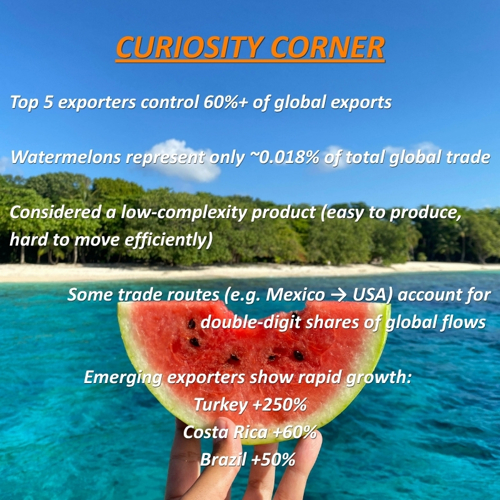
• Despite its global presence, watermelon is considered a low-complexity product, meaning it requires limited industrial processing compared to other traded goods
• The product accounts for only a tiny share of global trade (around 0.018%), yet it remains essential in the fresh produce category
• Some countries rely significantly on watermelon exports, even if the product represents less than 1% of their total trade, showing its importance within the agricultural sector
• The top exporters alone ship more than three-fifths of global supply, making the market more concentrated than expected.
CONCLUSION
The global fresh watermelon market is a perfect example of how a simple agricultural product can reflect complex trade dynamics.
With exports exceeding $2 billion and a handful of countries controlling the majority of supply, the sector is both stable and competitive. Europe plays a dominant role in exports, while the United States and other developed economies lead demand.
At the same time, the emergence of new exporters and steady growth rates indicate that the market is evolving, albeit gradually.
Ultimately, the journey of a watermelon, from field to table, is not just about seasonality, but about global connections, efficient logistics, and a delicate balance between supply and demand.