
OVERVIEW: A RESILIENT AND DIVERSIFIED ECONOMY
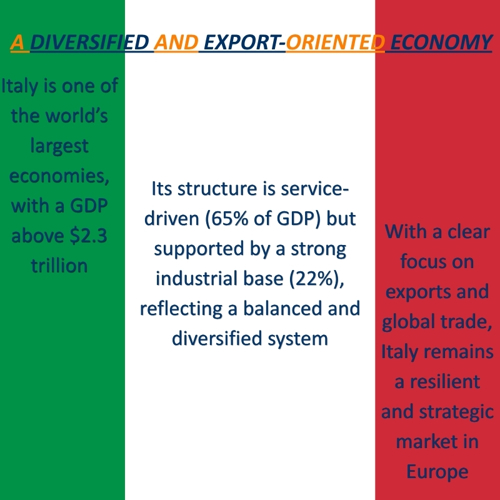
Italy stands as one of the world’s leading advanced economies, combining strong industrial capabilities with a globally recognized brand identity rooted in quality, design, and innovation. As the 8th largest economy globally with a GDP exceeding $2.3 trillion, the country plays a central role in European and international trade.
The Italian economic system is characterized by a high level of diversification, with strengths ranging from manufacturing and pharmaceuticals to agri-food and luxury goods. Its industrial structure is unique within Europe, largely driven by networks of small and medium-sized enterprises, alongside globally competitive multinational firms.
From a macroeconomic perspective, services dominate the economy, accounting for over 65% of GDP, while industry contributes around 22%, and agriculture remains marginal at roughly 2%.
TRADE PERFORMANCE: STRONG EXPORT ORIENTATION
Italy’s economy is deeply integrated into global trade flows, with exports representing a crucial growth driver. The country consistently ranks among the top exporters worldwide, with total exports reaching approximately $630–700 billion.
• Exports of goods and services account for ~33% of GDP
• Imports account for ~32% of GDP, highlighting a balanced trade structure
Italy maintains a positive trade balance, supported by strong international demand for high-value goods.
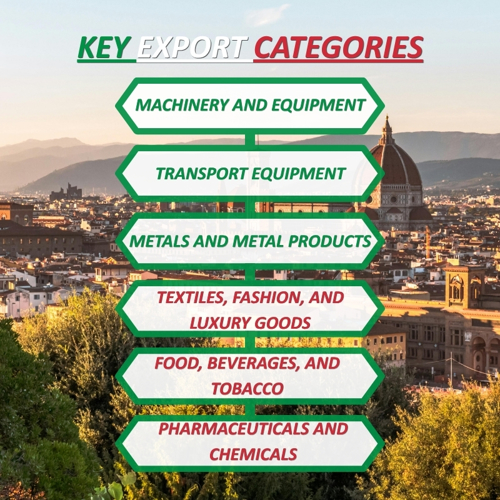
Key Export Categories
• Machinery and equipment: ~16–18% of total exports
• Transport equipment: ~10–11%
• Metals and metal products: ~10–11%
• Textiles, fashion, and luxury goods: ~10–11%
• Food, beverages, and tobacco: ~8%
• Pharmaceuticals and chemicals: ~6–8%
GEOGRAPHICAL TRADE DYNAMICS
Italy’s trade relationships are strongly rooted within Europe, while maintaining global reach.
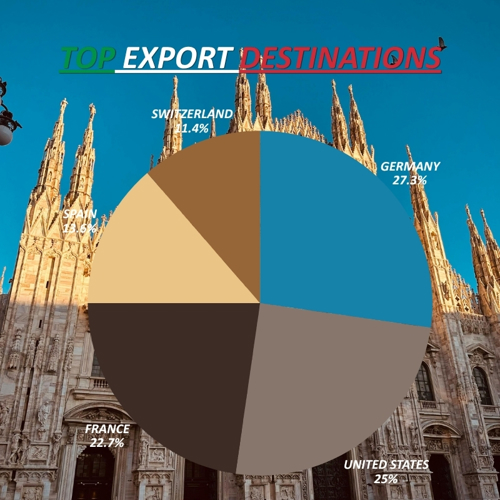
Top Export Destinations
• Germany: ~11–12% of exports
• United States: ~9–11%
• France: ~10%
• Spain: ~5–6%
• Switzerland & United Kingdom: ~4–5% each
Overall distribution
• ~65% of exports go to Europe
• ~15% to Asia
• ~12–13% to North America
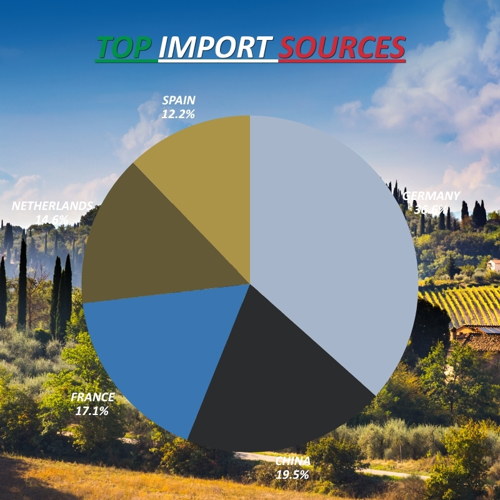
Top Import Sources
• Germany: ~15%
• China: ~8%
• France: ~7–8%
• Netherlands: ~6%
• Spain: ~5–6%
IMPORT STRUCTURE: A DEPENDENCE ON ENERGY AND INTERMEDIATE GOODS
While Italy is a strong exporter, its production system relies heavily on imported raw materials and intermediate goods, reflecting the nature of its manufacturing-driven economy.
Imports reach approximately $590–640 billion, positioning Italy among the world’s largest importers.
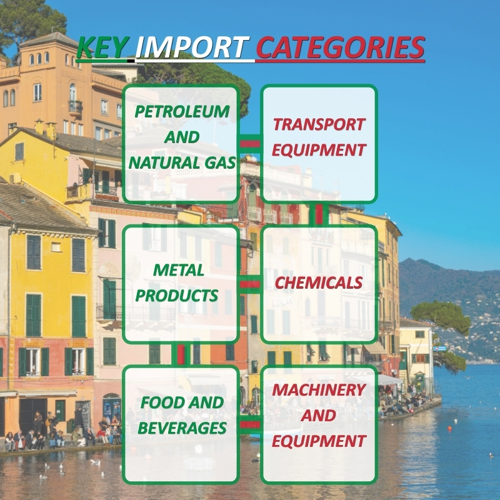
Key Import Categories
• Petroleum and natural gas: ~11% of total imports
• Transport equipment: ~10–11%
• Metal products: ~10%
• Chemicals: ~10%+ (combined categories)
• Food and beverages: ~7%
• Machinery and equipment: ~7%
This composition highlights a structural reliance on energy and industrial inputs, which are essential to sustain domestic production and exports.
Energy Dependency
Italy imports a significant share of its energy needs, particularly oil and natural gas, making the economy sensitive to global price volatility and geopolitical shifts.
At the same time, this dependency is driving diversification strategies and investments in renewable energy, opening new opportunities in energy transition and infrastructure.
INDUSTRIAL STRENGTH: THE CORE OF “MADE IN ITALY”
Italy’s global competitiveness is strongly tied to its industrial ecosystem, particularly in manufacturing.
Key sectors include:
• Mechanical engineering and industrial machinery
• Automotive and transport equipment
• Fashion, textiles, and luxury goods
• Food and beverage production
• Pharmaceuticals and chemicals
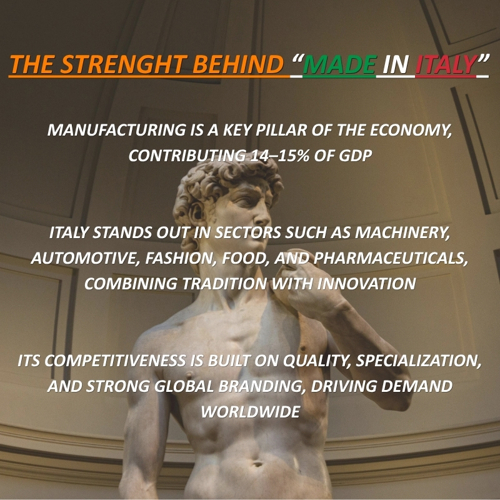
Manufacturing contributes approximately 14–15% of GDP, a relatively high share among advanced economies.
Italian companies compete globally through quality, specialization, and design, rather than volume, reinforcing the strength of the “Made in Italy” brand.
OPPORTUNITIES AND STRUCTURAL CHALLENGES
Key Strengths
• Strong export-driven model
• Global brand recognition
• Highly diversified industrial base
• Strategic position in Europe
Main Challenges
• Weak productivity growth
• Fragmented firm structure (SME dominance)
• Regional economic disparities
• Dependence on imported energy and raw materials
CONCLUSION: A MATURE BUT DYNAMIC MARKET
Italy represents a mature, export-oriented economy with a strong industrial backbone and global competitiveness in high-value sectors.
Its ability to combine tradition, innovation, and design continues to drive international demand, while its central role in European trade makes it a strategic market for businesses worldwide.
Despite structural challenges, Italy remains a resilient and opportunity-rich environment, particularly for companies operating in manufacturing, luxury, technology, and energy transformation.
Source: The Observatory of Economic Complexity