AN OVERVIEW OF THE GLOBAL ONION MARKET
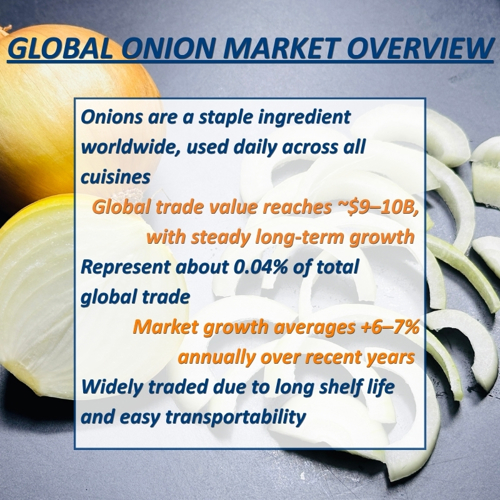
Onions are one of the most essential and versatile ingredients in global cuisine, forming the base of countless dishes across cultures. Beyond their culinary importance, onions represent a strategic commodity in international agricultural trade, thanks to their long shelf life, ease of transport, and steady global demand.
From a trade perspective, onions belong to the category of edible vegetables and roots. Despite their everyday nature, they play a measurable role in global trade flows, accounting for a small but stable share of international commerce.
In recent years, the global trade of onions has reached a value of approximately $9–10 billion, showing consistent growth (around +6–7% annually over a multi year period).
Although this represents only about 0.04% of total global trade, it highlights how even staple commodities contribute to the complexity of international supply chains.
EXPORT DYNAMICS: WHO LEADS THE MARKET
When looking at the supply side, the onion export market is relatively concentrated, with a few countries dominating global flows.
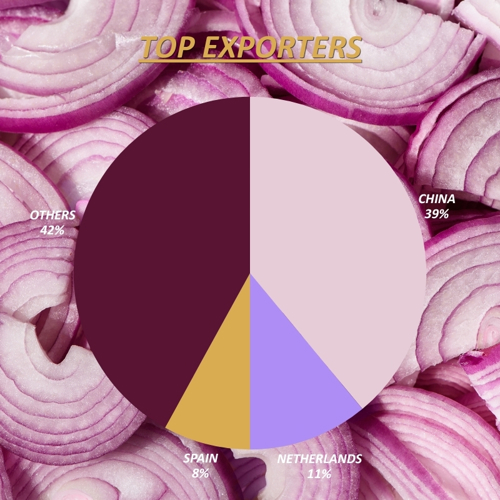
China stands out as the leading exporter, followed by major European players such as the Netherlands and Spain.
These countries benefit from large-scale production, efficient logistics, and strong integration into global agricultural markets.
At the same time, a broader group of exporters, including Mexico, India, and the United States, collectively shapes the global landscape. The top five exporters alone account for roughly 55–60% of global exports, confirming a moderately concentrated market structure.
From a regional perspective:
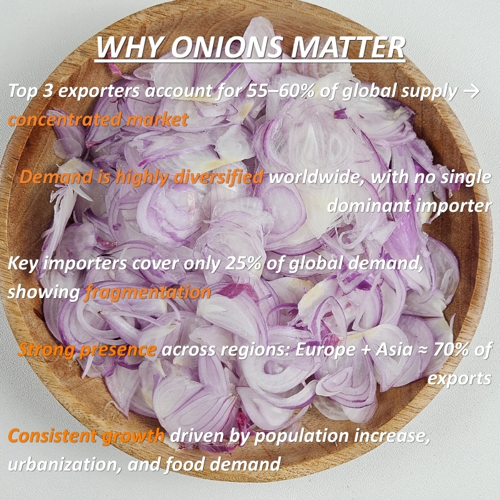
• Europe and Asia together account for nearly 70% of global onion exports
• North America contributes around 15–20%
• Other regions (Africa, Latin America, Oceania) remain smaller but increasingly dynamic players
This distribution reflects not only production capacity but also geographic advantages in serving key import markets.
IMPORT PATTERNS: WHERE DEMAND COMES FROM
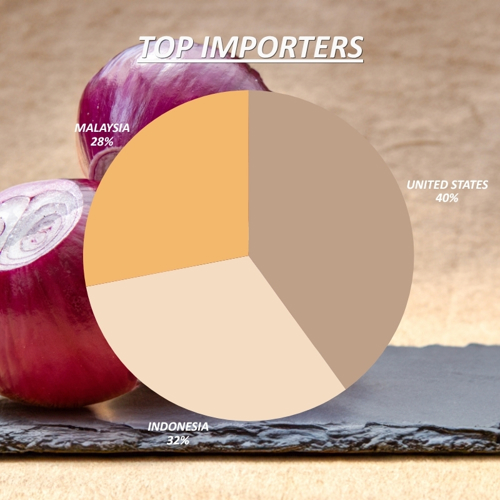
On the demand side, onion imports are more geographically diversified, with consumption spread across both developed and emerging economies.
The United States is the largest importer globally, accompanied by fast-growing Asian markets such as Indonesia and Malaysia.
Unlike exports, import demand is less concentrated:
• The top importers represent a relatively small combined share, indicating a broad global demand base
• Major importing regions include North America, Southeast Asia, and parts of the Middle East
This diversified demand is driven by several factors:
• Population growth in emerging economies
• Urbanization and changing diets
• Seasonal production gaps that require imports
In practical terms, this makes onions a highly traded commodity with strong cross-border interdependence.
GROWTH TRENDS AND MARKET EVOLUTION
The global onion market has been characterized by steady growth rather than extreme volatility.
Trade value has shown double-digit increases in certain years (around +10%), supported by:
• Expanding global demand
• Improvements in storage and logistics
• Increased integration of agricultural markets
Over a longer horizon, the market has grown at a compound annual rate above 6%, indicating resilience and long-term stability.
At the same time, structural challenges remain:
• Post-harvest losses can reach 20–25% globally, especially in developing regions
• Supply is sensitive to climate conditions and crop cycles
• Price volatility can occur due to sudden production shocks
Despite these challenges, the outlook remains positive, supported by growing consumption and expanding trade networks.
A LOW-COMPLEXITY BUT HIGH-VOLUME PRODUCT
From an economic complexity perspective, onions are considered a low-complexity product, meaning they do not require advanced technology or specialized capabilities to produce.
However, this simplicity is precisely what makes onions such a widely traded commodity:
• They can be grown in many regions
• They are essential in daily consumption
• They are easily stored and transported
This combination results in a product that is accessible, scalable, and globally integrated.
CONCLUSION: WHY ONIONS MATTER IN GLOBAL TRADE
Even though onions may seem like a basic agricultural product, their role in global trade is far from marginal.
Key takeaways:
• Global trade value: ~$9–10 billion
• Top exporters dominate ~60% of supply
• Demand is widely distributed across regions
• Steady growth driven by consumption and logistics improvements
Ultimately, onions illustrate how even the most ordinary products can offer valuable insights into global trade dynamics. They connect producers and consumers across continents, highlighting the importance of agricultural commodities in shaping international markets.