
OVERVIEW
The Bahamas is often associated with turquoise waters and luxury tourism, but behind the postcard image lies a highly open and trade-dependent economy. With a population of under 400,000 and a GDP of roughly $15–16 billion, the country operates as a high-income, service-driven economy deeply linked to global markets.
What makes the Bahamas particularly interesting is its economic structure; a combination of strong service exports, especially tourism, and a heavy reliance on imported goods. Trade plays a crucial role, accounting for nearly 79% of GDP, highlighting the country’s exposure to external demand and supply chains.
Despite its small size, the Bahamas is tightly integrated with major economies, most notably the United States, which dominates both its import and export landscape.
ECONOMIC PROFILE AND COMPLEXITY
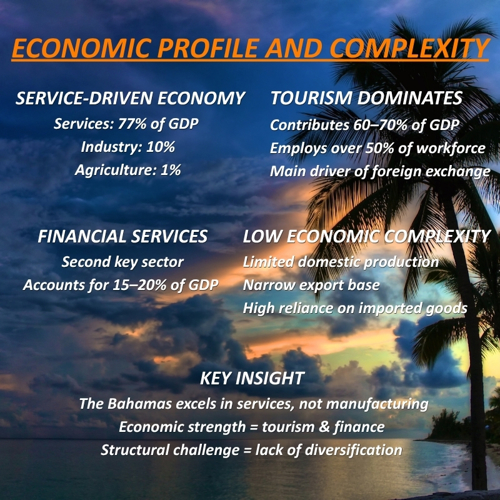
The Bahamian economy is overwhelmingly service-oriented. Services contribute approximately 77% of GDP, while industry makes up about 10%, and agriculture remains marginal at around 1%.
Tourism is the true backbone of the economy, contributing around 60–70% of GDP and employing more than half of the workforce.
Financial services represent the second pillar, accounting for roughly 15–20% of GDP.
This strong concentration in services results in relatively low economic complexity, as the country produces a narrow range of goods. Instead of manufacturing or diversified exports, the Bahamas relies on imported products to meet domestic demand, a structural feature that directly impacts its trade balance.
In essence, the Bahamas trades sophistication in goods production for specialization in high-value services.
EXPORTS
Goods exports from the Bahamas are relatively limited in both volume and diversity, totaling under $1 billion annually.
A defining feature of Bahamian exports is the dominance of re-exports, which account for approximately 73% of total exports, compared to only 27% in domestic exports.
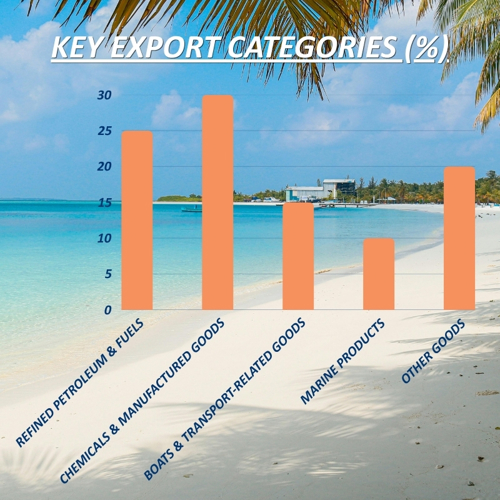
KEY EXPORT CATEGORIES INCLUDE:
• Refined petroleum and fuels
• Marine products, such as crustaceans and shellfish
• Boats and transport-related goods
• Chemicals and manufactured goods (mainly re-exported)
Among domestic exports specifically:
• Food and live animals represent about 49%
• Chemicals account for around 27%
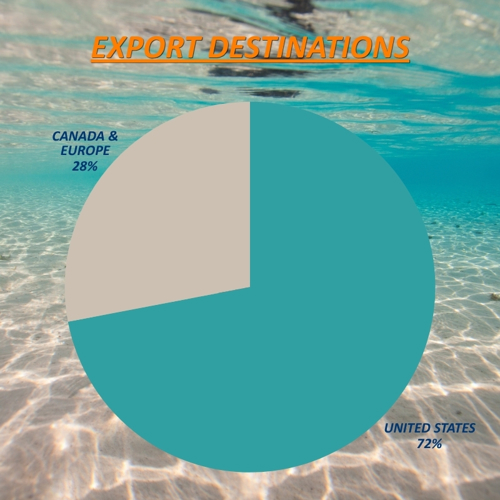
Geographically, exports are highly concentrated:
• The United States absorbs around 65–72% of exports
• Secondary partners include Canada and some European countries
This concentration creates both stability and vulnerability, stability through strong ties, and risk through dependence on a single major partner.
IMPORTS
If exports are limited, imports tell the opposite story; the Bahamas is heavily reliant on foreign goods. Total imports reach around $4.5–5 billion, far exceeding exports.
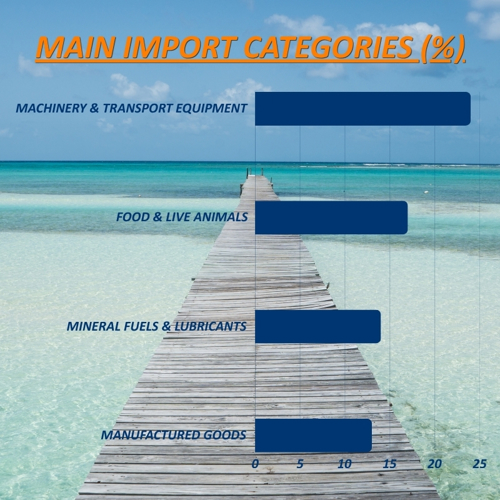
MAIN IMPORT CATEGORIES:
• Machinery and transport equipment: ~24%
• Food and live animals: ~17%
• Mineral fuels and lubricants: ~14%
• Manufactured goods: ~13%
The structure reflects the country’s limited domestic production capacity; everything from food to industrial inputs must be sourced externally.
In terms of trade partners:
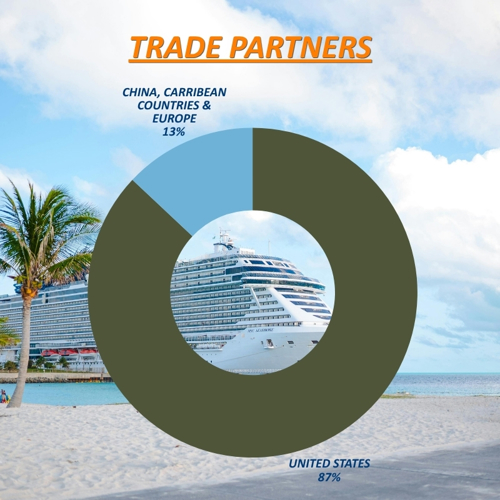
• The United States supplies about 83–87% of imports
• Other partners include China, Caribbean countries, and Europe
This makes the Bahamas one of the most import-dependent economies in the region, particularly for essential goods like food and fuel.
TRADE BALANCE
Given the imbalance between modest exports and substantial imports, the Bahamas consistently runs a significant trade deficit.
• Trade deficit levels typically exceed $3–4 billion annually
• Imports are often 4–5 times larger than exports
This structural deficit is a direct outcome of:
1. A narrow export base
2. Heavy domestic reliance on imports
3. Strong consumption driven by tourism
Interestingly, the deficit in goods is partially offset by surpluses in services, particularly tourism and financial services, which generate substantial foreign exchange inflows.
Still, the country remains vulnerable to external shocks, especially fluctuations in tourism demand or global trade conditions.
CURIOSITY CORNER
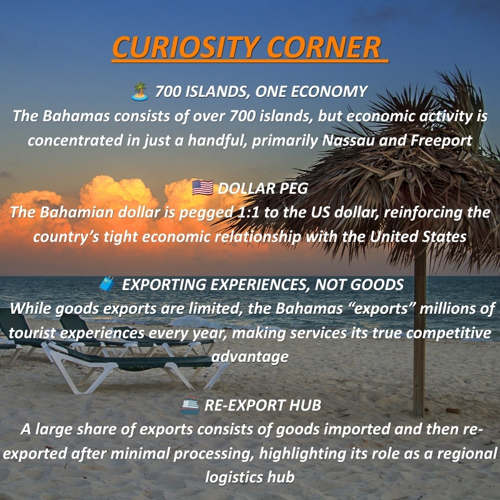
• 🏝️ 700 Islands, One Economy: The Bahamas consists of over 700 islands, but economic activity is concentrated in just a handful, primarily Nassau and Freeport.
• 🇺🇸 Dollar Peg: The Bahamian dollar is pegged 1:1 to the US dollar, reinforcing the country’s tight economic relationship with the United States.
• 🧳 Exporting Experiences, Not Goods: While goods exports are limited, the Bahamas “exports” millions of tourist experiences every year, making services its true competitive advantage.
• 🚢 Re-export Hub: A large share of exports consists of goods imported and then re-exported after minimal processing, highlighting its role as a regional logistics hub.
CONCLUSION
The Bahamas represents a fascinating case of a modern, service-driven economy built on global connectivity rather than industrial production.
Its strengths lie in:
• A dominant tourism industry
• Strong ties with major economies
• High income levels and stable financial services
Yet, these strengths come with structural challenges:
• Heavy reliance on imports
• Limited export diversification
• Persistent trade deficits
In many ways, the Bahamas is a consumption-driven, externally supported economy, a model that works well in periods of global stability, but requires careful balancing to remain resilient in an increasingly uncertain world.