
PRODUCT CLASSIFICATION
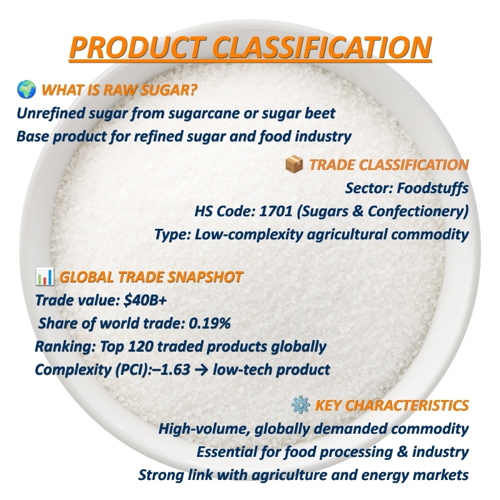
Raw sugar is one of the most widely traded agricultural commodities in the world, forming the backbone of the global sweetener industry. Extracted primarily from sugarcane and sugar beet, it represents the unrefined stage of sugar production before processing into white or refined sugar. Its importance extends far beyond food consumption, playing a crucial role in industrial applications, biofuels, and food manufacturing.
From a trade perspective, raw sugar falls under the Foodstuffs category, within HS Chapter 17: Sugars and Confectionery, specifically classified under HS4 code 1701. Despite being a relatively low-complexity product, raw sugar has enormous economic relevance due to its high global demand, large production volumes, and strategic importance in both developed and emerging economies.
Global trade in raw sugar exceeds $40 billion annually, accounting for approximately 0.19% of total world trade, and ranking among the top 120 most traded products worldwide.
Over recent years, the sector has shown strong momentum, with an average annual growth rate of around 12.5%, driven by rising global consumption, population growth, and expansion of food-processing industries.
In terms of complexity, raw sugar records a Product Complexity Index (PCI) of around –1.63, placing it among the least complex traded goods.
This reflects its relatively straightforward production process compared to high-tech products, yet it remains deeply embedded in global value chains.
EXPORT
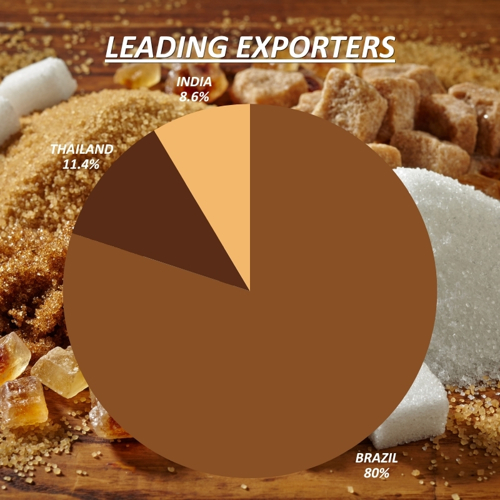
Raw sugar exports are highly concentrated, dominated by a small number of large-scale agricultural producers with favorable climates and well-developed agro-industrial systems.
The leading exporters include:
• Brazil – over $20B (48% of global exports)
• Thailand – about $2.5B (6%)
• India – about $2.1B (5%)
Brazil alone accounts for nearly half of global raw sugar exports, thanks to its vast sugarcane plantations, advanced processing capacity, and integrated logistics networks. Its dominance highlights how competitive advantage in this sector is strongly tied to climate, land availability, and scale efficiency.
Asian exporters such as Thailand and India play an increasingly important role, benefiting from strong regional demand and lower production costs.
Countries with the highest dependence on raw sugar within their export portfolios include several developing economies where sugar represents a strategic cash crop. In some cases, sugar can account for over 2–3% of total national exports, underlining its economic significance for rural development and foreign currency earnings.
The largest trade surpluses are typically recorded by:
• Brazil (by far the largest global surplus)
• Thailand
• India
These surpluses reflect not only production capacity but also strong export-oriented policies and established trade relationships, particularly with Asia and the Middle East.
IMPORT
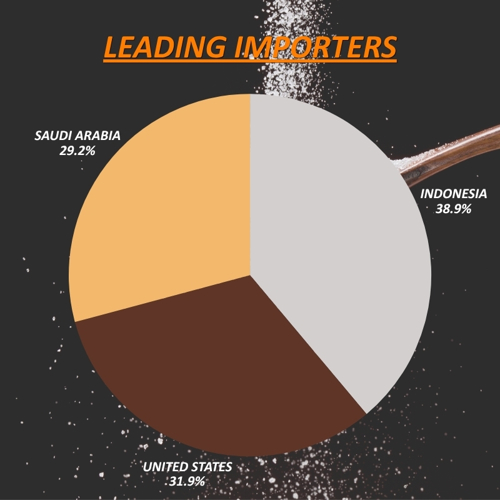
On the demand side, raw sugar imports are driven by countries with large populations, strong food-processing industries, or limited agricultural capacity.
The leading importers include:
• Indonesia – around $2.8B
• United States – approximately $2.3B
• Saudi Arabia – about $2.1B
Indonesia stands out as the world’s largest importer, reflecting its rapidly growing population and expanding food manufacturing sector, which relies heavily on imported raw sugar for refining.
The United States, despite being a major producer, imports significant quantities to balance domestic supply gaps and meet industrial demand. Similarly, Middle Eastern countries such as Saudi Arabia depend heavily on imports due to limited domestic production capacity.
The largest trade deficits are concentrated in these high-demand markets, highlighting a structural imbalance between production regions (tropics) and consumption centers (globally distributed).
CURIOSITY CORNER: THE GLOBAL SWEET ECONOMY
Raw sugar may seem like a simple commodity, but its story is deeply intertwined with global history, trade, and even geopolitics.
Sugar was once considered a luxury good, often referred to as “white gold” due to its high value and limited availability. Today, it has become a mass-consumed staple, with global consumption exceeding 180 million tonnes annually and per capita usage reaching over 22 kg per year.
Interestingly, raw sugar is rarely consumed directly. Instead, it is traded globally and then refined closer to end markets. This creates a two-step value chain, where countries importing raw sugar often specialize in refining and re-exporting processed sugar products.
Another fascinating aspect is its link to energy markets. In major producers like Brazil, sugarcane is also used to produce ethanol, meaning that global sugar exports are partially influenced by oil prices. When oil prices rise, more sugarcane is diverted to biofuel production, potentially reducing sugar supply and increasing prices.
Finally, sugar is one of the most politically sensitive agricultural commodities, often subject to tariffs, quotas, and subsidies, making it a key product in international trade negotiations.

CONCLUSION
The global raw sugar trade highlights the dynamics of a high-volume, low-complexity commodity that remains essential to modern economies. With a market size exceeding $40 billion and a steady long-term growth trajectory, raw sugar continues to play a critical role in global trade.
Exports are highly concentrated, led overwhelmingly by Brazil, while imports are driven by populous and industrialized countries such as Indonesia and the United States. This creates a clear geographical divide between production hubs and consumption centers, reinforcing the importance of efficient logistics and stable trade relationships.
Despite its simplicity from a production standpoint, raw sugar demonstrates how agricultural commodities can underpin complex global supply chains, influenced by factors ranging from climate conditions to energy markets and trade policies.
As global demand for food, processed goods, and biofuels continues to expand, raw sugar is likely to remain a strategic and highly traded product, balancing tradition with evolving economic and industrial needs.