
OVERVIEW
Over the past few decades, Vietnam has transformed itself from an agriculture-based economy into one of the world's most dynamic manufacturing and trading hubs. Strategic economic reforms, strong foreign direct investment (FDI), competitive labor costs, and increasing integration into global supply chains have helped position the country as a key player in international commerce.
Today, Vietnam ranks among the world's leading exporters, supported by a diverse industrial base that spans electronics, telecommunications equipment, textiles, footwear, and machinery. The country's geographic location at the heart of Southeast Asia further reinforces its role as a gateway between major Asian markets and global consumers.
With product exports exceeding $500 billion and imports approaching $400 billion, Vietnam has become one of the most trade-oriented economies in the world. International trade continues to act as a major engine of growth, attracting multinational corporations and strengthening the country's position within global value chains.
ECONOMIC PROFILE AND COMPLEXITY
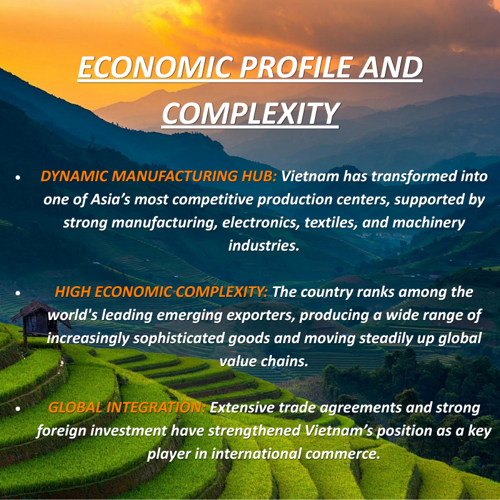
Vietnam's economic success is closely linked to its increasing industrial sophistication. The country has steadily moved beyond traditional low-value manufacturing toward higher-value sectors such as electronics, semiconductors, computer components, and advanced machinery. This transition has boosted productivity while enhancing the country's competitiveness in international markets.
According to the Observatory of Economic Complexity (OEC), Vietnam ranks among the world's most complex economies, reflecting its ability to produce and export a wide range of technologically advanced products. This evolution demonstrates how the country has successfully integrated itself into sophisticated global production networks.
Manufacturing plays a central role in the economy, supported by strong inflows of foreign investment, particularly from multinational technology companies that use Vietnam as a regional production base. The country's export portfolio now combines traditional strengths such as textiles with fast-growing sectors including electronics, computers, and telecommunications equipment.
EXPORTS
Vietnam's export sector is highly diversified and increasingly technology-driven. Total exports are valued at approximately $505 billion, placing the country among the world's largest exporters.
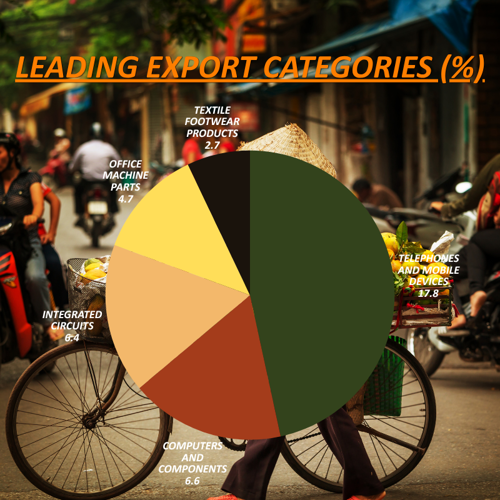
The leading export categories include:
• Telephones and mobile devices: approximately $90 billion, representing around 17.8% of total exports.
• Computers and computer components: about $33.5 billion, or 6.6% of exports.
• Integrated circuits: around $32.1 billion, accounting for 6.4%.
• Office machine parts: roughly $23.7 billion, equal to 4.7%.
• Textile footwear products: approximately $13.6 billion, representing 2.7%.
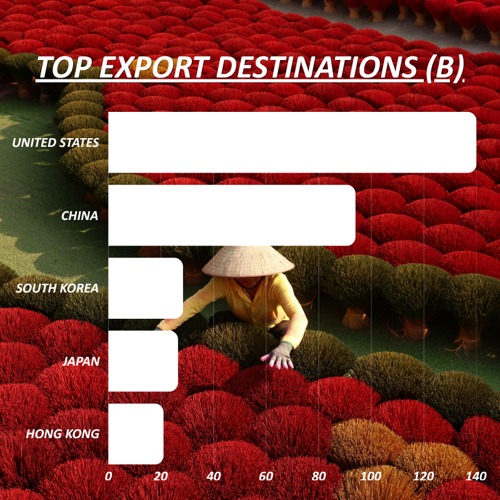
Vietnam's exports are heavily concentrated in a few key destinations:
• United States: approximately $140 billion (27.7% of total exports).
• China: around $94 billion (18.6%).
• South Korea: about $28.4 billion (5.6%).
• Japan: roughly $26.5 billion (5.2%).
• Hong Kong: approximately $21 billion (4.2%).
The prominence of electronics and technology products highlights Vietnam's successful move toward higher-value manufacturing and its importance within global supply chains.
IMPORTS
Vietnam's import structure reflects its strong manufacturing orientation. Many imported products are intermediate goods and components that are later assembled and re-exported as finished products.
Total imports amount to approximately $377 billion.
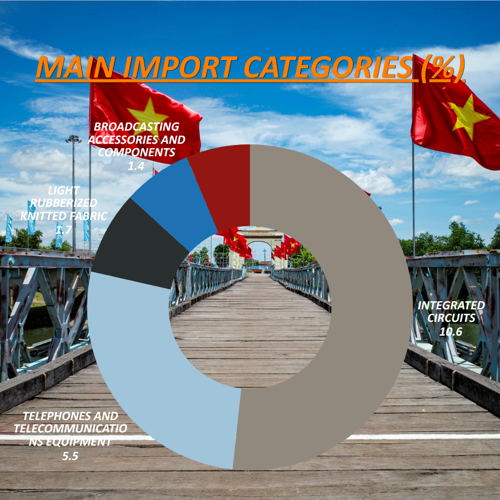
The main import categories are:
• Integrated circuits: about $39.8 billion, representing approximately 10.6% of imports.
• Telephones and telecommunications equipment: around $20.7 billion, or 5.5%.
• Light rubberized knitted fabric: approximately $6.3 billion, equal to 1.7%.
• Broadcasting accessories and components: about $5.4 billion, or 1.4%.
• Refined petroleum: roughly $4.8 billion, accounting for 1.3%.
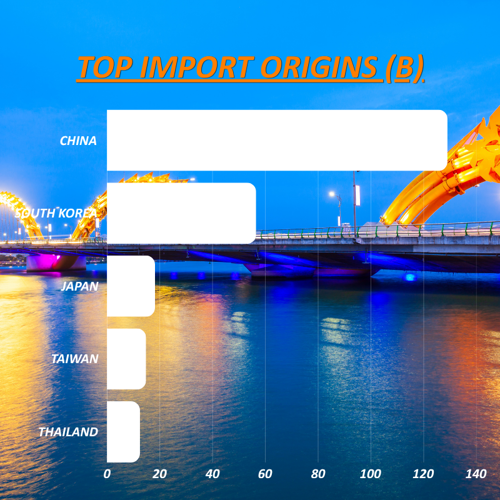
Vietnam sources most of its imports from neighboring Asian economies:
• China: approximately $129 billion (34.2% of total imports).
• South Korea: about $56.5 billion (15.0%).
• Japan: around $18.2 billion (4.8%).
• Taiwan: approximately $14.8 billion (3.9%).
• Thailand: roughly $12.5 billion (3.3%).
These figures underline Vietnam's deep integration into regional manufacturing networks, particularly across East and Southeast Asia.
TRADE BALANCE
One of Vietnam's most remarkable economic achievements is its ability to maintain a substantial trade surplus despite its heavy reliance on imported industrial inputs.
With exports valued at approximately $505 billion and imports at about $377 billion, the country records a positive trade balance of roughly $128 billion.
This surplus reflects the efficiency of Vietnam's export-oriented manufacturing model. Imported components are transformed into higher-value finished products that are shipped worldwide, creating significant value added within the domestic economy. The model has attracted global manufacturers seeking a competitive production base and has contributed to the country's rapid economic development.
CURIOSITY CORNER
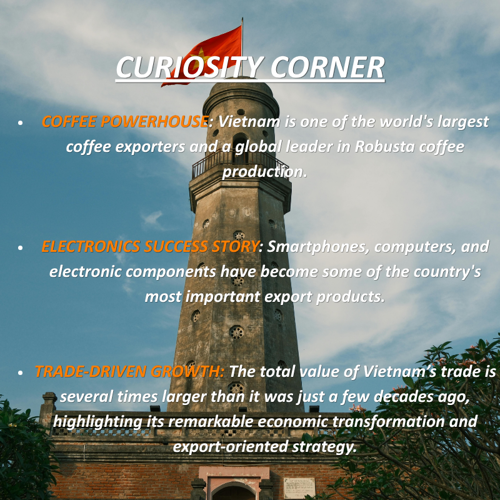
Vietnam is often described as one of Asia's greatest economic success stories. What makes its rise particularly interesting is the speed of its transformation. Within a relatively short period, the country evolved from being known primarily for agricultural exports to becoming a major global center for electronics manufacturing.
Another fascinating aspect is the country's dual identity in international trade. Vietnam remains one of the world's leading exporters of agricultural products such as cashews, cinnamon, and other commodities, while simultaneously ranking among the top exporters of advanced technology products. This unique combination allows the country to compete across both traditional and high-tech industries.
The growing presence of multinational technology firms has also helped create a highly interconnected economy where local production is closely linked to global innovation and consumer markets.
CONCLUSION
Vietnam has emerged as one of the most influential trade economies in Asia, combining strong manufacturing capabilities, rising economic complexity, and extensive participation in global value chains. Its ability to attract investment, diversify exports, and move into higher-value industries has transformed the country into a leading exporter on the world stage.
Looking ahead, Vietnam's continued focus on industrial development, technological upgrading, and international trade integration positions it for sustained growth. For businesses seeking opportunities in Asia, Vietnam represents a market where manufacturing expertise, export strength, and economic dynamism come together to create long-term potential.
