
PRODUCT CLASSIFICATION
Cheese is one of the world's most cherished and widely consumed food products, appreciated for its rich variety of flavors, textures, and cultural traditions. Produced from milk through coagulation and aging processes, cheese has evolved into thousands of distinct varieties ranging from fresh cheeses such as mozzarella and ricotta to aged specialties like Parmigiano Reggiano, Cheddar, and Gouda. Beyond its culinary appeal, cheese represents a major segment of the global dairy industry, serving both household consumption and food-processing markets.
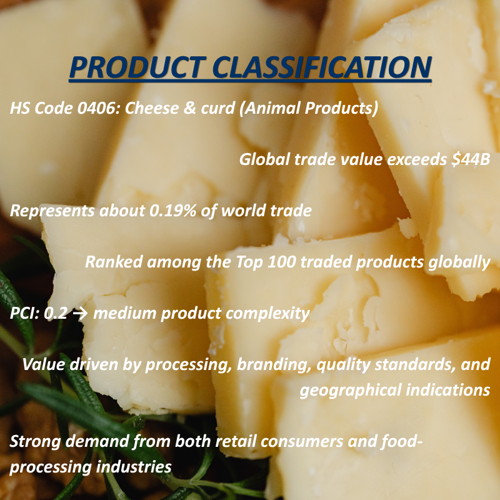
From a trade perspective, cheese belongs to the Animal Products section and is classified under HS Chapter 04: Edible products of animal origin, specifically HS4 0406 - Cheese and curd. Unlike basic agricultural commodities, cheese benefits from higher value creation through processing, branding, geographical indications, and specialized production techniques.
Global cheese trade exceeds $44 billion, accounting for approximately 0.19% of total world trade. Over recent years, international exchanges of cheese have shown steady expansion, supported by growing consumer demand, premium dairy products, and the increasing popularity of international cuisines.
Among globally traded products, cheese ranks within the top 100 by trade value. According to the Product Complexity Index (PCI), it records a score of approximately 0.2, placing it in the medium-complexity category. This reflects the combination of agricultural inputs, processing know-how, quality standards, cold-chain logistics, and strong regional specialization required for successful production and distribution.
EXPORT
Cheese exports are heavily concentrated in Europe, where centuries-old dairy traditions, advanced production systems, and strong international brands support global competitiveness. European suppliers account for the overwhelming majority of international cheese trade.
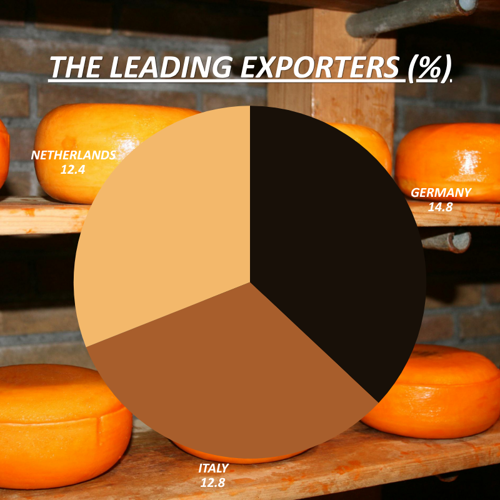
The leading exporters are:
• Germany - approximately 14.8% of global exports
• Italy - approximately 12.8%
• Netherlands - approximately 12.4%
Together, these three countries represent roughly 40% of total global cheese exports, highlighting Europe's dominant role in the sector. Germany benefits from a highly diversified dairy industry, Italy leverages the worldwide reputation of products such as Parmigiano Reggiano, Grana Padano, and Mozzarella, while the Netherlands combines efficient production with a strategic position as a distribution hub for European food trade.
Countries whose export portfolios show a particularly strong reliance on cheese include:
• New Zealand
• Denmark
• Ireland
In these economies, dairy products and cheese exports represent an important component of agricultural income and international competitiveness. Their success is supported by abundant pastureland, specialized dairy sectors, and strong export-oriented production systems.
The largest trade surpluses are recorded by:
• Netherlands - approximately $3.17B
• Italy - approximately $2.88B
• Denmark - approximately $1.86B
These surpluses demonstrate the ability of leading dairy nations to generate significantly more exports than imports, reinforcing their status as key suppliers to international markets.
IMPORT
Cheese imports are driven by both large consumer markets and countries with strong food industries that demand a wide variety of domestic and imported products. Cross-border cheese trade is particularly intense within Europe, where integrated supply chains and consumer preferences encourage constant exchange among neighboring countries.
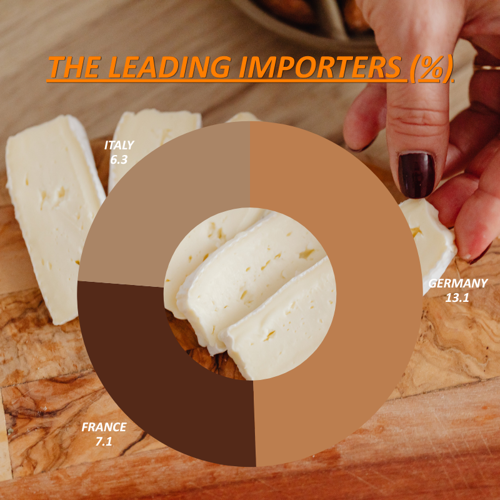
The leading importers are:
• Germany - approximately 13.1% of global imports
• France - approximately 7.1%
• Italy - approximately 6.3%
These figures may seem surprising given that all three countries are major producers themselves. However, imports are necessary to satisfy consumer demand for foreign varieties, support food manufacturing, and facilitate intra-European trade.
Other important importing markets include the United Kingdom, the Netherlands, Spain, the United States, Japan, and China, reflecting the growing global appetite for specialty and premium dairy products.
The largest trade deficits are typically found in countries where domestic production cannot fully satisfy demand for imported and premium cheeses. These markets rely heavily on international suppliers to provide product diversity and maintain year-round availability.
CURIOSITY CORNER: THE FASCINATING WORLD OF CHEESE
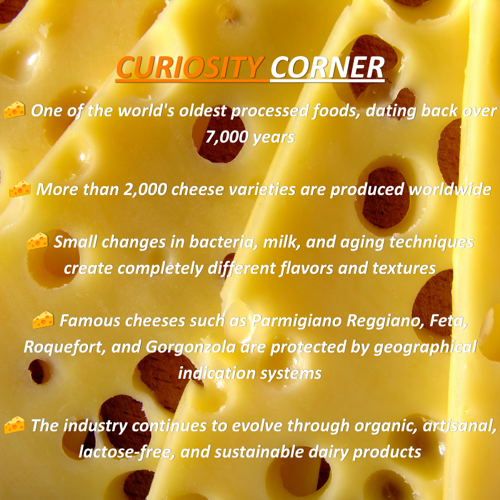
Cheese is believed to be one of humanity's oldest processed foods, with origins dating back more than 7,000 years. Historians suggest it was discovered accidentally when milk was stored in containers made from animal stomachs, where natural enzymes caused it to coagulate into curds and whey.
Today, there are over 2,000 recognized cheese varieties worldwide, each shaped by local climates, traditions, animal breeds, and aging techniques. Some cheeses mature for only a few days, while others are carefully aged for years to develop distinctive flavors and textures.
One of the most remarkable aspects of cheese is how a single ingredient, milk, can create an extraordinary range of products. Tiny variations in bacteria, production methods, and maturation conditions can transform the final result completely.
Cheese is also deeply connected to cultural heritage. Many famous varieties, including Parmigiano Reggiano, Roquefort, Feta, and Gorgonzola, are protected by geographical indication systems that preserve traditional production methods and regional identities.
Finally, despite being an ancient food, cheese continues to innovate. Growing demand for organic products, artisanal specialties, lactose-free alternatives, and sustainable dairy production is driving new opportunities across global markets.
CONCLUSION
The global cheese industry demonstrates how a traditional food product can remain highly relevant in modern international trade. Supported by strong consumer demand, premium branding, and sophisticated production networks, cheese has become one of the most valuable products in the global dairy sector.
European producers continue to dominate exports, with Germany, Italy, and the Netherlands accounting for nearly 40% of global shipments, while major consumer markets maintain robust import demand to satisfy increasingly diverse tastes.
With its combination of cultural heritage, economic value, and global appeal, cheese represents far more than a simple dairy product. It is a cornerstone of international food trade, connecting producers and consumers across continents while continuing to evolve alongside changing dietary preferences and market trends.
