
OVERVIEW
Thailand has established itself as one of Southeast Asia's most dynamic economies, combining a strong manufacturing base, strategic geographic location, and deep integration into global supply chains. Known worldwide for its tourism industry, the country is equally important as a manufacturing and export powerhouse, serving as a key trading hub between Asia and the rest of the world.
With a diversified economy and an extensive network of trade partners, Thailand plays a crucial role in industries ranging from electronics and automotive manufacturing to agriculture and food processing. Its ability to adapt to changing global demand has helped maintain its position among the world's leading exporting nations.
Today, Thailand stands among the largest economies in Southeast Asia and ranks among the top global exporters, demonstrating a strong balance between industrial development, technological capabilities, and international competitiveness.
ECONOMIC PROFILE AND COMPLEXITY
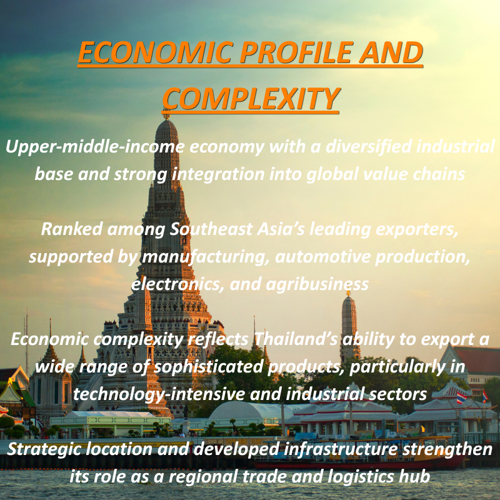
One of Thailand’s most remarkable strengths is the diversity and sophistication of its productive structure. The country consistently ranks among the world's most complex economies, reflecting its ability to manufacture and export a wide range of technologically advanced products. According to the Economic Complexity Index (ECI), Thailand ranks among the top 30 most complex economies globally, highlighting its capability to produce knowledge-intensive goods that require advanced industrial expertise.
Unlike economies heavily dependent on a limited number of commodities, Thailand benefits from a balanced mix of sectors. Electronics, automotive production, machinery, chemicals, agriculture, and food processing collectively contribute to economic stability and resilience. This diversification reduces exposure to sector-specific shocks and creates multiple avenues for growth.
Another key advantage is Thailand's role within regional supply chains. The country serves as an important manufacturing center for multinational corporations, particularly in electronics and automotive industries, where value-added production and technological integration continue to strengthen its competitive position.
EXPORTS
Thailand has established itself as one of Southeast Asia's leading export-driven economies, supported by a diversified industrial base and strong participation in global supply chains. High-value manufacturing products dominate the country's export portfolio, reflecting its advanced production capabilities and competitive position in international markets.
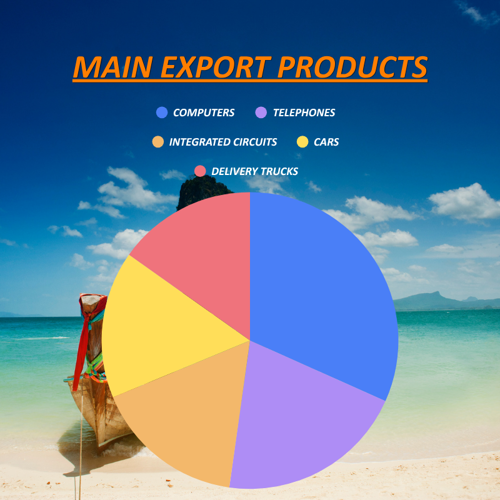
The country's main export products include:
• Computers: 7.1% of total exports (approximately $24.2 billion)
• Telephones: 4.6% (approximately $15.6 billion)
• Integrated Circuits: 3.7% (approximately $12.5 billion)
• Cars: 3.6% (approximately $12.3 billion)
• Delivery Trucks: 3.4% (approximately $11.5 billion)
These five categories account for more than one-fifth of Thailand's total exports, highlighting the importance of electronics, automotive manufacturing, and technology-intensive industries. Alongside these sectors, Thailand remains a major global exporter of agricultural and food products, including rubber, fruits, and processed foods, creating a balanced export structure that combines traditional strengths with modern industrial production.
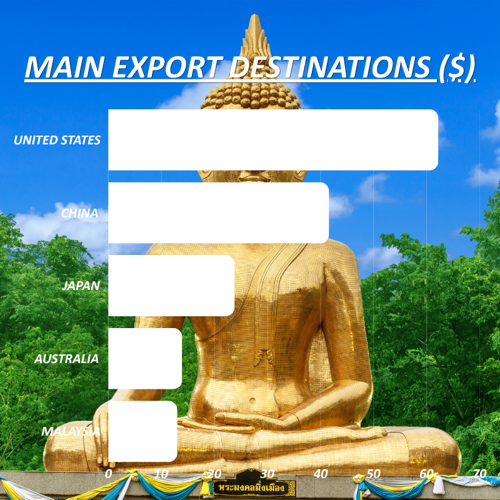
Thailand's exports reach markets across the globe, with demand concentrated in both advanced and emerging economies. The main export destinations are:
• United States: 18.3% of total exports (approximately $62.2 billion)
• China: 12.2% (approximately $41.6 billion)
• Japan: 7.0% (approximately $23.8 billion)
• Australia: 4.1% (approximately $13.9 billion)
• Malaysia: 3.8% (approximately $13.0 billion)
The United States and China alone represent more than 30% of Thailand's export market, underlining the country's deep integration into global trade networks and its strategic role within international manufacturing value chains.
IMPORTS
Thailand's import structure reflects the needs of a highly industrialized and export-oriented economy. The country imports significant quantities of energy resources, raw materials, and technological components that support domestic production and manufacturing activities.
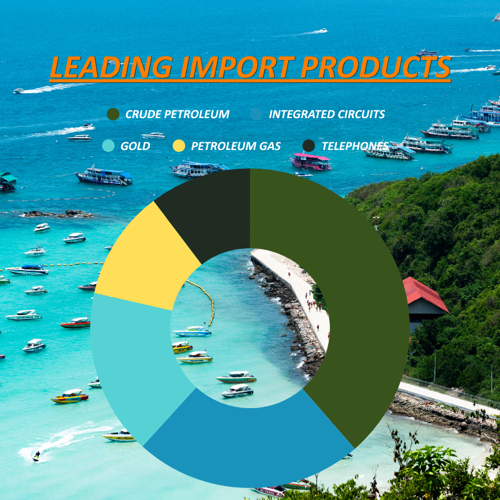
The leading import products are:
• Crude Petroleum: 11.0% of total imports (approximately $32.2 billion)
• Integrated Circuits: 6.6% (approximately $19.3 billion)
• Gold: 4.8% (approximately $14.0 billion)
• Petroleum Gas: 3.2% (approximately $9.3 billion)
• Telephones: 2.9% (approximately $8.6 billion)
Together, these categories account for nearly 30% of total imports, demonstrating Thailand's reliance on imported energy supplies and sophisticated electronic components. The prominence of integrated circuits and telecommunications equipment also illustrates the country's strong involvement in regional and global technology supply chains.
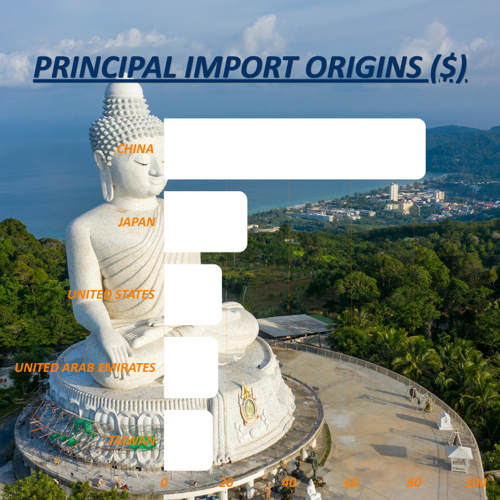
Thailand sources its imports from a diverse group of partners, with Asian economies playing a dominant role in supplying industrial inputs and consumer goods. The principal import origins include:
• China: 28.7% of total imports (approximately $83.8 billion)
• Japan: 9.1% (approximately $26.7 billion)
• United States: 6.4% (approximately $18.6 billion)
• United Arab Emirates: 6.0% (approximately $17.4 billion)
• Taiwan (Chinese Taipei): 5.4% (approximately $15.7 billion)
China stands out as Thailand's largest supplier by a considerable margin, providing nearly one-third of all imported goods. This strong trade relationship is particularly important for electronics, machinery, industrial components, and manufactured products that support Thailand's export-driven industries.
TRADE BALANCE
Thailand generally maintains a positive overall trade balance, reflecting the strength of its export sector and its capacity to compete in international markets. With exports exceeding imports by tens of billions of dollars, the country benefits from a strong external trade position.
Looking at individual markets provides further insight. Thailand records its largest trade surplus with the United States, generating a positive balance exceeding $40 billion. Significant surpluses are also observed with Australia, Cambodia, India, and the Netherlands. These relationships demonstrate the competitiveness of Thai products across a variety of industries and consumer markets.
At the same time, Thailand registers trade deficits with several countries that supply critical industrial inputs and energy resources, particularly China, the United Arab Emirates, Taiwan, Qatar, and Japan. Such deficits are often characteristic of manufacturing economies that import components and raw materials before transforming them into higher-value exports.
Overall, Thailand's trade balance reflects a mature economy that effectively combines imports necessary for production with a strong export capacity.
CURIOSITY CORNER
THE "DETROIT OF ASIA"
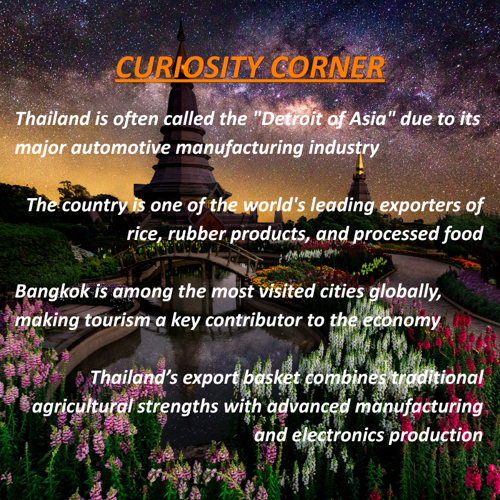
Thailand has earned the nickname "Detroit of Asia" thanks to its highly developed automotive industry. The country is one of the largest vehicle production centers in the region and hosts manufacturing facilities operated by major global automotive brands.
A GLOBAL RUBBER CHAMPION
Thailand is consistently among the world's leading exporters of natural rubber. The country's favorable climate and extensive agricultural expertise have made rubber one of its most recognizable export products.
ELECTRONICS POWERHOUSE
Many consumers around the world unknowingly use products that contain components manufactured in Thailand. Computers, integrated circuits, and telecommunications equipment represent some of the country's most valuable exports.
STRATEGIC GEOGRAPHIC POSITION
Located at the center of mainland Southeast Asia, Thailand serves as a natural gateway connecting major regional markets. This strategic location enhances logistics efficiency and strengthens trade relationships throughout Asia and beyond.
CONCLUSION
Thailand's economic success is built on a unique combination of industrial sophistication, export diversification, and strategic integration into global value chains. From advanced electronics and automotive production to world-leading agricultural exports, the country has developed a balanced economic model capable of competing across multiple sectors.
Its strong position in international trade, relatively high economic complexity, and ability to serve as a manufacturing hub for global markets make Thailand one of the most influential economies in Southeast Asia. As global trade continues to evolve, the country's diversified industrial base and extensive network of trade partnerships provide a solid foundation for sustained growth and future opportunities.
