
OVERVIEW
Mauritius is often associated with its tropical beaches and thriving tourism industry, but the island nation has also built one of Africa's most diversified and internationally connected economies. Positioned strategically in the Indian Ocean between Africa and Asia, Mauritius has transformed itself from a sugar-dependent economy into a regional hub for manufacturing, financial services, logistics, and international trade.
Despite its relatively small domestic market, the country has developed strong trade relationships across Europe, Africa, Asia, and North America. Its open economic model, stable business environment, and extensive trade agreements have enabled Mauritius to punch well above its weight in global commerce.
According to the Observatory of Economic Complexity (OEC), Mauritius records exports worth approximately $2.5 billion and imports exceeding $7 billion, highlighting its strong integration into international supply chains.
ECONOMIC PROFILE AND COMPLEXITY
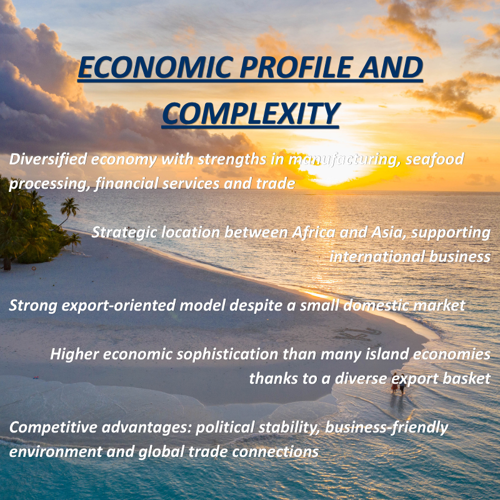
Mauritius stands out as one of the most economically advanced countries in Africa. Over the years, it has successfully diversified beyond traditional agriculture into sectors such as textile manufacturing, seafood processing, financial services, information technology, and logistics.
A key indicator of this transformation is the country's Economic Complexity Index (ECI), which measures the sophistication and diversity of a country's productive capabilities. Mauritius exports a relatively broad range of products compared to many economies of similar size, demonstrating a higher level of industrial know-how and economic adaptability. While the country remains dependent on imported energy and manufactured goods, its export basket reflects a growing capacity to compete in specialized industries.
The Mauritian economy benefits from several competitive advantages:
• Strategic location between Africa and Asia
• Strong institutional framework and political stability
• Highly developed financial and business services sector
• Export-oriented manufacturing industry
• Preferential access to multiple international markets
These factors have positioned Mauritius as an attractive gateway for companies seeking access to both African and Asian markets.
EXPORTS
Mauritius' export sector is remarkably diverse for a country of its size. The nation's traditional sugar industry remains important, but exports increasingly include processed seafood, garments, and other manufactured products.
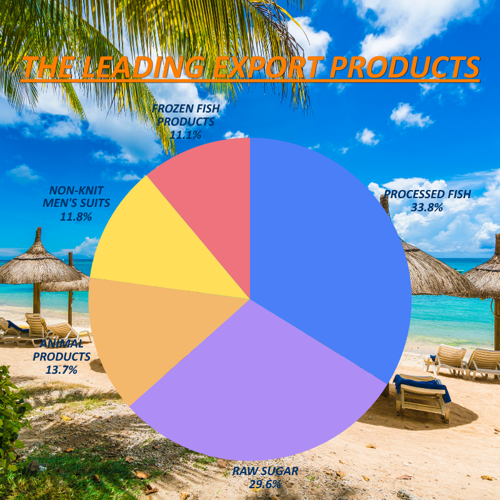
The leading export products include:
• Processed Fish: approximately $284 million
• Raw Sugar: approximately $249 million
• Other Animals and Animal Products: approximately $115 million
• Non-Knit Men's Suits: approximately $99 million
• Frozen Fish Products: approximately $93 million
Seafood processing has become a particularly significant industry, benefiting from Mauritius' maritime location and well-developed port infrastructure. Likewise, the textile and apparel sector continues to leverage decades of manufacturing expertise and preferential trade agreements.
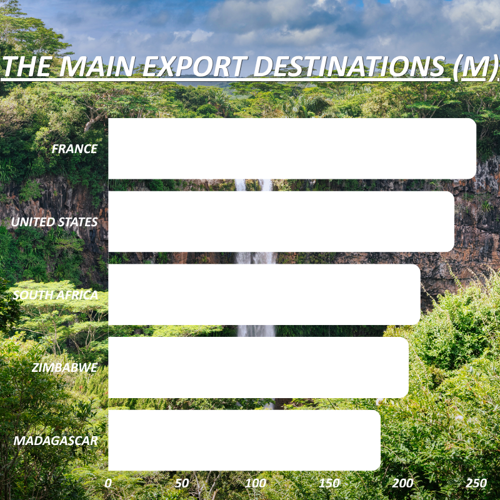
Mauritius exports primarily to a mix of developed and regional markets. The country's main export destinations include:
• France: around $250 million
• United States: around $235 million
• South Africa: around $212 million
• Zimbabwe: around $204 million
• Madagascar: around $185 million
This geographical diversification helps reduce dependence on any single market while strengthening the country's resilience to external economic shocks.
IMPORTS
As a small island economy with limited natural resources, Mauritius relies heavily on imports to meet domestic demand and support industrial activity. Imported goods supply both consumers and export-oriented industries.
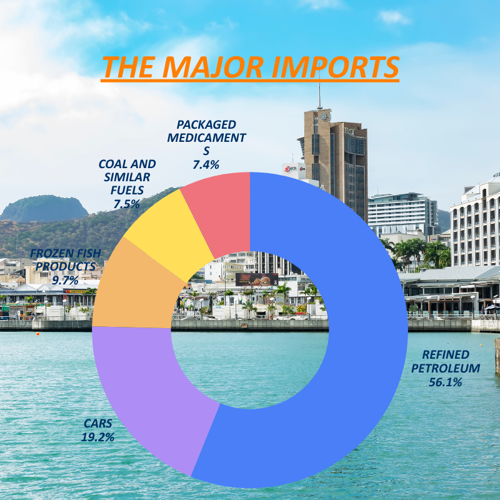
The country's major imports include:
• Refined Petroleum: approximately $1.29 billion
• Cars: approximately $442 million
• Frozen Fish Products: approximately $224 million
• Coal and Similar Fuels: approximately $173 million
• Packaged Medicaments: approximately $169 million
Energy products account for a substantial share of total imports, reflecting the country's dependence on external sources for fuel and power generation. The import profile also highlights the importance of transportation equipment, healthcare products, and industrial inputs.
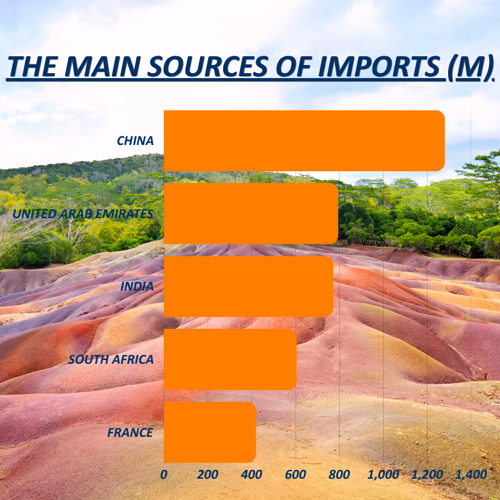
Mauritius sources goods mainly from:
• China: approximately $1.28 billion
• United Arab Emirates: approximately $794 million
• India: approximately $771 million
• South Africa: approximately $605 million
• France: approximately $420 million
These partners play a crucial role in supporting both consumption and production across the Mauritian economy.
TRADE BALANCE
Mauritius operates with a structural trade deficit, importing significantly more goods than it exports. With imports of around $7 billion compared to exports of approximately $2.5 billion, the country faces a merchandise trade gap of more than $4 billion.
However, this deficit does not necessarily indicate economic weakness. Many of the imported goods are strategic inputs needed for manufacturing, logistics, tourism, and energy supply. Furthermore, Mauritius offsets part of this imbalance through revenue generated by services such as tourism, financial activities, and international business operations.
The country's strongest positive trade balances are recorded with:
• Zimbabwe
• Madagascar
• United States
• Zambia
• Israel
Conversely, the largest trade deficits are associated with:
• China
• United Arab Emirates
• India
• South Africa
• Japan
These patterns reflect Mauritius' role as a major importer of industrial and consumer goods while exporting higher-value niche products and processed commodities.
CURIOSITY CORNER
Did you know that Mauritius is one of the few small island economies that successfully transformed itself from a monocrop agricultural economy into a diversified export-oriented nation?
For much of its history, sugar dominated the country's economic activity. Today, while sugar remains an important export, Mauritius has expanded into sectors such as seafood processing, textile manufacturing, financial services, information technology, and logistics. This evolution has allowed the country to build trade connections across multiple continents and reduce its dependence on a single industry.
Another fascinating aspect is the country's global reach. Despite a population of just over one million people, Mauritian products can be found in markets ranging from Europe and North America to Southern Africa and the Middle East. The island's ability to maintain commercial relationships with such a wide range of partners demonstrates how strategic positioning, economic openness, and specialization can overcome geographic limitations.
CONCLUSION
Mauritius represents one of the most compelling economic success stories in the Indian Ocean region. Through diversification, openness to international trade, and continuous investment in competitive industries, the country has developed an economic model that extends far beyond its small geographic size.
Its export portfolio combines traditional strengths such as sugar with newer industries like seafood processing and apparel manufacturing, while extensive trade relationships connect the island to major markets worldwide. Although Mauritius continues to depend heavily on imports, particularly for energy and industrial goods, its ability to create value through specialized exports and services has strengthened its position in the global economy.
As international trade patterns continue to evolve, Mauritius remains a notable example of how a small island nation can leverage strategic location, economic flexibility, and global connectivity to build a resilient and increasingly sophisticated economy.
