OVERVIEW
Situated at the crossroads of Europe and Asia, Uzbekistan has increasingly positioned itself as one of Central Asia’s most dynamic and strategically important economies. With a growing industrial base, abundant natural resources, and expanding trade connections, the country continues to strengthen its role in regional and global commerce. Today, Uzbekistan ranks among the world's top 80 exporters, with merchandise exports reaching approximately $23 billion and imports totaling $37.3 billion.
The country's trade profile reflects a blend of traditional strengths and industrial diversification. Gold remains the dominant export commodity, while increasing shipments of industrial products, fertilizers, and manufactured goods demonstrate Uzbekistan’s broader economic transformation. Meanwhile, strong import demand highlights ongoing investments in infrastructure, technology, manufacturing equipment, and consumer markets.
As the largest consumer market in Central Asia and a key link along modern trade corridors connecting China, Russia, the Middle East, and Europe, Uzbekistan continues to expand its international economic footprint.
ECONOMIC PROFILE AND COMPLEXITY
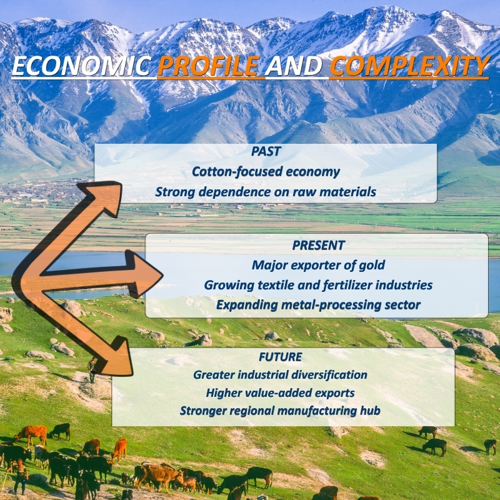
Uzbekistan's economy is characterized by a unique combination of natural resource wealth and growing industrial capabilities. Historically known for its cotton production, the country has steadily diversified into mining, chemicals, metallurgy, manufacturing, and energy-related industries.
According to the Observatory of Economic Complexity (OEC), Uzbekistan ranks 77th globally in Economic Complexity, reflecting an economy that continues to move beyond raw material exports into more sophisticated industrial activities.
Several sectors are driving this transformation:
• Mining and precious metals
• Chemical production and fertilizers
• Textile manufacturing
• Copper processing and metallurgy
• Energy and natural gas-related industries
• Machinery and industrial equipment production
The government's focus on industrialization, foreign investment attraction, and infrastructure modernization has accelerated the country's integration into international value chains. As a result, Uzbekistan is gradually strengthening its position as a manufacturing and logistics hub for Central Asia.
Key Economic Indicators
• Exports: $23 billion
• Imports: $37.3 billion
• Economic Complexity Ranking: 77th worldwide
• Exports per capita: $634
• Imports per capita: $1,030 approximately
EXPORTS
Exports remain one of the most important pillars of the Uzbek economy. The country exported approximately $23 billion worth of goods globally, with precious metals and industrial products accounting for the largest shares.
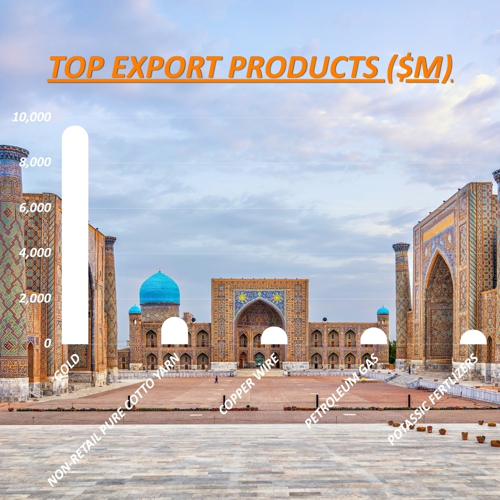
Top Export Products
Gold → $9.66B
Non-Retail Pure Cotton Yarn → $1.21 B
Copper Wire → $789 M
Petroleum Gas→ &743 M
Potassic Fertlizers → $652 M
Gold alone represents a substantial portion of total exports, highlighting the country's significant mineral wealth. However, the presence of cotton yarn, copper products, fertilizers, and natural gas illustrates a gradual broadening of the export basket.
Main Export Destinations
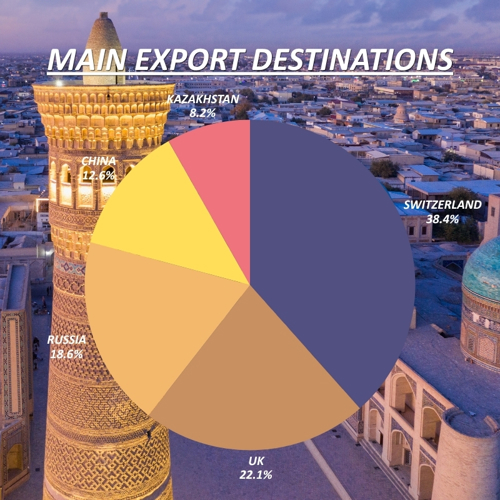
Switzerland → $6.14 B
United Kingdom→ $3.53 B
Russia→ $2.98 B
China→ $2.02 B
Kazakhstan → $1.31 B
The prominence of Switzerland and the United Kingdom is largely linked to international precious metals trading, while Russia, China, and Kazakhstan reflect the country's strong regional economic ties.
Export Trends
A notable feature of Uzbekistan's export structure is the combination of resource-based products and emerging industrial goods. The country is leveraging its natural resources while simultaneously expanding value-added production, particularly in textiles, fertilizers, and metal processing. This diversification helps reduce dependence on a single sector and strengthens long-term trade resilience.
IMPORTS
Imports play a crucial role in supporting Uzbekistan's economic modernization. Total imports stand at approximately $37.3 billion, reflecting strong domestic demand and significant investment in industrial development.
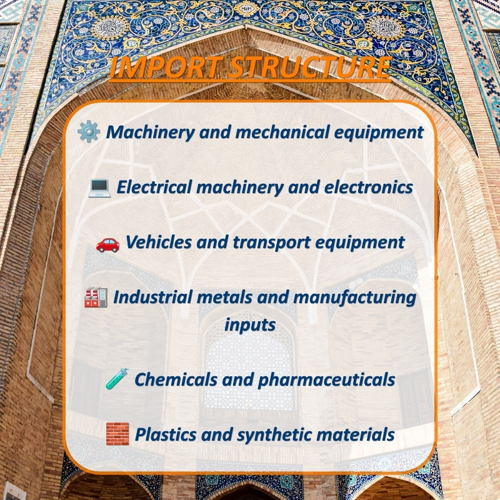
The country's import profile is heavily oriented toward machinery, industrial equipment, electronics, vehicles, chemicals, and intermediate goods used in manufacturing processes. These imports support industrial expansion and infrastructure development across the country.
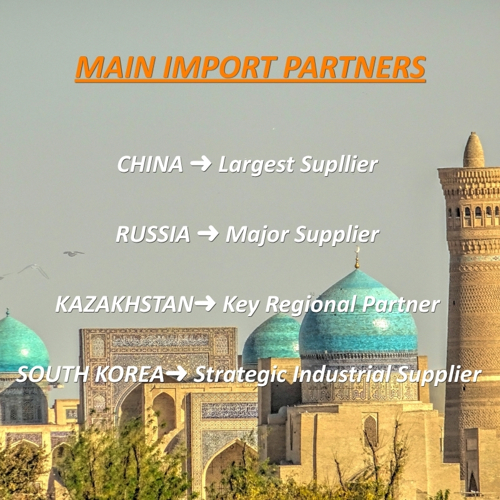
Main Import Partners
China – Largest Supllier
Russia – Major Supplier
Kazakhstan – Key Regional Partner
South Korea – Strategic Industrial Supplier
Other Asian Markets – Growing Role
China has emerged as the country's leading import partner, supplying machinery, electronics, industrial equipment, and consumer products. Russia continues to play a critical role in energy, industrial goods, and regional trade flows, while South Korea contributes advanced technologies and manufacturing inputs.
Import Drivers
Key factors driving imports include:
• Industrial modernization projects
• Infrastructure investments
• Manufacturing expansion
• Rising consumer demand
• Energy and technology upgrades
These trends indicate a country actively investing in future productive capacity rather than relying solely on consumption-based imports.
TRADE BALANCE
Uzbekistan currently records a trade deficit, with imports exceeding exports by a significant margin. While the country exports approximately $23 billion worth of goods, imports reach around $37.3 billion, reflecting the strong demand generated by economic growth, industrial expansion, and infrastructure development.
A closer look at trade relationships reveals some interesting dynamics. Uzbekistan enjoys substantial trade surpluses with countries such as Switzerland and the United Kingdom, largely driven by the export of gold and other precious metals. Regional partners including Afghanistan, Tajikistan, and Saudi Arabia also contribute positively to the country's trade balance through strong demand for Uzbek products.
On the other hand, the largest trade deficits are linked to major suppliers of industrial and technological goods. China remains the country's primary source of machinery, equipment, electronics, and manufactured products, while Russia and South Korea play important roles in supplying industrial inputs and advanced technologies. As a result, imports from these economies significantly outweigh exports directed to them.
Rather than representing an economic weakness, much of this deficit reflects Uzbekistan's ongoing modernization efforts. The country is investing heavily in productive assets, industrial machinery, infrastructure, and technology that can enhance future competitiveness and support the development of higher-value exports.
Looking ahead, continued industrial diversification and the expansion of manufacturing sectors could help narrow the trade gap over time, while strengthening Uzbekistan's position within regional and global supply chains.
CURIOSITY CORNER
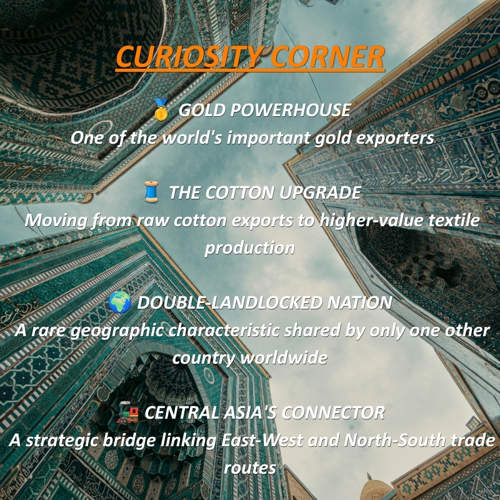
🥇 Gold Is the Nation's Export Champion
Gold accounts for nearly half of Uzbekistan's export earnings, making the country one of the world's most important precious metal exporters. Much of this trade flows through international financial centers such as Switzerland and the United Kingdom.
🧵 From Cotton Fields to Textile Exports
Uzbekistan has long been associated with cotton production. However, the country is increasingly exporting processed cotton products and yarn rather than raw cotton, capturing more value within its domestic economy.
🌍 Double-Landlocked but Highly Connected
Uzbekistan is one of only two double-landlocked countries in the world, meaning it must cross at least two other countries to access the sea. Despite this geographical challenge, it has become a crucial trade and logistics hub in Central Asia.
⚡ Strategic Position in Eurasian Trade
Located between major markets such as China, Russia, the Middle East, and South Asia, Uzbekistan benefits from its role as a regional transit corridor, supporting both trade flows and economic integration initiatives.
CONCLUSION
Uzbekistan is undergoing a remarkable economic evolution. While gold remains the backbone of its export sector, the country is increasingly diversifying into industrial products, fertilizers, textiles, and metal processing.
Strong import demand reflects ongoing modernization efforts, infrastructure development, and industrial expansion.
Its strategic location, growing manufacturing base, and expanding trade relationships position Uzbekistan as one of Central Asia's most promising economies. As the country continues to upgrade its industrial capabilities and deepen international economic ties, it is steadily transforming from a resource-driven exporter into a more diversified and competitive participant in global trade.