PRODUCT CLASSIFICATION
Cucumbers are among the most widely cultivated and consumed vegetables in the world, appreciated for their refreshing taste, versatility, and nutritional benefits. Thanks to their high water content and crisp texture, they are a staple ingredient in salads, sandwiches, healthy snacks, and a wide range of processed products, including pickles and gherkins. Their adaptability to different growing conditions has made them an essential crop in both domestic agriculture and international trade.
From a commercial perspective, cucumbers fall within HS Chapter 07: Edible Vegetables and Certain Roots and Tubers, specifically under the category covering fresh or chilled cucumbers and gherkins. Although they are considered a relatively low-complexity agricultural product, cucumbers generate billions of dollars in global trade and play a key role in supplying fresh produce markets worldwide.
The global cucumber market continues to benefit from technological advances in greenhouse cultivation, controlled-environment agriculture, and cold-chain logistics. These innovations allow producers to meet consumer demand year-round and support the increasingly international nature of the fresh produce industry.
EXPORT
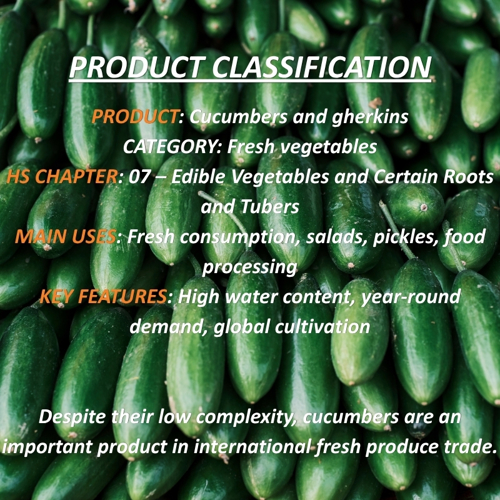
The global cucumber export market is highly concentrated, with a small group of countries accounting for most international shipments. Spain leads the world market, representing approximately 25.8% of global cucumber exports. Mexico follows with 22.8%, while the Netherlands accounts for 17.5% and Canada for 15.4%. Together, these four countries supply more than 80% of globally traded cucumbers, highlighting the importance of specialized production systems and efficient logistics networks.
Spain's dominant position is supported by its advanced greenhouse industry, particularly in the Almería region, which provides high-quality produce throughout the year. Mexico benefits from its strategic proximity to the United States and its highly integrated North American supply chain. The Netherlands combines cutting-edge agricultural technology with one of Europe's most sophisticated distribution hubs, while Canada plays a major role in supplying fresh cucumbers across North America.
Other notable exporters include Türkiye and Belgium, each contributing around 1.8% of global exports, followed by Greece (1.7%), the United States (1.4%), China (1.3%), and Germany (0.9%). The remaining 10.6% is distributed among dozens of smaller exporting nations.
Export Market Share
• Spain – 25.8%
• Mexico – 22.8%
• Netherlands – 17.5%
• Canada – 15.4%
• Türkiye – 1.8%
• Belgium – 1.8%
• Greece – 1.7%
• United States – 1.4%
• China – 1.3%
• Germany – 0.9%
• Others – 10.6%
IMPORT
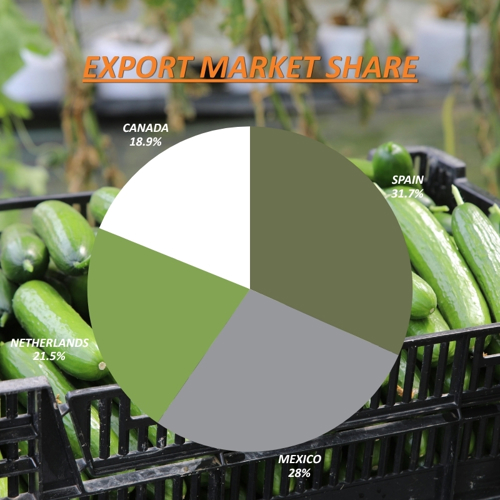
Demand for imported cucumbers is driven by large consumer markets seeking fresh produce throughout the year, regardless of domestic growing seasons. The leading importers include the United States, Germany, the United Kingdom, France, and Canada, which collectively represent a substantial share of global demand.
The United States is the world's largest cucumber importer, relying heavily on shipments from Mexico to ensure year-round availability. Germany remains one of Europe's largest destinations for imported cucumbers, while the United Kingdom and France import significant volumes to complement domestic production. Canada is both a major exporter and importer, reflecting the highly integrated nature of North American agricultural trade.
The need to maintain continuous availability of fresh vegetables has made cucumbers a perfect example of how modern supply chains operate. Efficient transportation, refrigerated storage, and cross-border trade agreements allow consumers to access fresh cucumbers regardless of local production cycles.
Import Market Share
• United States – 28%
• Germany – 18%
• United Kingdom – 10%
• France – 8%
• Canada – 7%
• Others – 29%
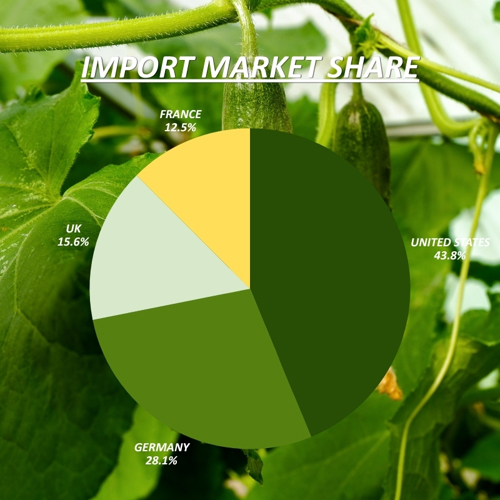
These figures illustrate how demand is concentrated in a handful of large consumer markets, particularly North America and Western Europe.
CURIOSITY CORNER: THE HIDDEN STORY BEHIND CUCUMBERS
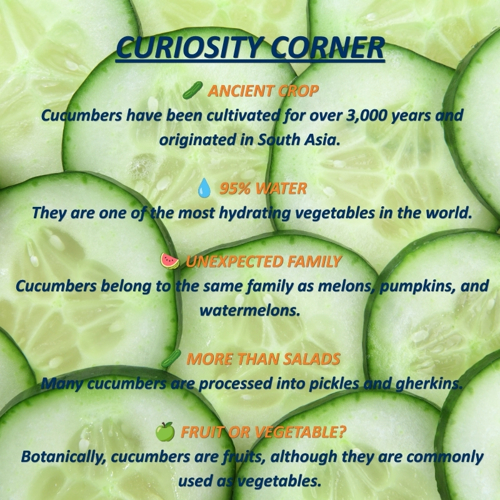
Cucumbers may seem like a simple vegetable, but their history stretches back more than 3,000 years. Most historians trace their origins to South Asia, from where they spread across ancient civilizations including Egypt, Greece, and Rome.
One of the most remarkable facts about cucumbers is that they consist of approximately 95% water, making them one of the most hydrating foods consumed around the world. This characteristic has helped fuel their popularity among health-conscious consumers and contributed to their reputation as a refreshing summer food.
Not all cucumbers end up on salad plates. A significant portion of the global crop is transformed into pickles and gherkins, products that enjoy strong demand in international food markets and represent an important segment of the processed food industry.
Botanically, cucumbers belong to the same family as melons, pumpkins, squash, and watermelons. Despite their modest appearance, they are part of one of the most economically important plant families in global agriculture.
CONCLUSION
The global cucumber trade highlights how a seemingly simple vegetable can become a major player in international agricultural commerce. Strong consumer demand, technological innovation, and increasingly sophisticated supply chains have transformed cucumbers into a truly global product.
Spain, Mexico, the Netherlands, and Canada dominate the export market, accounting for the vast majority of worldwide shipments. On the import side, the United States, Germany, the United Kingdom, France, and Canada represent some of the largest consumer markets, ensuring steady demand throughout the year.
Despite being a low-complexity product, cucumbers demonstrate the importance of modern logistics, greenhouse technology, and international trade networks. As consumers continue to prioritize fresh, healthy foods and year-round product availability, cucumbers are expected to remain an essential component of the global fresh produce industry.