
PRODUCT CLASSIFICATION
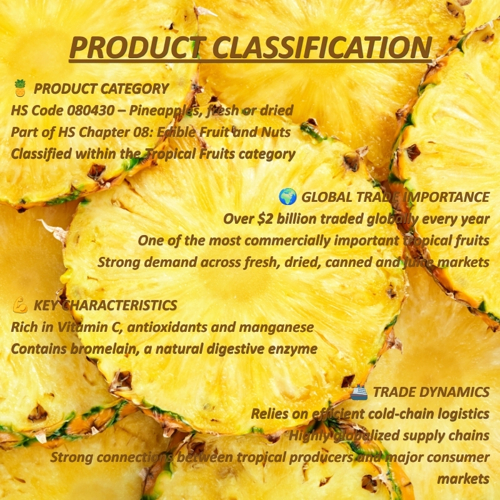
Pineapples are among the world's most popular tropical fruits, valued for their sweet taste, refreshing character, and remarkable versatility. Rich in vitamin C, antioxidants, manganese, and bromelain, a natural enzyme known for its digestive properties, pineapples have become a staple in both fresh produce markets and processed food industries worldwide.
They are consumed fresh, dried, canned, juiced, and incorporated into a wide variety of products ranging from desserts and snacks to health-oriented foods.
From a commercial perspective, pineapples are classified under HS Code 080430 – Pineapples, fresh or dried, within HS Chapter 08: Edible Fruit and Nuts. They belong to the broader category of tropical fruits, a segment characterized by globalized supply chains and strong international demand.
Global trade in fresh and dried pineapples exceeds $2 billion annually, making pineapples one of the most significant tropical fruits in international commerce. Despite their relatively low Product Complexity Index (PCI), the success of pineapple trade relies on sophisticated logistics, efficient cold-chain systems, and reliable transportation networks capable of delivering perishable fruit across long distances.
EXPORT
The global pineapple export market is highly concentrated, with a small number of producing countries accounting for the majority of worldwide shipments.
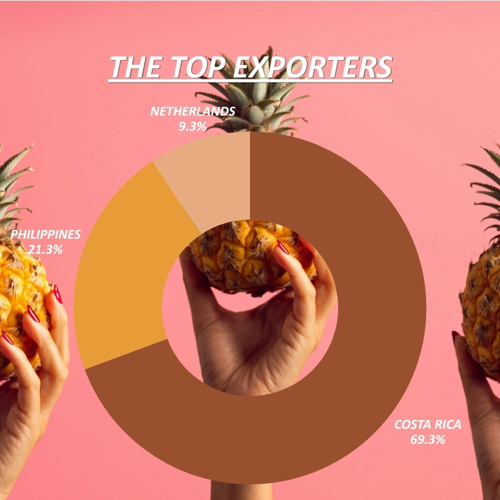
The top exporters are:
• Costa Rica – 52% of global exports
• Philippines – 15.7%
• Netherlands – 7.3%
Costa Rica is the undisputed leader of the global pineapple industry, supplying more than half of all pineapples traded internationally. Its tropical climate, large-scale plantations, advanced agricultural practices, and strong commercial ties with North American and European retailers have enabled the country to build a dominant position in the market.
The Philippines ranks second globally, benefiting from extensive commercial cultivation and strong demand from Asian markets, particularly China and Japan. Meanwhile, the Netherlands plays a strategic role as a European trade hub, combining domestic handling activities with significant re-export operations throughout the continent.
Countries with the highest share of pineapples in their overall export portfolios are:
• Costa Rica – 6.49%
• Dominica – 0.53%
• Philippines – 0.49%
• Kenya – 0.41%
• Guatemala – 0.25%
These figures highlight the importance of pineapple production for several tropical economies, where the fruit represents a significant source of agricultural income, employment, and export revenue. In Costa Rica in particular, pineapples rank among the country's most valuable agricultural exports.
The largest trade surpluses are consistently generated by major producing countries, especially Costa Rica and the Philippines, reflecting their strong export-oriented agricultural sectors and their ability to satisfy growing global demand.
IMPORT
Global pineapple imports are concentrated in large consumer markets where climatic conditions limit domestic production or where demand requires year-round supply.
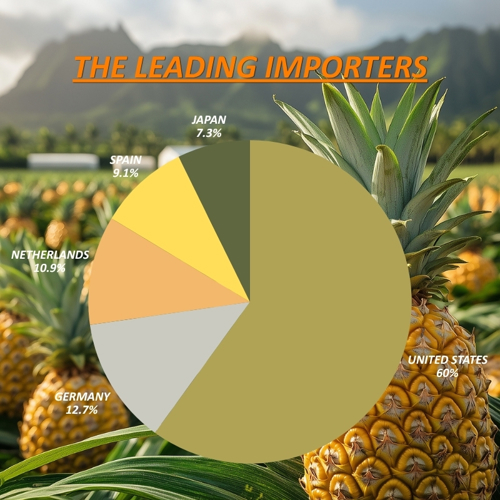
The leading importers are:
• United States
• Germany
• Netherlands
• Spain
• Japan
The United States accounts for approximately 30–33% of global pineapple imports, making it the world's largest importing market. Most imports originate from Costa Rica, supported by strong consumer demand and highly developed distribution networks.
Among the principal import markets, estimated shares of global imports are:
• United States – approximately 30–33%
• Germany – approximately 6–7%
• Netherlands – approximately 5–6%
• Spain – approximately 4–5%
• Japan – approximately 4–5%
Europe collectively represents one of the largest destination markets for internationally traded pineapples. A significant portion of Costa Rica's exports is directed toward European countries such as Spain, Belgium, Italy, and the Netherlands, demonstrating the region's importance both as a final consumer market and as a distribution center.
The Netherlands occupies a particularly strategic position, serving not only as a large importer but also as one of Europe's main re-export hubs, supplying neighboring countries through its highly efficient logistics infrastructure and major seaports.
In Asia, countries such as China and Japan continue to drive demand for premium tropical fruits, contributing to the expansion of international pineapple trade and encouraging further investment in production and export capabilities.
CURIOSITY CORNER: THE HIDDEN STORY BEHIND PINEAPPLES
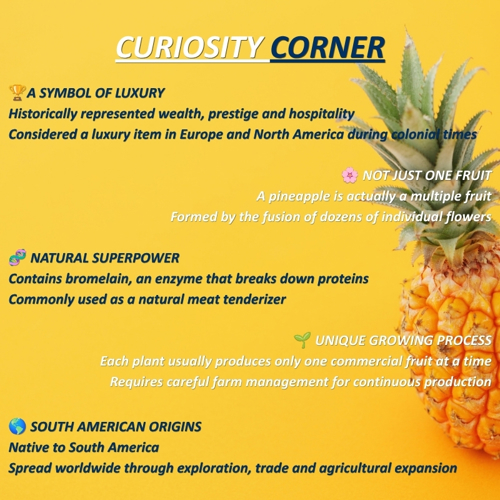
Few fruits have a history as fascinating as the pineapple. For centuries, it has symbolized hospitality, wealth, and prestige. In colonial Europe and North America, displaying a pineapple at social events was a sign of status because the fruit was rare, exotic, and extremely expensive to import.
Despite its appearance, a pineapple is not a single fruit. Botanically, it is a multiple fruit, formed when dozens of individual flowers fuse around a central core. Each segment visible on the fruit's skin corresponds to a separate flower that has become part of the final structure.
Another remarkable characteristic is the presence of bromelain, a natural enzyme capable of breaking down proteins. This property explains why pineapple is often used as a natural meat tenderizer and why it has attracted interest in nutritional and scientific research.
Pineapple plants are also surprisingly efficient. They can thrive in tropical environments with relatively moderate water requirements, but each plant generally produces only one commercial fruit at a time. As a result, large-scale pineapple farming requires careful planning and management to ensure continuous production.
Although Costa Rica dominates exports today, the pineapple originated in South America before spreading throughout the world via exploration, trade, and agricultural development. It has since become one of the most recognized and widely consumed tropical fruits globally.
CONCLUSION
The global pineapple trade demonstrates the growing importance of tropical fruits in international agricultural commerce. Dominated by exporters such as Costa Rica and the Philippines, the sector relies on efficient supply chains, advanced logistics, and strong consumer demand across North America, Europe, and Asia.
One of the most striking characteristics of the market is its concentration. Costa Rica alone accounts for more than half of global pineapple exports, while the United States represents roughly one-third of worldwide imports, illustrating the strong interdependence between producing and consuming regions.
Although pineapples are considered a relatively low-complexity agricultural product, their global success depends on highly sophisticated production systems and international distribution networks. As consumers continue to seek healthy, fresh, and exotic produce, pineapples are expected to remain a vibrant and essential component of global trade, connecting tropical farms with markets around the world.