OVERVIEW
Located on the southern shore of the Mediterranean Sea, Tunisia occupies a strategic position at the crossroads of Europe, Africa, and the Middle East. Thanks to its proximity to major European markets, well-established industrial base, and extensive trade agreements, the country has developed into one of North Africa’s most export-oriented economies.
Tunisia combines a diversified manufacturing sector with strong agricultural traditions. While olive oil remains one of its most internationally recognized products, the country has successfully expanded into automotive components, electrical equipment, textiles, and mechanical industries, creating a balanced export portfolio that serves a wide range of global markets.
The country's economy benefits from close commercial ties with the European Union, particularly France, Italy, Germany, and Spain, which together absorb a significant share of Tunisian exports while also supplying many of its imported goods.
ECONOMIC PROFILE AND COMPLEXITY
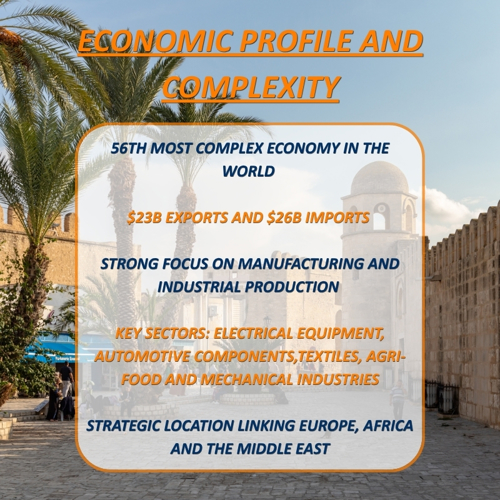
Tunisia ranks among the most diversified economies in North Africa and is recognized as the 56th most complex economy in the world according to the Economic Complexity Index (ECI). This ranking reflects the country's ability to produce and export a wide range of sophisticated manufactured goods that require specialized industrial know-how.
The Tunisian economy is strongly supported by:
• Manufacturing industries
• Electrical and electronic equipment
• Automotive components
• Textile and apparel production
• Agri-food products
• Energy-related industries
Unlike many resource-dependent economies in the region, Tunisia relies heavily on value-added industrial production. This makes the country particularly attractive for foreign investors seeking proximity to European supply chains combined with competitive production costs.
With total exports reaching approximately $23 billion and imports exceeding $26 billion, Tunisia plays a significant role in Mediterranean trade networks.
EXPORTS
Tunisia exports around $23 billion worth of goods annually, with industrial products accounting for a significant portion of total export revenues.
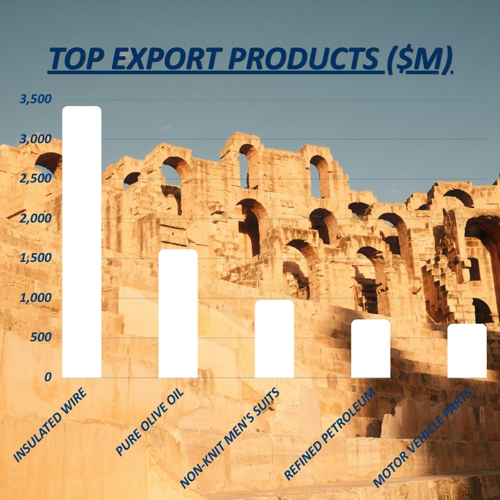
The country's leading export product is insulated wire, which generates approximately $3.4 billion and represents almost 15% of total exports. This remarkable performance reflects Tunisia's strong integration into European automotive and electrical manufacturing value chains.
Another flagship product is pure olive oil, which contributes roughly $1.6 billion and accounts for nearly 7% of total exports. Tunisian olive oil enjoys a strong international reputation and is exported extensively across Europe and North America.
Other important export categories include non-knit men's suits, representing around 4.3% of exports, refined petroleum products with 3.2%, and motor vehicle parts and accessories with approximately 3% of total export value.
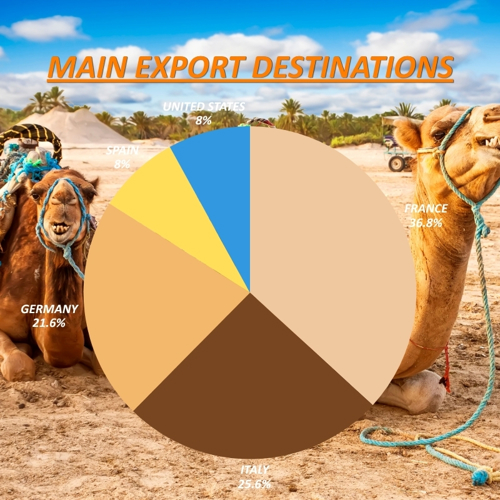
France remains Tunisia's largest export destination, absorbing roughly 23% of total exports. Italy follows with 16%, while Germany accounts for approximately 13.5%. Spain and the United States each represent close to 5% of export sales. Together, France, Italy, and Germany purchase more than half of Tunisia's exports, highlighting the country's strong dependence on European demand.
These figures clearly show that Tunisia's export success relies on a balanced combination of industrial manufacturing and high-value agricultural products.
IMPORTS
Tunisia imports approximately $26 billion worth of goods every year, reflecting the needs of a growing economy that depends on foreign energy supplies, industrial equipment, and raw materials.
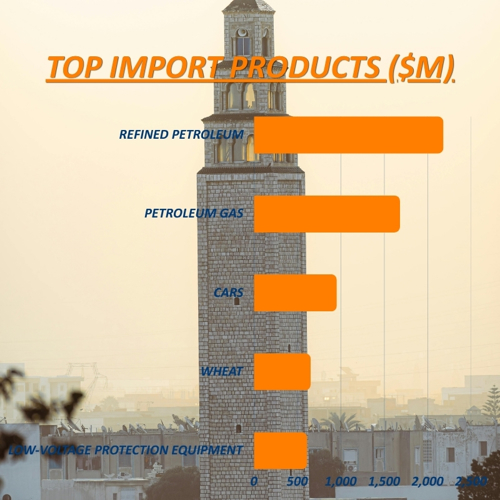
Energy products represent the largest portion of imports. Refined petroleum alone accounts for about 8.4% of total imports, while petroleum gas contributes another 6.4%. Combined, these two categories represent nearly 15% of Tunisia's import bill, underlining the country's dependence on external energy sources.
Vehicle imports also play an important role, with cars accounting for approximately 3.6% of total imports. Wheat contributes around 2.5%, reflecting the strategic importance of food security, while low-voltage protection equipment represents another 2.3%.
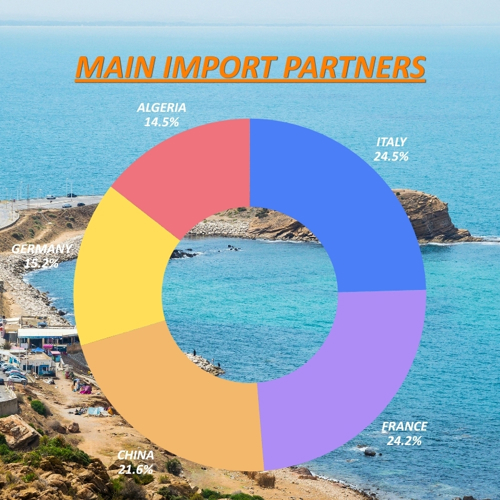
Italy is Tunisia's leading supplier, accounting for roughly 12.7% of total imports, closely followed by France at 12.5%. China has become Tunisia's third-largest source of imported goods with more than 11% of import value, while Germany and Algeria contribute approximately 8% and 7.5% respectively.
The import structure highlights Tunisia's need for energy resources and industrial inputs while also demonstrating the country's close commercial relationships with European and Asian partners.
TRADE BALANCE
Tunisia operates with a negative trade balance, as imports exceed exports by approximately $3 billion. While the country exports goods worth around $23 billion, imports reach about $26 billion.
The main reason behind this deficit is the significant cost of energy imports, particularly refined petroleum and natural gas. However, Tunisia partially offsets these expenditures through strong performances in manufacturing sectors such as electrical equipment, automotive components, textiles, and olive oil production.
Although the trade balance remains negative, the country's diversified export base provides a level of resilience that distinguishes Tunisia from several other economies in the region.
CURIOSITY CORNER
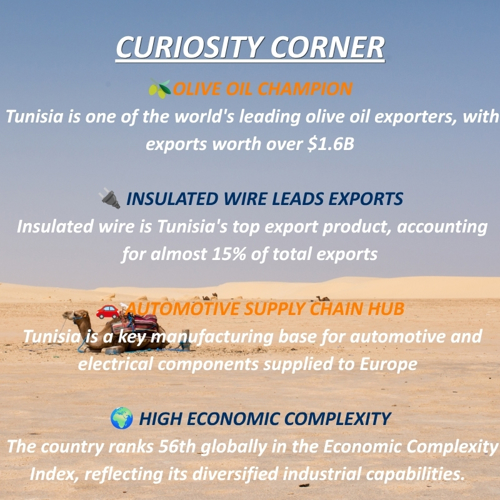
🫒 Tunisia is an Olive Oil Powerhouse
Pure olive oil is Tunisia's second-largest export product and generates over $1.6 billion in international sales. Tunisian olive oil is exported worldwide and is often blended into premium Mediterranean brands.
🔌 The Hidden Champion of Electrical Manufacturing
Insulated wire represents nearly 15% of the country's entire export basket, making Tunisia a key supplier for European automotive and industrial sectors.
🚗 Connected to Europe's Automotive Industry
Tunisia has become an important production base for automotive components and electrical systems used by major European manufacturers. The sector continues to attract international investment thanks to skilled labor and geographic proximity to Europe.
🌍 One of Africa's Most Complex Economies
With an Economic Complexity ranking of 56th worldwide, Tunisia performs better than many economies with significantly larger populations or resource bases.
CONCLUSION
Tunisia stands out as one of the Mediterranean region's most dynamic and diversified economies. Its combination of industrial manufacturing, agricultural excellence, and strategic geographic position enables the country to serve as a bridge between Europe, Africa, and the Middle East.
While the country faces challenges linked to energy dependence and a persistent trade deficit, its strong export base in electrical equipment, automotive components, textiles, and olive oil demonstrates considerable resilience.
For companies exploring opportunities in North Africa, Tunisia offers a particularly attractive environment thanks to its skilled workforce, established trade connections with Europe, and increasingly sophisticated industrial ecosystem. As regional and global supply chains continue to evolve, Tunisia is well positioned to strengthen its role as a competitive export platform and strategic trade partner.