
OVERVIEW
Kenya has long been recognized as one of the most dynamic economies in East Africa. Strategically positioned along the Indian Ocean, the country serves as a key commercial hub connecting regional markets with global trade routes. Its modern port infrastructure, growing urban centers, and diversified economic base have helped Kenya become a leading player within the East African Community and across the broader African continent.
With a GDP of approximately $120 billion, Kenya ranks among Africa’s largest economies and continues to strengthen its role as a gateway for trade, investment, and innovation. The country's commercial landscape combines traditional strengths in agriculture with expanding industrial activity and a rapidly developing services sector.
What makes Kenya particularly interesting is its ability to blend established export industries, such as tea, coffee, and floriculture, with emerging opportunities in manufacturing, energy, and regional trade. This balance has allowed the country to maintain a resilient economic structure while continuously expanding its international commercial footprint.
ECONOMIC PROFILE AND COMPLEXITY
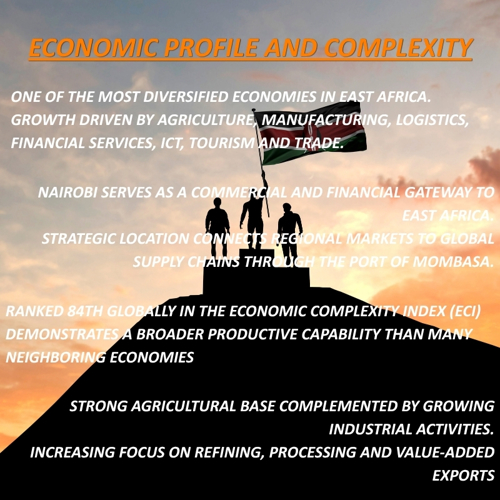
Kenya is considered one of Sub-Saharan Africa’s most diversified economies. Unlike many resource-dependent nations, its growth is supported by multiple sectors including agriculture, manufacturing, logistics, telecommunications, financial services, and tourism. This diversified structure provides greater economic flexibility and resilience against market fluctuations.
According to the Observatory of Economic Complexity (OEC), Kenya ranks 84th globally in the Economic Complexity Index (ECI), reflecting a production base that extends beyond simple commodity exports. While complexity levels remain below those of highly industrialized nations, Kenya demonstrates a greater level of diversification than many neighboring economies.
The country's economic development is also closely tied to its role as a regional distribution and logistics center. Nairobi has become a focal point for multinational companies, international organizations, and technology firms seeking access to East African markets. This strategic position continues to attract investment while supporting the development of knowledge-intensive industries.
EXPORTS
Kenya exported approximately $8.74 billion worth of goods, confirming its position as one of East Africa's leading exporting economies. Exports have expanded significantly in recent years, reflecting the country's growing integration into global trade networks.
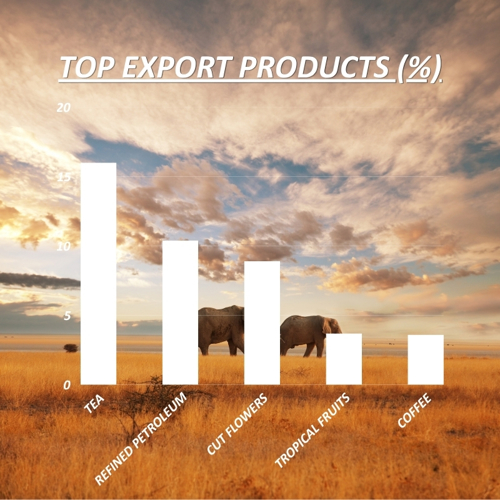
Agriculture remains the cornerstone of Kenya's export sector. Tea alone generates around $1.4 billion and accounts for approximately 16% of total exports, making Kenya the world's largest tea exporter. Kenyan tea is known globally for its quality and reaches consumers across Asia, Europe, the Middle East and Africa.
The country's floriculture industry is another major success story. Cut flowers contribute roughly $780 million, representing 8.9% of total exports, while coffee exports generate over $313 million (3.6%) and tropical fruits add approximately $320 million (3.7%). Together, these products underline Kenya's strong reputation as a supplier of premium agricultural products.
Beyond agriculture, Kenya is gradually moving up the value chain. Refined petroleum exports reached approximately $907 million, accounting for 10.4% of export revenues, demonstrating the country's growing industrial and processing capabilities.
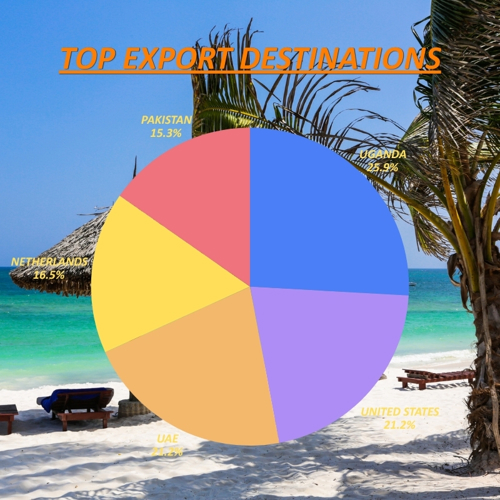
Kenya's export markets are well diversified. Uganda absorbs 10.9% of total exports ($951 million), followed by the United States with 9.1% ($791 million), the United Arab Emirates with 8.6% ($754 million), the Netherlands with 7.3% ($639 million) and Pakistan with 6.5% ($569 million). This mix highlights Kenya's ability to compete both within the African continent and in highly developed international markets.
IMPORTS
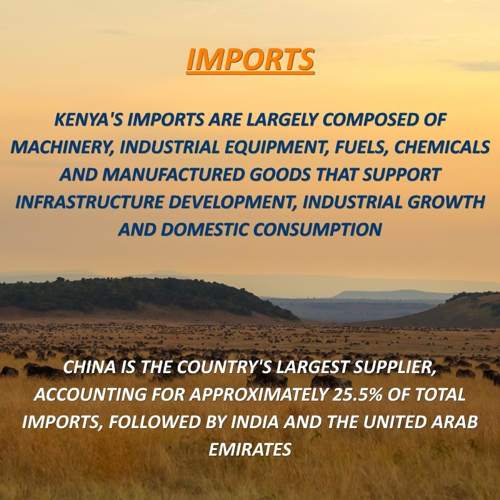
Kenya imported approximately $23.6 billion worth of goods, reflecting the needs of a fast-growing economy that relies on foreign supplies to support industrial activity, infrastructure development and domestic consumption.
A significant share of imports consists of machinery, industrial equipment, fuels, chemicals and manufactured goods that help sustain economic expansion across multiple sectors.
China remains Kenya's leading supplier, with imports worth approximately $6.01 billion, representing 25.5% of total imports. It is followed by India ($2.54 billion, 10.8%) and the United Arab Emirates ($2.52 billion, 10.7%), two key partners for industrial products, energy and manufactured goods.
Other important suppliers include Saudi Arabia ($1.12 billion, 4.7%) and Japan ($1.09 billion, 4.6%). Collectively, these five countries account for more than half of Kenya's total imports, illustrating the country's strong commercial ties with both Asia and the Middle East.
The composition of imports also reveals an economy in transformation. Demand for advanced machinery, transportation equipment and industrial inputs continues to grow alongside infrastructure projects, urbanization and the expansion of domestic industries.
TRADE BALANCE
Despite its strong export sectors, Kenya operates with a significant trade deficit. With exports valued at approximately $8.74 billion and imports reaching $23.6 billion, the country imports considerably more goods than it exports.
However, this imbalance should not be viewed solely as a weakness. A large portion of imported goods consists of productive assets such as machinery, industrial materials, fuel, and infrastructure-related equipment. These imports contribute directly to economic growth, industrialization, and long-term development.
At the same time, Kenya continues to pursue export diversification strategies aimed at increasing value-added production and reducing dependence on a relatively narrow range of export products. Continued investment in manufacturing, agro-processing, renewable energy, and technology could further strengthen the country's trade position over the coming years.
CURIOSITY CORNER
Kenya is the World’s Tea Champion
Few people realize that Kenya is the largest tea exporter in the world. Kenyan tea is consumed daily in households across Europe, Asia, Africa, and the Middle East, making the country a true global powerhouse in the beverage industry.
Flowers That Travel Thousands of Miles
The flower industry is one of Kenya’s greatest success stories. Roses and other cut flowers grown near Lake Naivasha can be harvested in the morning and appear in European flower shops within days. This highly efficient supply chain has made Kenya one of the world's leading floriculture exporters.
Nairobi: The Silicon Savannah
Kenya is increasingly known as the "Silicon Savannah," thanks to its vibrant startup ecosystem and leadership in digital financial services. Nairobi has become a regional center for innovation, attracting entrepreneurs, investors, and technology companies from around the world.
A Strategic Gateway to East Africa
Kenya’s geographic location makes it a natural entry point to a regional market of hundreds of millions of consumers. Through the Port of Mombasa and its transport corridors, the country serves as a critical logistics hub for landlocked neighboring economies.

CONCLUSION
Kenya stands out as one of Africa’s most compelling trade and investment destinations. Its strong agricultural exports, growing industrial capabilities, strategic location, and expanding consumer market create a unique combination of opportunities for international businesses.
While challenges remain, particularly regarding the trade deficit, the country’s diversified economy, regional influence, and ongoing modernization efforts provide a solid foundation for future growth. From world-renowned tea and flowers to emerging manufacturing and technology sectors, Kenya continues to demonstrate why it is considered a key economic engine of East Africa and an increasingly important player in global trade.