PRODUCT CLASSIFICATION
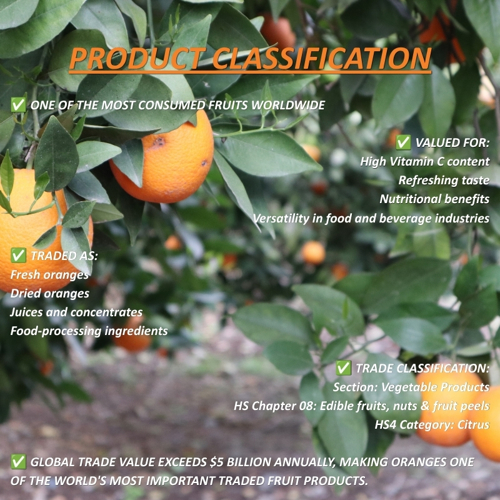
Oranges are among the most widely consumed fruits in the world, appreciated for their refreshing taste, high vitamin C content, and versatility across both fresh and processed food industries. Whether consumed as fresh fruit, juice, concentrates, or ingredients in food manufacturing, oranges play a central role in global agriculture and international trade. Their year-round demand, combined with production concentrated in specific climatic regions, has created a highly interconnected global market.
From a trade perspective, oranges belong to the Vegetable Products section and are classified within HS Chapter 08: Edible fruits, nuts and fruit peels, under the broader Citrus category. Despite being a relatively low-complexity agricultural commodity, oranges represent one of the most valuable fruit products traded worldwide due to their scale of production and global consumption.
Global trade in fresh and dried oranges exceeds $5 billion annually, making oranges one of the most important internationally traded fruit products. Among thousands of products exchanged across global markets, oranges rank among the leading agricultural commodities, demonstrating their enduring commercial relevance and widespread consumer demand.
According to the Product Complexity Index (PCI), oranges are considered a low-complexity product, reflecting straightforward cultivation and processing requirements compared with more technologically advanced goods. Nevertheless, successful participation in the orange trade depends heavily on efficient logistics, cold-chain infrastructure, quality control, and access to international distribution networks.
EXPORT
The global orange export market is dominated by a select group of countries that benefit from favorable climates, extensive citrus-growing regions, and well-developed export infrastructure.
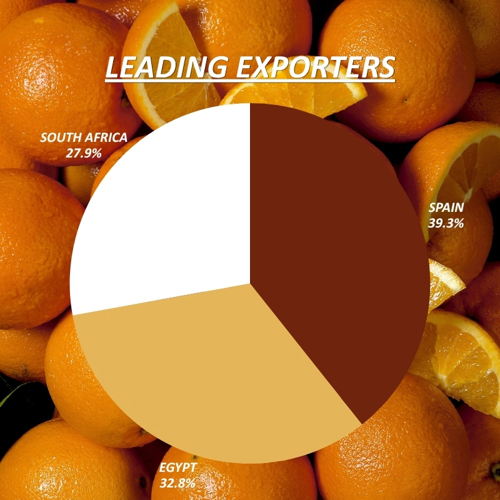
The leading exporters are:
• Spain – $1.21B
• Egypt – $1.01B
• South Africa – $857M
Spain has long maintained a prominent position in the international citrus market, supported by its strong reputation for quality fruit and geographical proximity to major European consumers. Egypt has emerged as a global export powerhouse thanks to expanding production, competitive costs, and increasing investment in agricultural exports. South Africa complements global supply through its counter-seasonal production, helping satisfy demand when Northern Hemisphere harvests are out of season.
Countries with the highest share of oranges within their overall export portfolios include:
• Egypt – 1.9%
• South Africa – 0.57%
• Zimbabwe – 0.55%
These figures illustrate the strategic importance of citrus exports for several African economies, where oranges represent a significant source of agricultural revenue and foreign exchange earnings.
The largest trade surpluses are recorded by:
• Spain – $1.08B
• Egypt – $1.01B
• South Africa – $853M
These surpluses highlight the strength of their production systems and their ability to consistently meet international demand while maintaining competitive positions in global markets.
IMPORT
The orange import market is largely concentrated in countries with large consumer populations, advanced food-processing industries, and strong demand for year-round citrus supplies.
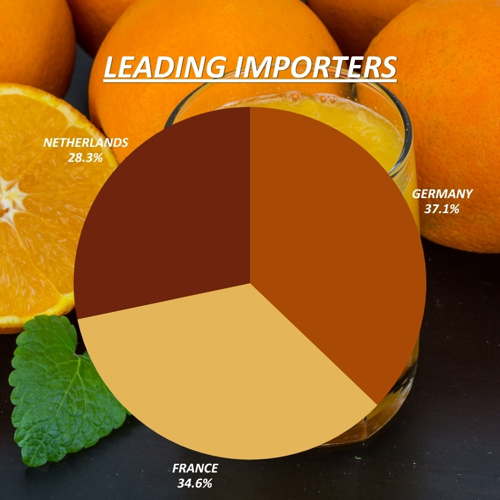
The leading importers are:
• Germany – $465M
• France – $433M
• Netherlands – $354M
Germany and France are among Europe's largest fruit-consuming markets and rely heavily on imported citrus due to climatic limitations on domestic production. The Netherlands serves not only as a consumer market but also as a major European logistics and distribution hub, importing substantial volumes that are subsequently redistributed across the continent.
The largest trade deficits are registered by:
• France – –$409M
• Germany – –$399M
• Russia – –$267M
These deficits reflect strong consumer demand combined with limited domestic orange production, reinforcing their dependence on international suppliers and efficient import channels.
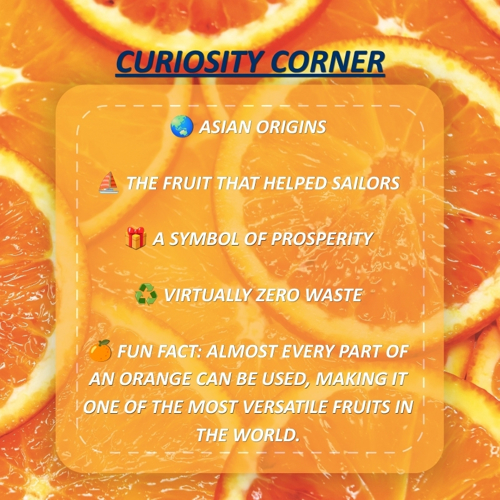
CURIOSITY CORNER: THE SWEET LEGACY OF ORANGES
Oranges have a history that spans thousands of years and multiple continents. Contrary to what many people assume, sweet oranges did not originate in the Mediterranean. They are believed to have first developed in Asia, particularly in regions that today include southern China, northeastern India, and parts of Southeast Asia, before spreading westward through ancient trade routes.
One of the most fascinating aspects of oranges is their influence on global exploration. During the Age of Sail, citrus fruits became essential provisions aboard ships because of their high vitamin C content, helping sailors combat scurvy on long ocean voyages. As a result, oranges played a small but meaningful role in enabling international trade and exploration itself.
The fruit has also become deeply embedded in culture and symbolism. In many countries, oranges are associated with prosperity, good fortune, and celebration. They are frequently exchanged as gifts during holidays and festive occasions.
Beyond fresh consumption, almost every part of the orange can be utilized. The juice industry represents a major global market, while peels are used in flavorings, essential oils, cosmetics, cleaning products, and even natural fragrances. This exceptional versatility helps maximize the economic value of the crop and minimize waste throughout the supply chain.
CONCLUSION
The global orange trade demonstrates the enduring importance of citrus fruits within international agricultural commerce. Supported by strong consumer demand, extensive production networks, and sophisticated logistics systems, oranges remain one of the world's most traded fruit products. Major exporters such as Spain, Egypt, and South Africa continue to shape global supply, while leading importers including Germany, France, and the Netherlands sustain robust demand across major consumer markets.
Despite their relatively low product complexity, oranges illustrate how successful agricultural trade depends on far more than cultivation alone. Efficient transportation, quality standards, cold-chain management, and seasonal complementarities all contribute to maintaining the continuous flow of oranges across international borders. As consumer interest in healthy and natural foods remains strong, oranges are expected to retain their position as a cornerstone of the global fresh fruit market.