
A GLOBAL ECONOMIC LEADER DRIVING TRADE, INNOVATION, AND ENERGY
OVERVIEW
The United States stands at the center of the global economy, combining unmatched economic scale, technological leadership, and a complex industrial ecosystem. With a GDP of $28.8 trillion in 2024, it remains the world’s largest economy, the second‑largest exporter, and ranks 9th in GDP per capita globally.
In December 2025, U.S. trade flows remained substantial:
- Exports: $179B
- Imports: $282B
- Trade balance: –$103B
Compared with the previous year, exports grew significantly by $13.7B (+8.27%), while imports declined slightly by –$2.68B (–0.94%), reflecting strong external demand and easing domestic consumption pressures.
The country’s economic resilience is driven by diverse industries, from aerospace and energy to technology, agriculture, and advanced manufacturing, supported by one of the world’s largest consumer markets and innovation ecosystems.
ECONOMIC PROFILE AND COMPLEXITY
The U.S. economy is highly diversified, characterized by:
- global leadership in technology, aerospace, and energy,
- a large internal market,
- dominant multinational corporations,
- and world‑leading innovation hubs such as Silicon Valley, Boston, and Austin.
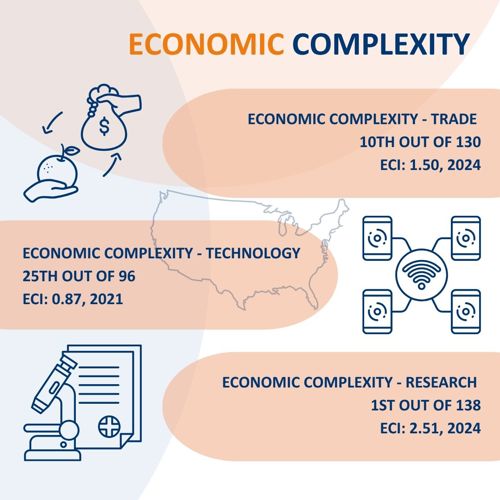
Its export structure reveals strong specialization in high‑value goods, including aircraft components, petroleum products, computers, and gas turbines. This economic complexity contributes to the country’s strong position in global trade despite persistent trade deficits driven by high domestic demand for foreign goods.
EXPORTS
In 2024, the United States exported $1.9T, reinforcing its position as the 2nd largest exporter worldwide. Over five years, exports increased by $340B, from $1.56T in 2019.
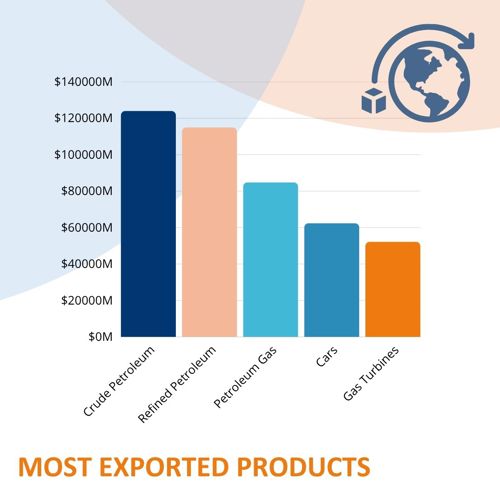
Top Export Products (2024)
- Crude Petroleum – $124B
- Refined Petroleum – $115B
- Petroleum Gas – $84.8B
- Cars – $62.4B
- Gas Turbines – $52.2B
These categories highlight the U.S.’s strong presence in the global energy market and its advanced industrial and transport technologies.
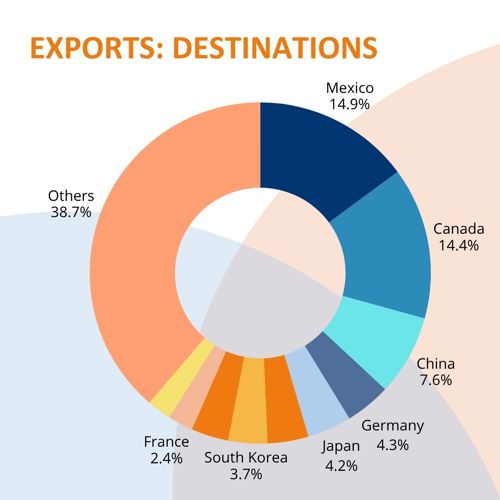
Top Export Destinations (2024)
- Mexico – $283B
- Canada – $273B
- China – $145B
- Germany – $82B
- Japan – $79.5B
Export Growth Drivers (Dec 2025)
Exports increased strongly due to:
- greater shipments to Mexico (+$3.59B)
- soaring exports to Switzerland (+240%)
- robust demand from Germany (+39.1%)
Key products driving growth:
- Computers (+96.7%)
- Aircraft parts (+25.5%)
- Gold (+110%)
IMPORTS
In 2024, the United States imported $3.12T, making it the largest importer in the world. Over five years, imports grew by $701B, rising from $2.42T in 2019.
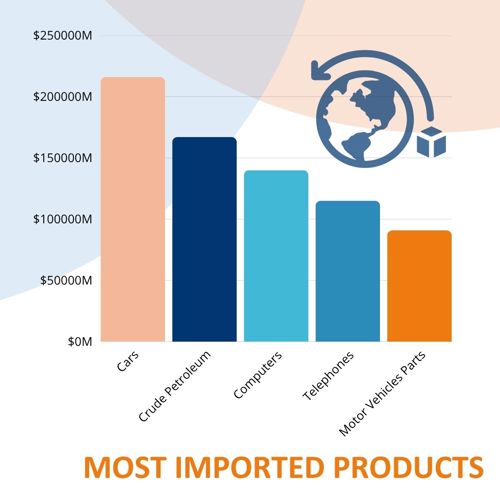
Top Import Products (2024)
- Cars – $216B
- Crude Petroleum – $167B
- Computers – $140B
- Telephones – $115B
- Motor vehicle parts – $90.8B
These figures reflect high consumer demand, a strong automotive market, and reliance on global supply chains for technology and electronics.
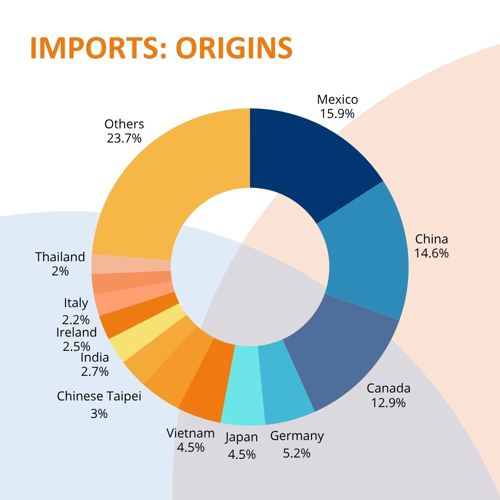
Top Import Origins (2024)
- Mexico – $494B
- China – $453B
- Canada – $400B
- Germany – $161B
- Japan – $141B
Import Trends (Dec 2025)
Significant declines came from:
- China (–43.8%)
- Switzerland (–66.8%)
- Canada (–10.6%)
Imports increased notably for:
- Other precious metal products
- Packaged medicaments
- Cars
TRADE BALANCE
In 2024, the United States posted its largest trade surpluses with:
- Netherlands – +$42.9B
- Hong Kong – +$20.7B
- Australia – +$18.7B
- United Arab Emirates – +$15.7B
- Singapore – +$12.7B
The largest trade deficits were recorded with:
- China – –$309B
- Mexico – –$211B
- Vietnam – –$128B
- Canada – –$128B
- Germany – –$78.9B
These imbalances reflect the U.S.’s dependence on imported consumer goods, electronics, and automotive products, coupled with strong domestic demand.
CURIOSITY CORNER: INNOVATION, ENERGY, AND CULTURE IN THE U.S. ECONOMY
1. A Nation Powered by Innovation
The United States is home to the world’s most influential tech ecosystems. Silicon Valley alone drives breakthroughs in AI, semiconductors, cloud computing, and biotechnology, contributing massively to high‑value exports.
2. A Global Energy Giant
The U.S. is a leading producer of crude oil, natural gas, and refined petroleum. This positions the country as a key supplier in global energy markets and a major player in the geopolitical landscape of energy security.
3. State‑Driven Economic Power
States like Texas, California, and New York play outsized roles in global commerce. Texas leads in energy exports, California in technology and electronics, and New York in high‑value services and gold re‑exports.
4. Culture Meets Economy
The U.S. creative industries, from Hollywood to major streaming platforms, are among the country’s most influential soft‑power assets, driving tourism, international branding, and global cultural reach.

CONCLUSION
The United States remains a global economic leader, driven by unmatched scale, industrial diversity, and technological innovation. Its export strength in energy, aerospace, and advanced machinery, combined with its position as the world’s largest importer, makes it central to global trade flows.
Despite persistent trade deficits, the country’s dynamic industries, strong domestic demand, and powerful innovation engines ensure long‑term competitiveness. As the U.S. continues to invest in technology, energy transition, and advanced manufacturing, it will remain a cornerstone of the global economy and a critical driver of international markets.