PRODUCT CLASSIFICATION
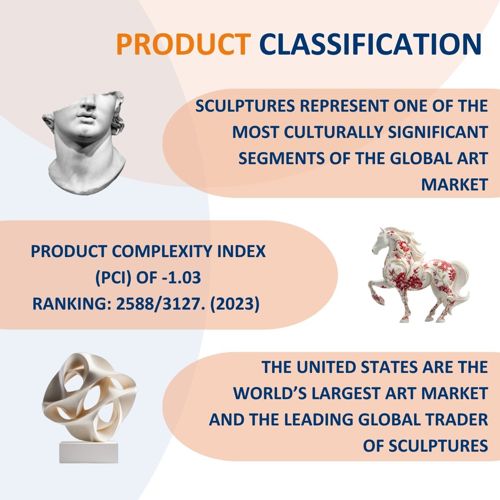
Original sculptures and statuary, crafted in materials ranging from stone and metal to wood and mixed media, represent one of the most culturally significant segments of the global art market. These works embody artistic expression, craftsmanship, and historical value, circulating through galleries, auction houses, private collections, and museums worldwide.
Sculptures fall under the Arts and Antiques section, specifically within the HS4 category “Original sculptures and statuary, in any material.” This classification includes unique artworks rather than mass‑produced decorative objects, reflecting their role as high‑value cultural assets.
In 2024, sculptures recorded a Product Complexity Index (PCI) of -0.31, ranking 2,052 out of 3,119 products, indicating relatively low complexity in production but high value in cultural and economic terms. In 2024, global trade of Original sculptures and statuary, in any material reached $3.78B, reflecting a 18.1% decrease from 2023, when trade totaled $4.61B. Over the past five years, trade in this category has declined at an annualized rate of 0.6%. Among the 5,380 products traded in 2024, this category ranked 978 in global trade value., accounting for 0.017% of world trade.
This article focuses specifically on the United States, the world’s largest art market and the leading global trader of sculptures.
THE ART MARKET IN THE UNITED STATES
The United States has been the world’s dominant art market since the 1960s, with New York serving as the central hub for both domestic and international transactions. In 2024, the U.S. generated over 40% of global sales value of art and antiques, surpassing the United Kingdom and China.
Despite this leadership, the U.S. art market experienced a 9% decline in total sales in 2024, mirroring a broader slowdown in global art activity. Economic uncertainty, political tensions and cautious buyer behavior contributed to this contraction.
The COVID‑19 pandemic had previously disrupted the sector, but both imports and exports rebounded in the years that followed, nearly returning to pre‑pandemic levels before the 2024 slowdown.
SCULPTURE TRADE IN THE UNITED STATES
In 2024, the United States was both the top exporter and the top importer of original sculptures and statuary:
- Exports: $951 million
- Imports: $926 million
This dual role underscores the U.S.’s position as a global hub for the circulation of high‑value artworks.
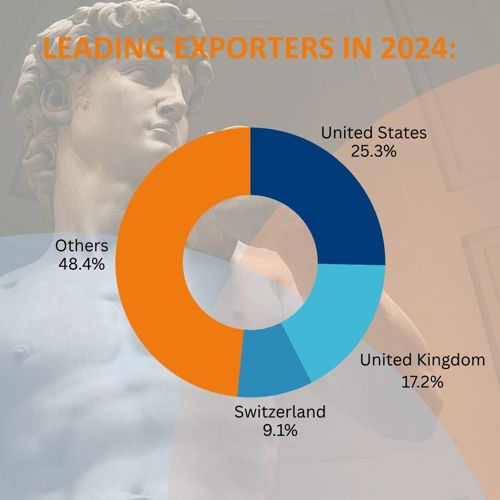
Top global exporters of sculptures (2024):
- United States – $951M
- United Kingdom – $664M
- France – $341M
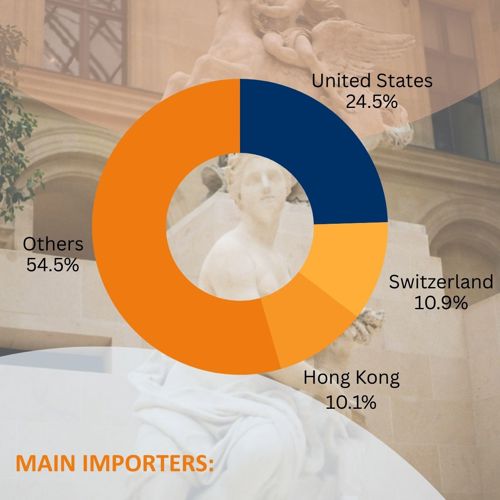
Top global importers of sculptures (2023):
- United States – $926M
- Switzerland – $414M
- Hong Kong – $382M
The U.S. market is deeply interconnected with Europe, which remains its primary partner for both imports and exports.
EXPORT
In 2024, the United States exported $951 million in original sculptures, confirming its position as the world’s leading exporter. This reflects the strength of its gallery networks, private dealers, and auction houses, particularly in New York.
In 2024, the main destinations for U.S. art exports (across categories, including sculptures) were:
- United Kingdom
- Switzerland
These countries host major art hubs (London, Geneva, and Zurich) where artworks are frequently re‑exported or sold through high‑end auction houses.
However, exports declined by around 7% in 2024, influenced by market caution and political uncertainty.
Other important exporters in 2024 were United Kingdom ($664M) and rance ($341M).
IMPORT
The United States imported $926 million in sculptures in 2024, making it the world’s largest importer. This reflects strong domestic demand from collectors, museums, and investment buyers.
In 2024, the leading suppliers of artworks to the U.S. were:
- United Kingdom
- France
- Italy
These countries have long‑established art markets and are home to major galleries, estates, and auction houses.
Imports fell by 15% in 2024, driven by economic concerns and fluctuating tariffs affecting U.S.–Europe art trade.
Other main importers were Switzerland ($414M) and Hong Kong ($328M).
THE UNITED STATES IN THE GLOBAL AUCTION MARKET
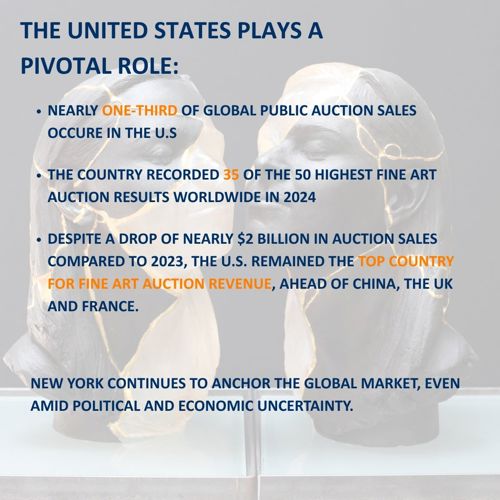
The global auction market, public and private sales combined, was valued at over $20 billion in 2024. The United States plays a pivotal role:
- Nearly one‑third of global public auction sales occur in the U.S.
- The country recorded 35 of the 50 highest fine art auction results worldwide in 2024.
- Despite a drop of nearly $2 billion in auction sales compared to 2023, the U.S. remained the top country for fine art auction revenue, ahead of China, the UK, and France.
New York, home to major auction houses like Christie’s, Sotheby’s, and Phillips, continues to anchor the global market, even amid political and economic uncertainty.
CONCLUSIONS
The United States remains the undisputed leader of the global art market, and its dominance extends clearly to the trade of original sculptures. With nearly $2 billion in combined imports and exports in 2023, the U.S. acts as both a gateway and a destination for high‑value artworks.
Despite recent declines linked to economic uncertainty, shifting tariffs, and political tensions, the structural strength of the U.S. art ecosystem continues to sustain its global influence.
New York’s central role, combined with the country’s deep ties to European art markets, suggests that the United States will remain a powerhouse in sculpture trade and the broader art economy for years to come.
Sources: Art market in the United States - statistics & facts | Statista , Original sculptures and statuary, in any material (HS: 970300) Product Trade, Exporters and Importers | The Observatory of Economic Complexity