OVERVIEW
Located at the crossroads of Central Asia, Turkmenistan is a resource-rich nation whose economy is deeply connected to global energy markets. While often less visible than some of its regional neighbors, the country plays a significant role in international trade thanks to its vast natural gas reserves and strategic position between Asia, Europe, and the Middle East.
With a GDP exceeding $50 billion and a population of around 7 million people, Turkmenistan has built an export-oriented economy centered on hydrocarbons, while gradually expanding its industrial and chemical sectors. The country's trade profile reveals a market that is highly specialized, strongly export-driven, and increasingly connected to major Asian economies.
ECONOMIC PROFILE AND COMPLEXITY
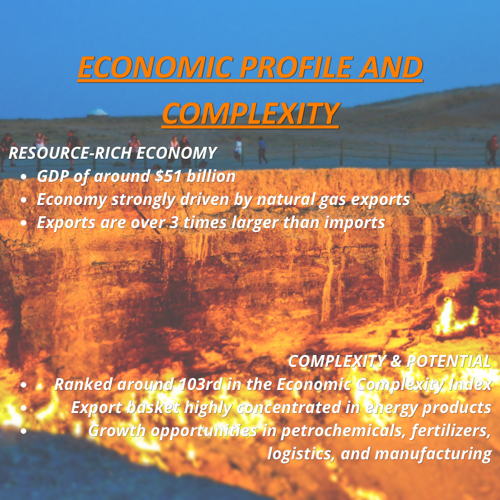
Turkmenistan's economic structure is heavily influenced by its abundant natural resources, particularly natural gas. This specialization has enabled the country to generate significant export revenues, but it also creates a dependence on global commodity prices and a limited diversification of economic activities.
According to the Economic Complexity Index (ECI), Turkmenistan ranks among the lower half of global economies, reflecting an export basket concentrated in a relatively small number of products rather than a broad range of sophisticated manufactured goods.
However, this apparent weakness also highlights a major opportunity. Investments in petrochemicals, fertilizers, manufacturing, logistics, and infrastructure could allow the country to move further up the value chain while leveraging its existing energy advantages.
Key economic indicators include:
• GDP: approximately $51 billion
• GDP per capita: around $6,800
• Economic Complexity Index ranking: around 103rd globally
• Export value equivalent to more than three times imports
• Strong trade surplus supported by energy exports
EXPORTS
Exports are the driving force behind Turkmenistan's economy. The country exports approximately $13.5 billion worth of goods annually, with the energy sector accounting for the overwhelming majority of export revenues.
TOP EXPORT PRODUCTS
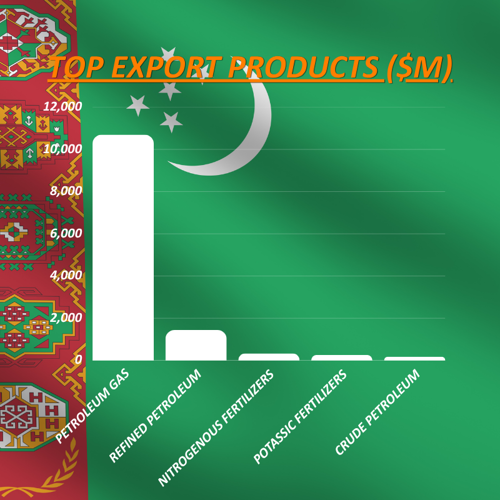
Petroleum Gas dominates the export basket with around $10.7 billion, representing roughly 79% of total exports.
Other major exports include:
• Refined Petroleum: about $1.44 billion (10.7% of exports)
• Nitrogenous Fertilizers: about $330 million (2.4%)
• Potassic Fertilizers: about $259 million (1.9%)
• Crude Petroleum: about $175 million (1.3%)
Together, mineral fuels and energy-related products account for more than 90% of total exports, highlighting the country's strong specialization in the hydrocarbons sector.
MAIN EXPORT DESTINATIONS
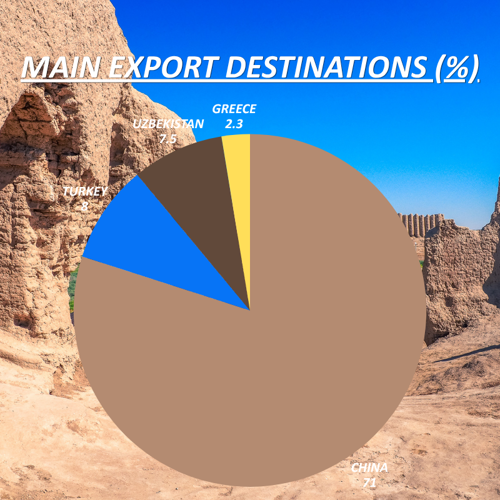
China is by far Turkmenistan's largest trading partner, purchasing approximately $9.62 billion in goods, equal to about 71% of total exports.
Other important destinations include:
• Turkey: approximately 8%
• Uzbekistan: approximately 7.5%
• Greece: approximately 2.3%
• Azerbaijan: approximately 2.2%
The dominance of China demonstrates Turkmenistan's growing integration into Asian energy supply chains and reinforces the strategic importance of its natural gas sector.
IMPORTS
Turkmenistan imports approximately $3.9 billion worth of goods annually, significantly less than it exports. Imports are focused on machinery, industrial equipment, technology, transportation assets, and manufactured products needed to support domestic development and industrialization.
MAIN IMPORTED PRODUCTS
The country's import structure is considerably more diversified than its export basket.
Leading imported categories include:
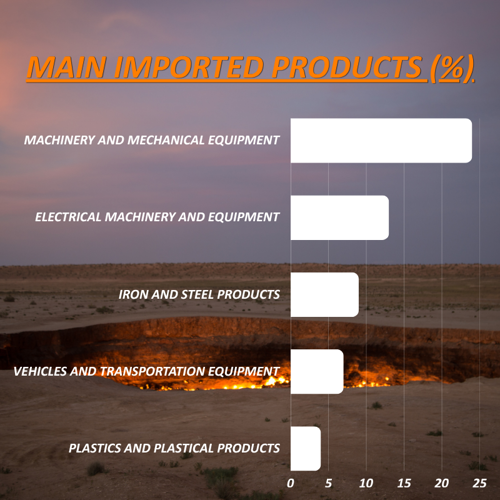
• Machinery and Mechanical Equipment: approximately 24% of imports
• Electrical Machinery and Equipment: approximately 13%
• Iron and Steel Products: approximately 9%
• Vehicles and Transportation Equipment: approximately 7%
• Plastics and Plastic Products: approximately 4%
• Optical and Medical Instruments: approximately 4%
• Pharmaceutical Products: approximately 4%
This import profile reflects ongoing investments in infrastructure, manufacturing capacity, transportation networks, and industrial modernization.
MAIN IMPORT PARTNERS
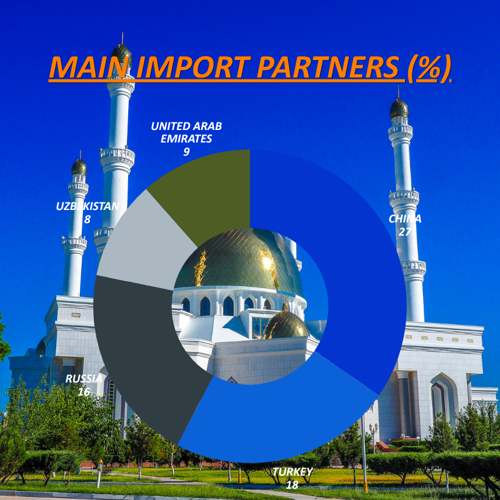
On the import side, Turkmenistan depends on a relatively diversified network of trading partners. China is the country's leading supplier, accounting for around 27% of total imports, followed by Turkey (18%) and Russia (16%). Regional integration also plays an important role, with Uzbekistan contributing approximately 8% of imports, while the United Arab Emirates accounts for around 9%. Among European partners, Germany represents about 4%, mainly supplying machinery, industrial equipment, and advanced technology products. This diversified sourcing strategy helps Turkmenistan support infrastructure projects, industrial development, and economic modernization.
TRADE BALANCE
One of the most striking characteristics of Turkmenistan's economy is its substantial trade surplus.
With annual exports around $13.5 billion and imports near $3.9 billion, the country generates a positive trade balance of roughly $9.6 billion. This means exports are approximately 3.4 times larger than imports, a remarkable ratio by international standards.
This surplus is largely supported by natural gas exports, which continue to provide strong foreign currency earnings and strengthen the country's external position.
However, the same dependence on energy exports means that trade performance remains sensitive to fluctuations in global commodity demand and prices. Diversification therefore represents both a challenge and an opportunity for future growth.
CURIOSITY CORNER
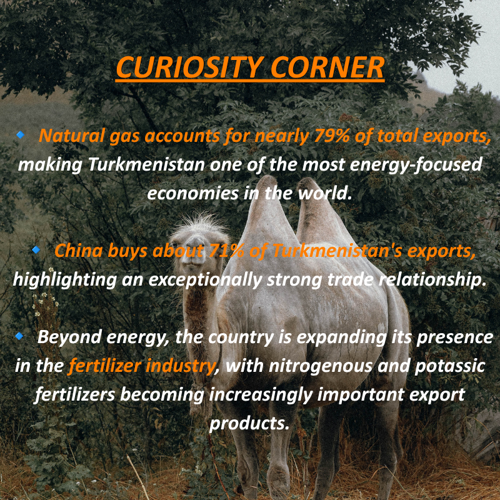
Turkmenistan is home to one of the world's largest natural gas reserves, a factor that has shaped both its economy and its geopolitical relevance for decades. This abundance of energy resources explains why petroleum gas alone generates nearly four-fifths of all export revenues.
Another interesting aspect is the country's extraordinary dependence on a single market. More than 70% of exports are destined for China, making it one of the most concentrated export relationships among major energy-exporting countries.
Despite being known primarily for energy, Turkmenistan has also developed a growing fertilizer industry. Products such as nitrogenous and potassic fertilizers have become increasingly visible in the country's export portfolio, helping broaden its industrial base beyond hydrocarbons.
CONCLUSION
Turkmenistan presents a unique economic profile characterized by abundant natural resources, a strong export surplus, and a strategic role within Eurasian trade routes. Its economy is powered by energy exports, particularly natural gas, which generate the majority of national trade revenues and support a consistently positive trade balance.
While the country's reliance on hydrocarbons remains significant, opportunities are emerging in fertilizers, petrochemicals, logistics, manufacturing, and infrastructure development. For businesses and investors looking at Central Asia, Turkmenistan represents a market where resource wealth, geographic positioning, and long-term diversification efforts combine to create considerable potential for future growth.
