PRODUCT CLASSIFICATION
Brussels sprouts may be small in size, but they occupy a distinctive position in the global vegetable market. Recognized for their compact green buds, slightly nutty flavor, and impressive nutritional profile, they have gained popularity among health-conscious consumers worldwide. Rich in vitamins C and K, fiber, antioxidants, and phytonutrients, Brussels sprouts are increasingly valued as part of modern healthy diets.
From a trade perspective, Brussels sprouts belong to the Vegetable Products section and are classified under HS Chapter 07: Edible Vegetables and Certain Roots and Tubers, specifically under HS 070420: Brussels Sprouts, Fresh or Chilled. Like many fresh vegetables, they are considered a relatively low-complexity agricultural product, yet they require efficient logistics, cold-chain transportation, and well-coordinated distribution networks to reach consumers in optimal condition.
Global trade in fresh and chilled Brussels sprouts exceeds $250 million annually, demonstrating stable international demand despite the product's niche status compared with larger vegetable categories. Among thousands of products traded worldwide, Brussels sprouts represent a specialized but resilient segment supported by growing consumer interest in nutritious and plant-based foods.
EXPORT
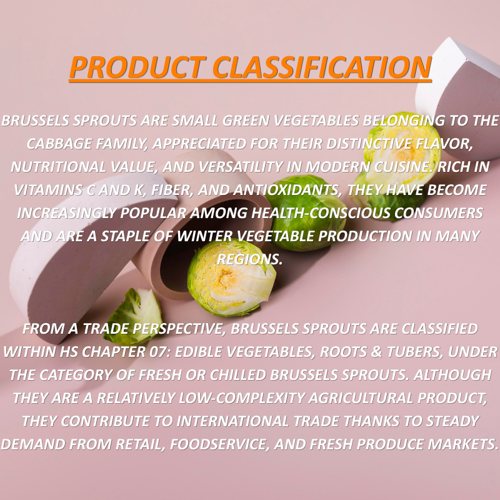
The international Brussels sprouts market is highly concentrated, with a small group of countries accounting for most global exports.
The leading exporters are:
• Mexico: approximately 40% of global exports
• Netherlands: approximately 28%
• United States: approximately 14.4%
Together, these three countries account for more than 80% of worldwide exports, highlighting a significant concentration of production and export capacity.
Mexico dominates the market thanks to favorable growing conditions, large-scale agricultural production, and strong integration with North American supply chains.
The Netherlands combines domestic production with its role as a major European logistics hub, leveraging advanced transport infrastructure and extensive distribution networks. The United States remains a key supplier, benefiting from efficient farming operations and well-established commercial relationships throughout North America.
Other notable exporters include:
• Morocco: about 5.3% of global exports
• Belgium: about 5.0%
• Guatemala: about 1.7%
In terms of export specialization, Brussels sprouts represent a relatively important agricultural product for countries such as Guatemala, Morocco, and Mexico, where the product contributes a meaningful share of national export portfolios compared to larger economies.
IMPORT
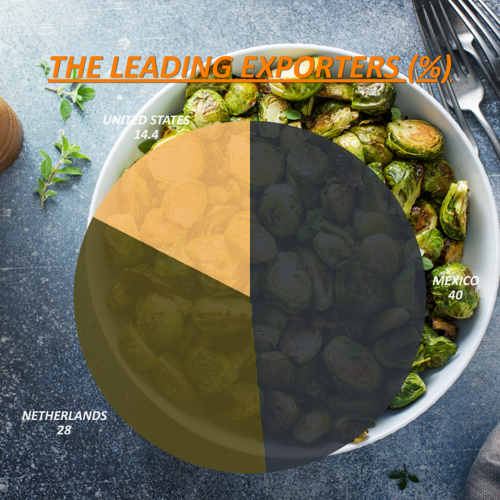
Demand for Brussels sprouts is concentrated in developed consumer markets where healthy eating trends and established retail distribution systems support year-round consumption.
The top importers are:
• United States: approximately 41% of global imports
• Germany: approximately 13%
• Canada: approximately 9%
The United States is both the largest importer and one of the largest exporters. This reflects the seasonal nature of production and the integration of North American agricultural trade, particularly with Mexico. Germany remains Europe's largest importer, driven by strong consumer demand and a mature fresh-produce market. Canada also relies on imports to complement domestic production and maintain consistent supply throughout the year.
Additional important importing markets include:
• Netherlands: around 5% of global imports
• Mexico: around 4.5%
• United Kingdom: around 3.5%
• France: around 2.5%
These figures reveal a trade structure strongly linked to regional supply chains, particularly in North America and Europe, where proximity and efficient transportation are essential for maintaining freshness and product quality.
CURIOSITY CORNER: THE HIDDEN STORY BEHIND BRUSSELS SPROUTS
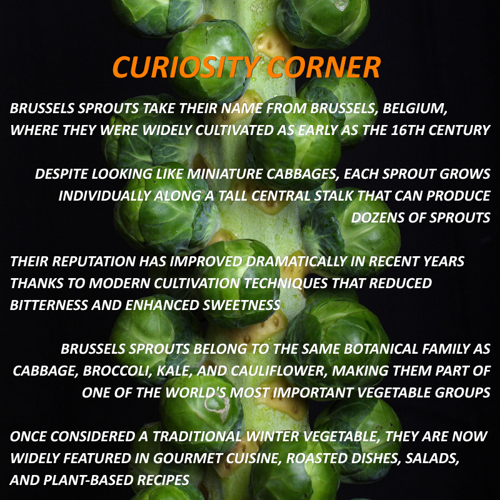
Despite their modern popularity, Brussels sprouts have a long history that dates back centuries. They are believed to have been cultivated extensively in the region surrounding Brussels, Belgium, from which they take their name.
For many years, Brussels sprouts had a reputation as one of the world's least-loved vegetables. However, changing cooking techniques, especially roasting and grilling, have transformed public perception, helping the vegetable become a favorite ingredient in contemporary cuisine.
Brussels sprouts belong to the same botanical family as cabbage, broccoli, kale, and cauliflower. This family, known as Brassica, is celebrated for its high concentration of vitamins, minerals, and plant compounds associated with numerous health benefits.
One fascinating characteristic is that each plant can produce dozens of individual sprouts growing along a tall central stalk. A single mature stalk often resembles a miniature tree covered with tiny cabbages, making Brussels sprouts one of the most visually distinctive vegetables in commercial agriculture.
Today, they are increasingly featured in gourmet recipes, plant-based diets, and healthy meal plans, proving that even vegetables once considered unfashionable can successfully reinvent themselves.
CONCLUSION
The global Brussels sprouts trade demonstrates how a relatively specialized vegetable can achieve significant international relevance through strong consumer demand, efficient logistics, and concentrated production networks. While the market is smaller than many other vegetable categories, it remains highly dynamic and deeply integrated across North America and Europe.
Mexico, the Netherlands, and the United States continue to dominate exports, together supplying the vast majority of world demand. On the import side, the United States, Germany, and Canada represent the largest consumer markets, supported by growing interest in nutritious foods and year-round product availability.
As health-conscious consumption patterns continue to evolve, Brussels sprouts are well positioned to maintain their presence in international trade, combining traditional agricultural roots with modern dietary trends.
