OVERVIEW
Sierra Leone is one of West Africa’s most resource-rich economies, combining abundant mineral reserves, a strategic Atlantic coastline, and a young, growing population. While the country remains heavily dependent on extractive industries, it has gradually diversified its economic activities through agriculture, fisheries, and selected manufacturing sectors. The economy is strongly connected to international markets, with trade playing a crucial role in generating foreign exchange and supporting domestic development.
What makes Sierra Leone particularly interesting from a trade perspective is the dominance of natural resources in its export basket. Minerals such as iron ore, titanium ore, diamonds, and bauxite account for most export revenues, while imports are largely composed of machinery, vehicles, fuel, construction materials, pharmaceuticals, and food products. This structure creates both opportunities and vulnerabilities, as economic performance is closely linked to global commodity demand and price fluctuations.
ECONOMIC PROFILE AND COMPLEXITY
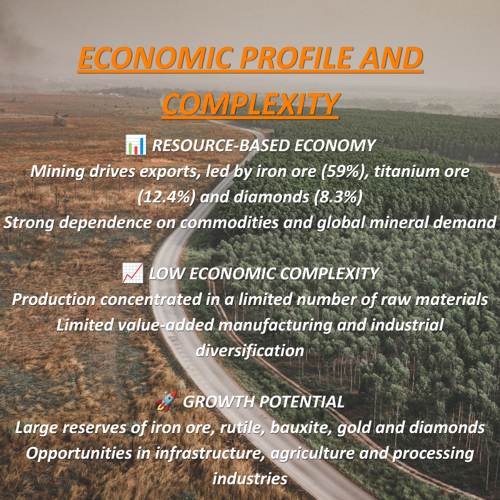
Sierra Leone is classified among the world's lower-income economies and exhibits a relatively low level of economic complexity. The country's productive capacity is concentrated in a limited number of sectors, particularly mining and primary commodities, which generate a significant share of export earnings.
The country's Economic Complexity Index reflects a production structure that remains largely focused on raw materials rather than higher value-added manufactured goods. Nevertheless, Sierra Leone possesses considerable long-term potential thanks to its deposits of iron ore, rutile, bauxite, gold, and diamonds, as well as its agricultural resources.
A key challenge for the country's future development is expanding its industrial base and increasing value-added production. Greater diversification would help reduce exposure to commodity cycles and improve economic resilience. At the same time, infrastructure investments, improvements in logistics, and a growing private sector could strengthen Sierra Leone’s integration into regional and global value chains.
EXPORTS
Exports are the backbone of Sierra Leone's international trade profile. The country ships a relatively concentrated basket of products, with mineral commodities accounting for the overwhelming majority of export revenues.
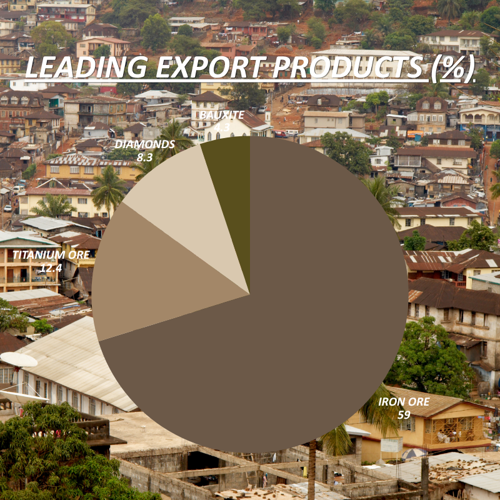
The leading export products include:
• Iron ore: approximately 59% of total exports
• Titanium ore (rutile): around 12.4%
• Diamonds: about 8.3%
• Bauxite: roughly 4.3%
• Cocoa beans: nearly 3.3%
• Zirconium ores: around 2.7%
Together, iron ore, titanium ore, and diamonds account for nearly 80% of Sierra Leone's export value, highlighting the country's strong dependence on the mining sector.
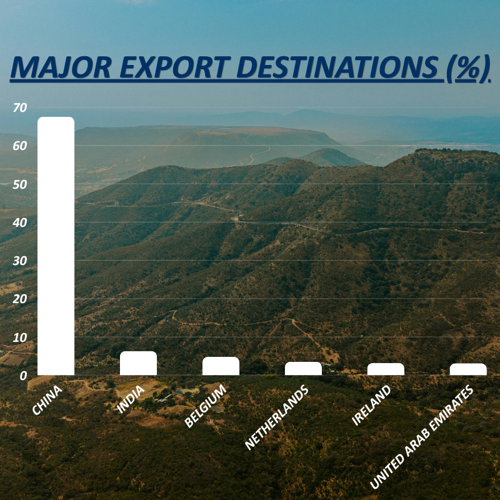
From a geographical perspective, exports are concentrated in a limited number of destinations:
• China: approximately 67.5% of total exports
• India: around 6.3%
• Belgium: about 4.8%
• Netherlands: roughly 3.5%
• Ireland: close to 3.2%
• United Arab Emirates: around 3.1%
China's dominant position reflects its strong demand for industrial minerals and raw materials, making it Sierra Leone's most important trading partner by a wide margin.
IMPORTS
Unlike exports, Sierra Leone's imports are more diversified and mainly consist of products needed to support domestic consumption, infrastructure projects, industrial activity, and public services.
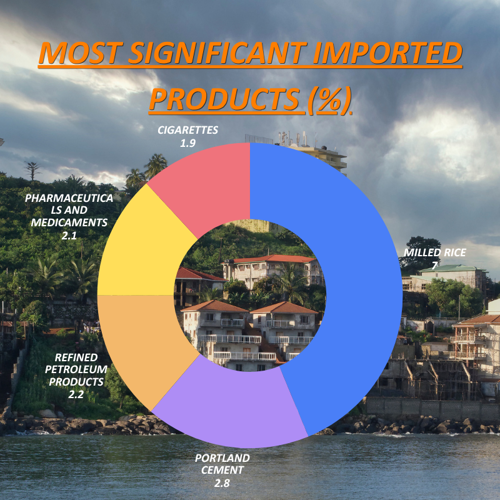
Some of the most significant imported products include:
• Milled rice: approximately 7.0% of total imports
• Portland cement: around 2.8%
• Refined petroleum products: roughly 2.2%
• Pharmaceuticals and medicaments: about 2.1%
• Cigarettes: nearly 1.9%
• Vaccines and medical products: around 1.6%
• Plastic household products: approximately 1.5%
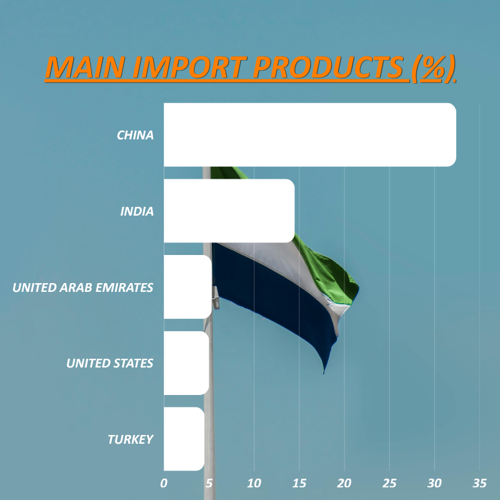
The country's main import partners are:
• China: approximately 32.4% of imports
• India: around 14.5%
• United Arab Emirates: about 5.3%
• United States: roughly 5.0%
• Türkiye: around 4.5%
• South Africa: approximately 4.2%
• Belgium: about 3.6%
China's leadership on both the import and export sides underlines the growing economic relationship between the two countries and highlights Sierra Leone's integration into Asian supply chains.
TRADE BALANCE
Sierra Leone generally records a trade deficit, meaning that the value of imported goods exceeds the value of exported goods. This imbalance stems from the country's need to import a wide range of manufactured products, fuel, machinery, medicines, and food items while relying on a relatively narrow export base.
Although periods of strong mineral production can significantly boost export revenues, the trade balance remains sensitive to fluctuations in global commodity prices. A fall in iron ore or mineral demand can quickly impact export earnings, while import demand tends to remain relatively stable due to domestic consumption and infrastructure requirements.
The long-term reduction of the trade deficit will largely depend on export diversification, increased domestic production, and the development of value-added industries capable of serving both local and international markets.
CURIOSITY CORNER
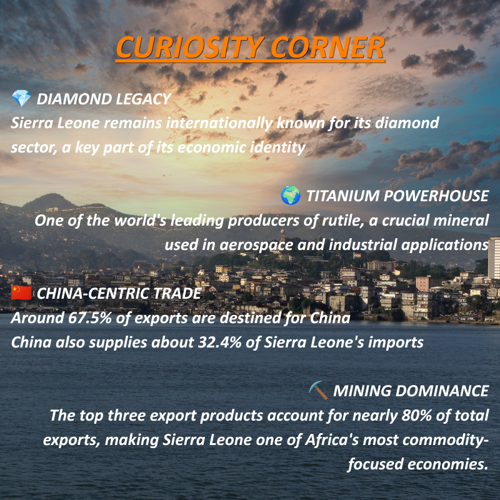
One of Sierra Leone's most distinctive economic characteristics is its position as one of the world's leading producers of rutile, a titanium-bearing mineral used in aerospace, pigments, and high-tech industrial applications. Despite its relatively small economy, Sierra Leone plays a strategically important role in global titanium supply chains.
Another fascinating aspect is the country's remarkable concentration of exports. With nearly two-thirds of exports directed to China, Sierra Leone is among the African economies most closely linked to Chinese commodity demand. This relationship provides significant opportunities for growth but also increases exposure to shifts in Chinese industrial activity.
The country is also internationally recognized for its diamond industry. While diamonds no longer dominate exports as they once did, they remain an important symbol of Sierra Leone's economic history and continue to contribute to foreign trade revenues.
CONCLUSION
Sierra Leone is a market characterized by significant natural resource wealth and strong international trade connections. Its export sector is driven primarily by minerals such as iron ore, titanium ore, diamonds, and bauxite, while imports support domestic consumption, infrastructure development, and industrial growth.
The country's economic future will largely depend on its ability to diversify production, attract investment, and move further up the value chain. While the mining sector will likely remain the primary engine of growth, opportunities also exist in agriculture, logistics, infrastructure, and manufacturing. For companies exploring opportunities in West Africa, Sierra Leone represents a market with substantial potential, supported by abundant resources and increasing integration into global trade networks.
