PRODUCT CLASSIFICATION
Chocolate is one of the world’s most beloved food products, enjoyed across cultures and age groups for its rich flavor, versatility, and emotional appeal. Produced from cocoa beans and transformed through sophisticated manufacturing processes, chocolate has evolved from a luxury commodity into a global consumer staple. Today, it is sold in countless forms, ranging from premium artisanal products to mass-market confectionery, making it a key component of the international food industry.
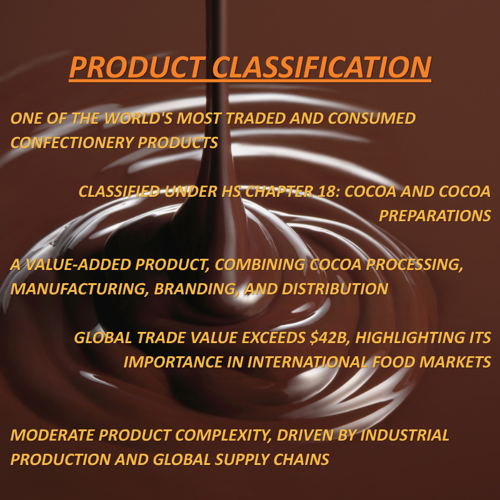
From a trade perspective, chocolate belongs to the Foodstuffs section and is classified under HS Chapter 18: Cocoa and Cocoa Preparations, specifically within the chocolate product category. Unlike raw agricultural commodities, chocolate is a value-added manufactured product that combines agricultural inputs, industrial processing, branding, and global distribution networks.
Global trade in chocolate is valued at approximately $42.5B, making it one of the most significant products within the confectionery sector. Despite relying on cocoa grown primarily in tropical regions, the countries that dominate chocolate exports are mainly advanced manufacturing economies that specialize in processing, packaging, and branding.
Among internationally traded products, chocolate stands out as a consumer good with relatively broad global demand. Its Product Complexity Index (PCI) is around 0.22, reflecting a moderate level of manufacturing sophistication compared with many agricultural products.
EXPORT
The global chocolate export market is led by a small group of highly industrialized economies with strong food-processing sectors and well-established international brands.
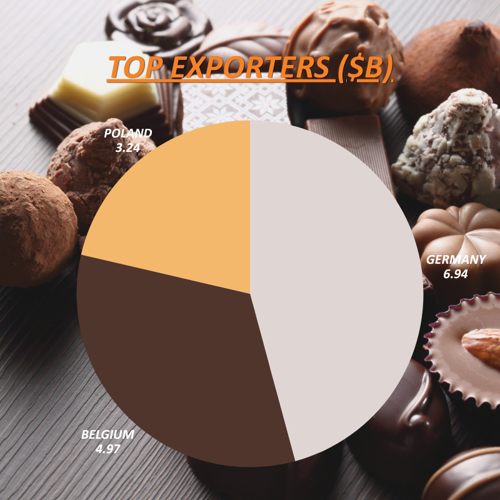
The top exporters are:
• Germany – $6.94B (16.3% of global exports)
• Belgium – $4.97B (11.7%)
• Poland – $3.24B (7.6%)
Germany is the undisputed leader in global chocolate exports, benefiting from advanced production facilities, strong logistics infrastructure, and the presence of some of the world's largest confectionery manufacturers. Belgium remains synonymous with premium chocolate and luxury confectionery, while Poland has emerged as a major production hub thanks to competitive manufacturing costs and growing investment from international brands.
Other important exporters include Italy, Canada, the Netherlands, France, Switzerland, and the United Kingdom, highlighting Europe's dominant role in the chocolate value chain. Notably, most leading exporters do not produce cocoa beans themselves but import cocoa and transform it into high-value finished products.
The concentration of exports among a limited number of countries demonstrates the importance of manufacturing expertise, brand reputation, and efficient supply chains rather than access to raw cocoa production alone.
IMPORT
Chocolate imports are largely driven by developed consumer markets with high per-capita consumption and strong retail sectors.
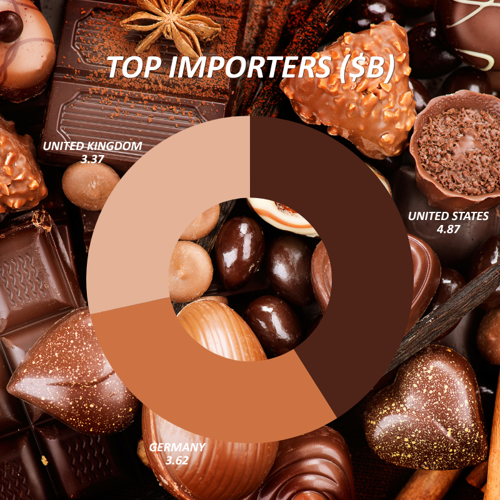
The top importers are:
• United States – $4.87B (11.5% of global imports)
• Germany – $3.62B (8.5%)
• United Kingdom – $3.37B (7.9%)
The United States is the largest importer of chocolate in the world, reflecting the enormous size of its consumer market and steady demand for both premium and mainstream products. Germany's position among the leading importers highlights its dual role as both a major producer and a distribution hub within Europe. Meanwhile, the United Kingdom remains one of the world's most important chocolate-consuming nations, supported by a mature confectionery market and strong retail demand.
Other significant importing countries include France, the Netherlands, Belgium, Canada, Poland, Spain, and Italy. Together, European nations account for a substantial share of global chocolate imports, underlining the region's central role in both consumption and re-export activities.
The scale of international chocolate imports demonstrates how deeply integrated the global confectionery industry has become, with products frequently crossing multiple borders before reaching final consumers.
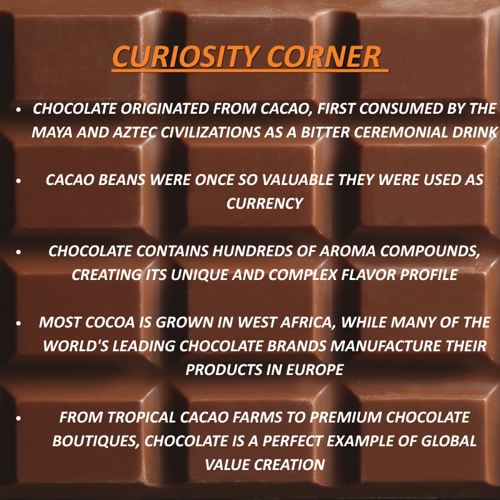
CURIOSITY CORNER: THE SWEET SCIENCE OF CHOCOLATE
Chocolate's journey begins with the cacao tree, a plant native to Central and South America that was cultivated by ancient civilizations such as the Maya and the Aztecs. Long before chocolate became the sweet treat we know today, cacao was consumed as a bitter ceremonial drink and was so valuable that cacao beans were sometimes used as currency.
One of chocolate's most fascinating characteristics is its complexity. Researchers have identified hundreds of aromatic compounds that contribute to its flavor profile, helping explain why tasting notes can range from fruity and floral to nutty and earthy.
Dark chocolate is also known for containing antioxidants called flavonoids, which have contributed to its reputation as a food that can be enjoyed as both an indulgence and, when consumed in moderation, part of a balanced diet.
Perhaps the greatest paradox of the chocolate industry is that the majority of the world's cocoa is grown in tropical countries such as Côte d'Ivoire and Ghana, while the highest-value chocolate products are manufactured and exported mainly by European economies. This transformation from agricultural commodity to premium consumer product is what makes chocolate one of the most fascinating examples of value creation in global trade.
CONCLUSION
Chocolate represents far more than a simple confectionery product. It is a globally traded manufactured good that connects cocoa producers, food processors, logistics providers, retailers, and consumers across multiple continents. With global trade valued at approximately $42.5B, chocolate remains one of the most important products within the international food industry.
Leading exporters such as Germany, Belgium, and Poland continue to dominate world markets through advanced manufacturing capabilities and strong global brands, while major importers including the United States, Germany, and the United Kingdom reflect the product's enduring popularity among consumers worldwide.
The chocolate industry perfectly illustrates how value, innovation, and branding can transform a raw agricultural ingredient into a globally recognized product. As demand for premium, sustainable, and specialty chocolate continues to grow, chocolate is likely to remain one of the most dynamic and influential segments of international food trade.
