OVERVIEW
Despite its limited land area and lack of natural resources, Singapore has established itself as one of the world's most influential trading economies. Strategically located along some of the busiest maritime routes on the planet, the city-state serves as a vital gateway connecting Asia with the rest of the world. Its business-friendly environment, advanced infrastructure, political stability, and highly skilled workforce have transformed Singapore into a key hub for finance, technology, manufacturing, and international trade.
Singapore consistently ranks among the world's leading trading nations and is recognized for its ability to attract foreign investment while maintaining strong connections with global supply chains. This combination of openness, innovation, and efficiency has made the country a benchmark for economic success.
ECONOMIC PROFILE AND COMPLEXITY
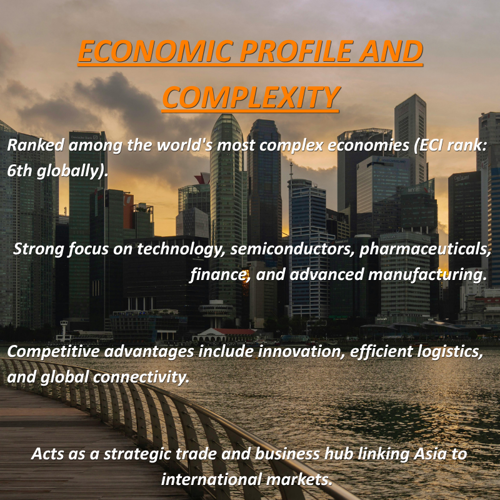
Singapore's economy is characterized by a high degree of sophistication and diversification. The country ranks among the world's most economically complex economies, reflecting its ability to produce and export advanced, knowledge-intensive products. Its Economic Complexity Index (ECI) places Singapore among the global leaders in technological and industrial capabilities.
Rather than relying on raw materials, Singapore specializes in high-value industries such as semiconductors, pharmaceuticals, biotechnology, precision engineering, financial services, and digital technologies. This focus on innovation allows the country to remain competitive despite increasing global competition.
The nation also benefits from strong institutions, world-class logistics infrastructure, and an extensive network of trade agreements, enabling businesses to access markets across Asia, Europe, and the Americas with remarkable efficiency.
EXPORTS
Exports are a cornerstone of Singapore's economic model. The country exports approximately $331 billion worth of goods annually, making it one of the most important exporters in the global economy.
The export structure highlights Singapore's strength in advanced manufacturing and technology:
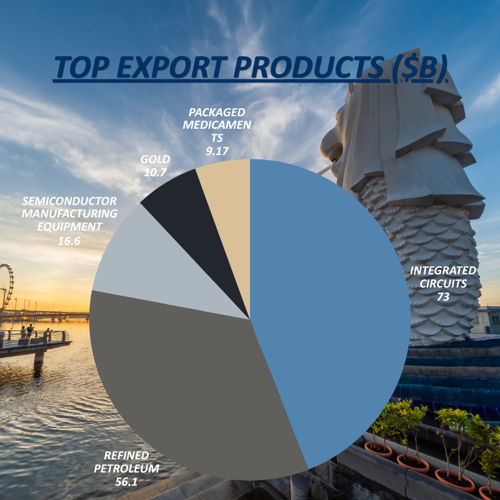
• Integrated Circuits: approximately $73 billion (22.1% of total exports)
• Refined Petroleum: approximately $56.1 billion (16.9%)
• Semiconductor Manufacturing Equipment: approximately $16.6 billion (5.0%)
• Gold: approximately $10.7 billion (3.2%)
• Packaged Medicaments: approximately $9.17 billion (2.8%)
Together, these five product categories account for around 50% of Singapore's total exports, demonstrating the country's strong specialization in technology, energy products, and high-value manufacturing.
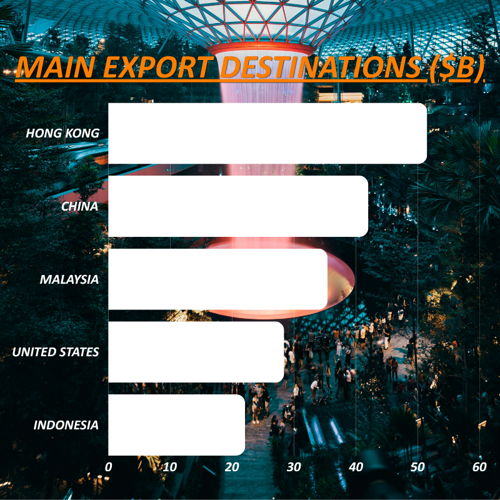
Singapore's main export destinations are:
• Hong Kong: $51.5 billion (15.6% of total exports)
• China: $42 billion (12.7%)
• Malaysia: $35.4 billion (10.7%)
• United States: $28.4 billion (8.6%)
• Indonesia: $22.1 billion (6.7%)
The diversity of export markets helps reduce dependence on any single economy and strengthens Singapore's position as a global trading hub.
IMPORTS
Singapore imports approximately $432 billion worth of goods annually, reflecting its role as both a major consumer market and a strategic re-export center.
Many imported products are used as inputs for manufacturing processes before being re-exported to international markets. This makes imports an essential component of Singapore's highly integrated supply chain ecosystem.
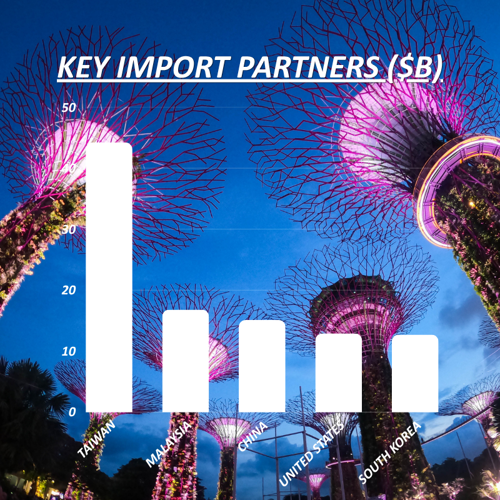
Key import partners include:
• Chinese Taipei (Taiwan)
• Malaysia
• China
• United States
• South Korea
These countries supply critical inputs for Singapore's electronics, semiconductor, energy, and manufacturing industries. The strong presence of Asian partners highlights the country's deep integration into regional production networks.
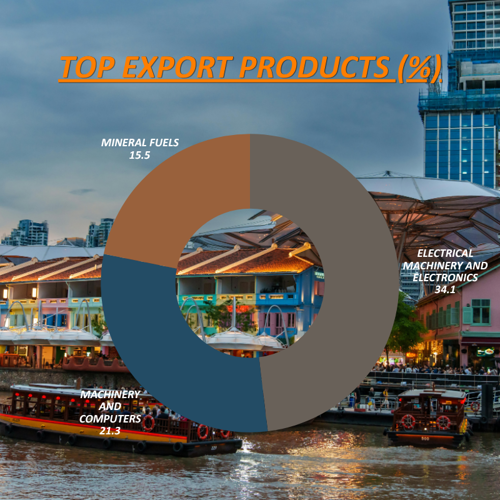
On the product side, electrical machinery and electronics represent 34.1% of all imports, while machinery and computers contribute 21.3% and mineral fuels 15.5%. These figures highlight Singapore's deep integration into global supply chains and its strategic position as a gateway for trade across Asia and beyond.
Compared with many economies, Singapore's large import volume is not a sign of dependency but rather evidence of its role as a global logistics and processing hub where goods are transformed, distributed, and re-exported worldwide.
TRADE BALANCE
Singapore's trade flows are among the largest relative to the size of its economy. While import and export volumes are both exceptionally high, trade balances vary significantly depending on individual trading partners.
The country's largest trade surpluses are recorded with:
• Hong Kong: approximately +$47.3 billion
• Vietnam: approximately +$10.7 billion
• Indonesia: approximately +$7.39 billion
• Australia: approximately +$2.96 billion
• Myanmar: approximately +$2.89 billion
Meanwhile, the largest trade deficits occur with:
• Chinese Taipei (Taiwan): approximately -$44.2 billion
• Malaysia: approximately -$16.8 billion
• China: approximately -$15.1 billion
• South Korea: approximately -$12.9 billion
• United States: approximately -$12.7 billion
These figures illustrate Singapore's role within complex international value chains, where importing high-value components often supports the production of sophisticated exports.
CURIOSITY CORNER
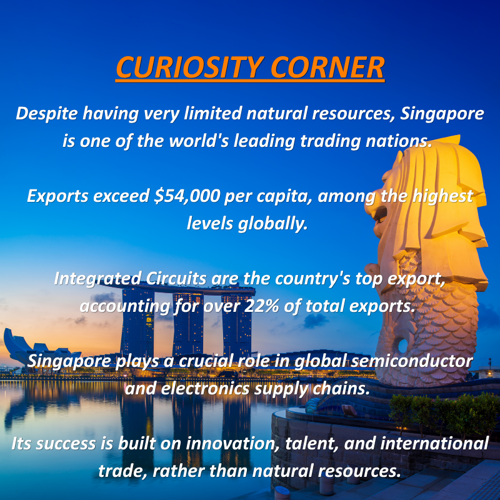
One of the most remarkable aspects of Singapore's economy is how a country with virtually no natural resources has become a global leader in advanced industries and international trade.
Singapore ranks among the world's most complex economies and records one of the highest export-per-capita figures globally, exceeding $54,000 per person. Its import-per-capita level is also exceptionally high, surpassing $71,000 per person.
Another interesting feature is the dominance of the semiconductor sector. Integrated circuits alone account for more than one-fifth of all exports, highlighting Singapore's critical role in the global electronics industry. At a time when digital technologies are reshaping economies worldwide, Singapore serves as a crucial link in the production of the chips that power everything from smartphones to artificial intelligence systems.
CONCLUSION
Singapore demonstrates how strategic vision, innovation, and global connectivity can overcome geographical limitations. By investing in technology, infrastructure, education, and trade facilitation, the city-state has built one of the world's most sophisticated and resilient economies.
Its export portfolio is dominated by advanced manufacturing and high-tech products, while its extensive trade network connects businesses across every major region of the world. As global industries continue to evolve, Singapore's combination of economic complexity, logistical excellence, and international openness ensures that it will remain a key player in global trade for years to come.
