OVERVIEW
Estonia has earned a reputation as one of Europe's most innovative and digitally advanced economies. Despite its relatively small population, the Baltic nation has built a strong international presence through technological development, efficient institutions, and a highly open economy. Its strategic location between Northern and Eastern Europe has helped establish the country as an important hub for trade, logistics, and cross-border business activities.
International trade plays a central role in Estonia's economic success. Strong connections with European markets, a competitive business environment, and a commitment to innovation have enabled the country to develop a diversified export base while maintaining close commercial ties with leading global economies.
ECONOMIC PROFILE AND COMPLEXITY
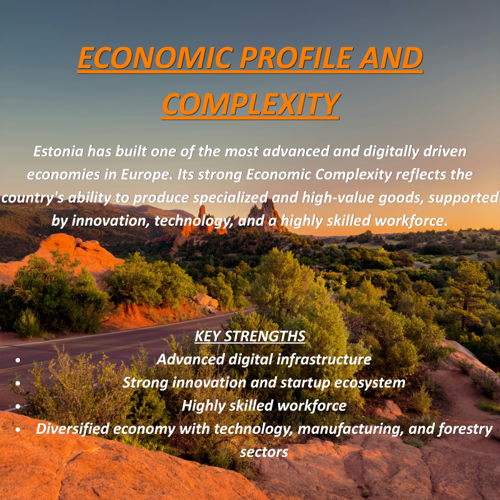
Estonia is recognized as one of the world's most economically sophisticated nations relative to its size. Its strong Economic Complexity ranking reflects the country's ability to produce and export a broad range of specialized and knowledge-intensive products. Rather than relying on a single industry, Estonia benefits from a balanced economy that combines advanced manufacturing, technology, wood processing, logistics, and professional services.
A highly educated workforce, widespread digital infrastructure, and a business-friendly environment have contributed to the development of competitive sectors such as electronics, telecommunications, software development, and industrial manufacturing. These strengths continue to attract international investors and support the country's long-term economic resilience.
EXPORTS
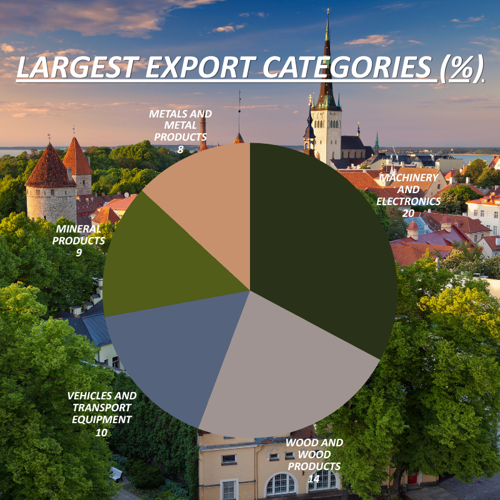
Estonia's export sector reflects its ability to blend traditional industries with cutting-edge technology. Machinery and electronics represent the country's largest export category, accounting for approximately 18-20% of total exports. Wood and wood products follow with 12-14%, highlighting the continued importance of Estonia's forestry sector. Vehicles and transport equipment contribute around 8-10%, while mineral products account for approximately 8-9% and base metals and metal products generate a further 6-8% of export value.
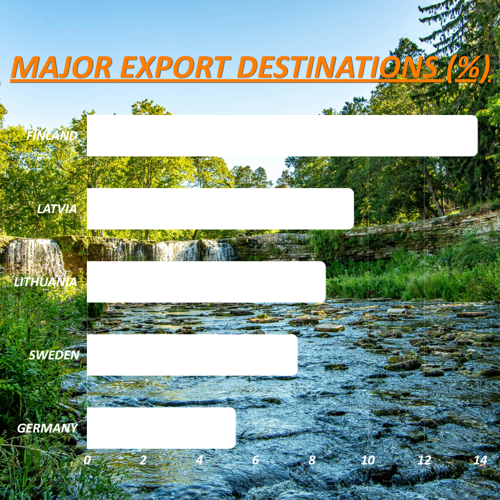
Estonia's export destinations are predominantly European. Finland is the country's largest export market, receiving 13.9% of total exports. Latvia follows with 9.5%, Lithuania with 8.5%, Sweden with 7.5%, and Germany with 5.3%. Together, these five markets absorb nearly half of Estonia's international sales, underlining the country's strong integration within Northern and Baltic European supply chains.
The combination of advanced manufacturing, technology products, and natural-resource-based industries gives Estonia a diversified export profile capable of adapting to changing global demand patterns.
IMPORTS
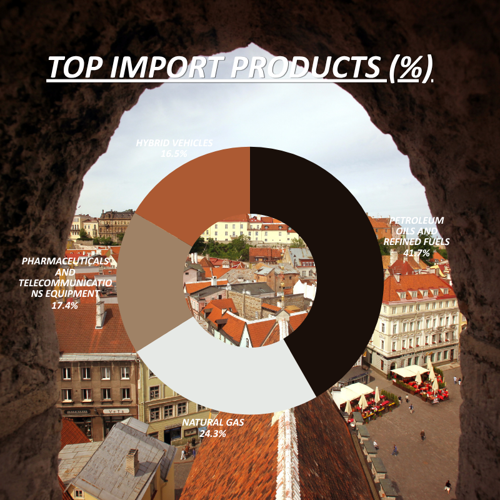
As a highly open economy, Estonia depends on imports to support both domestic consumption and industrial production. Energy products play a particularly important role within the country's import structure. Petroleum oils and refined fuels represent approximately 4.8% of total imports, making them the largest import category. Natural gas and other hydrocarbons account for around 2.8%, while pharmaceuticals and telecommunications equipment each contribute roughly 2.0%. Hybrid vehicles complete the top five import categories at approximately 1.9%.
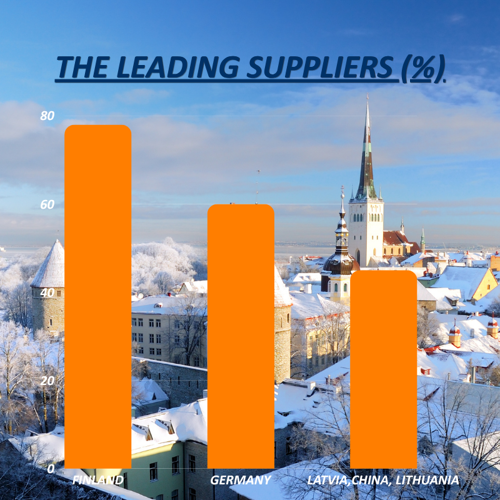
Finland is also Estonia's leading supplier, accounting for 11.8% of total imports. Germany follows closely at 10.9%, while Latvia, China, and Lithuania each represent 7.3% of imported goods. These figures highlight Estonia's deep integration into European and global supply chains, particularly in energy, manufacturing, and technology-related sectors.
The country's import profile reflects the needs of a modern economy that relies on international markets for energy resources, industrial inputs, advanced equipment, and consumer goods.
TRADE BALANCE
Estonia typically records a trade deficit, with imports generally exceeding exports. This imbalance is largely linked to the country's dependence on imported energy resources, industrial components, and capital goods used in domestic production and investment activities.
However, the trade balance alone does not fully reflect Estonia's economic performance. The country benefits from a dynamic services sector, particularly in information technology, digital solutions, and business services, which strengthens its international competitiveness and supports long-term economic growth.
CURIOSITY CORNER
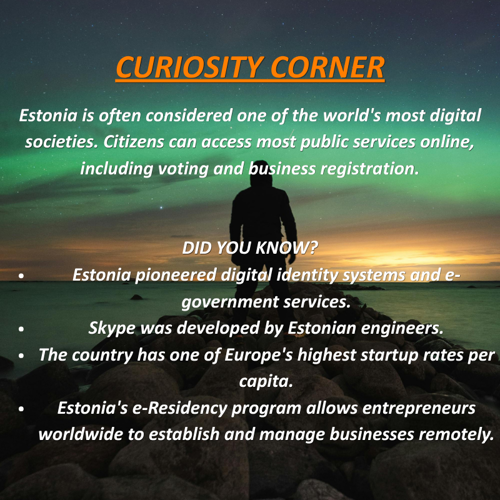
Estonia is widely regarded as one of the world's most digitally advanced societies. It was among the first countries to introduce nationwide digital identity systems and online voting, allowing citizens to access a wide range of public services electronically. This commitment to digitalization has become a defining characteristic of the Estonian economy and society.
The country is also known for its thriving startup ecosystem. Estonia has produced several globally successful technology companies, including Skype, and consistently ranks among Europe's leading nations for startups per capita. Its culture of innovation and entrepreneurship continues to attract talent, investors, and international businesses.
CONCLUSION
Estonia demonstrates how a small nation can achieve global relevance through innovation, digital transformation, and international trade. Its diversified export portfolio, technologically advanced industries, and strong economic complexity position the country as one of the most dynamic economies in the Baltic region.
With close ties to European markets, a highly competitive business environment, and a growing reputation as a technology hub, Estonia offers significant opportunities for companies seeking access to a modern, connected, and forward-looking economy.
