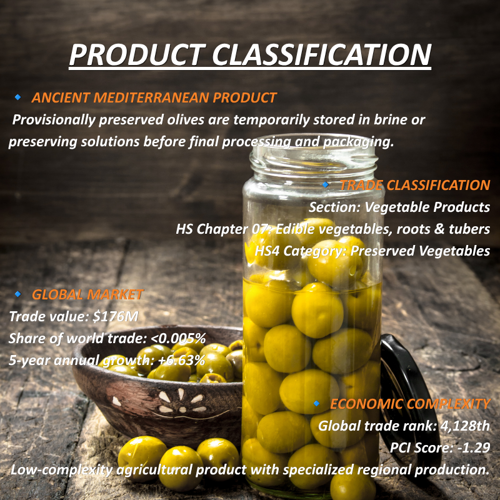
PRODUCT CLASSIFICATION
Olives have been an integral part of Mediterranean agriculture, cuisine, and culture for thousands of years. While most consumers are familiar with table olives and olive oil, provisionally preserved olives occupy a unique position within the global food industry. These olives undergo an initial preservation process, typically using brine, sulfur dioxide, or other temporary preserving agents, allowing them to be stored and transported before undergoing further processing for final consumption.
From a commercial perspective, olives (provisionally preserved) belong to the Vegetable Products section, specifically within HS Chapter 07: Edible vegetables, roots & tubers, under the broader category of Preserved Vegetables. Although considered a relatively low-complexity agricultural product, they play a strategic role in international food supply chains, particularly across Mediterranean and olive-producing regions.
Global trade in provisionally preserved olives is valued at approximately $176 million, representing less than 0.005% of total world trade. Despite its niche market size, the sector has shown solid long-term expansion, recording an annualized growth rate of 6.63% over the past five years, reflecting increasing international demand for processed olive products and the globalization of Mediterranean food consumption.
Among the 5,380 products traded worldwide, olives (provisionally preserved) rank 4,128th by trade value. According to the Product Complexity Index (PCI), the product scores-1.29, placing it among the lower-complexity traded goods. This ranking reflects the agricultural nature of the product, the relatively standardized production process, and the concentration of exports in countries with well-established olive-growing industries.
EXPORT
Exports of provisionally preserved olives are strongly concentrated around the Mediterranean basin, where climatic conditions, agricultural expertise, and centuries-old olive cultivation traditions provide a significant competitive advantage.
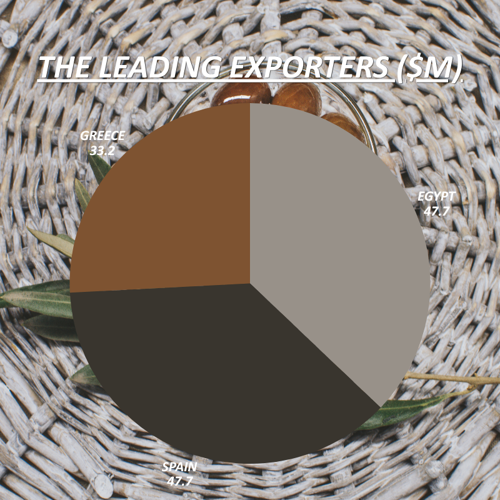
The leading exporters are:
Egypt – $47.7M
Spain – $47.7M
Greece – $33.2M
Together, these three countries account for more than 73% of global exports, highlighting the dominance of Mediterranean producers within the industry. Egypt has emerged as a major supplier thanks to expanding olive plantations, competitive production costs, and growing export-oriented investments. Spain leverages its position as one of the world's largest olive producers, supported by advanced processing facilities and extensive international distribution networks. Greece benefits from a long-standing reputation for premium-quality olives and strong connections to European and international markets.
Countries with the highest share of provisionally preserved olives in their total export portfolios are:
Syria – 0.22%
Egypt – 0.09%
Greece – 0.063%
These figures underline the importance of the olive sector for several Mediterranean economies, where olive cultivation remains both an economic activity and a cultural heritage.
The largest trade surpluses are recorded by:
Egypt – $47.7M
Greece – $30.7M
Spain – $19.9M
These surpluses reflect strong domestic production, efficient export channels, and sustained international demand for olives destined for further industrial processing.
IMPORT
Imports of provisionally preserved olives are driven by countries with significant food-processing industries, large consumer markets, and growing demand for Mediterranean-style products.
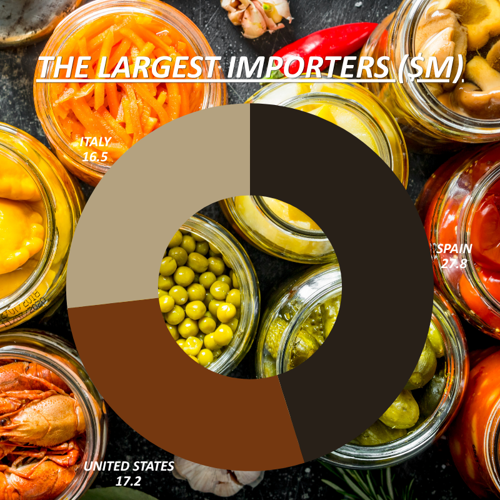
The largest importers are:
Spain – $27.8M
United States – $17.2M
Italy – $16.5M
Spain's presence among both top exporters and importers highlights its role as a global processing and redistribution hub. Imported olives are frequently transformed, packaged, blended, or prepared for re-export. The United States continues to demonstrate strong consumer demand for olive-based products, while Italy imports significant volumes to support its extensive food manufacturing and retail sectors.
The largest trade deficits are registered by:
United States ––$16.9M
Australia ––$15M
Italy ––$11.3M
These deficits illustrate the dependence of major consumer markets on imported olive products, particularly where domestic production is insufficient to satisfy growing demand.
CURIOSITY CORNER: THE HIDDEN STORY BEHIND PROVISIONALLY PRESERVED OLIVES
At first glance, provisionally preserved olives may seem like an obscure commodity, but they represent an essential step in one of the world's oldest food industries.
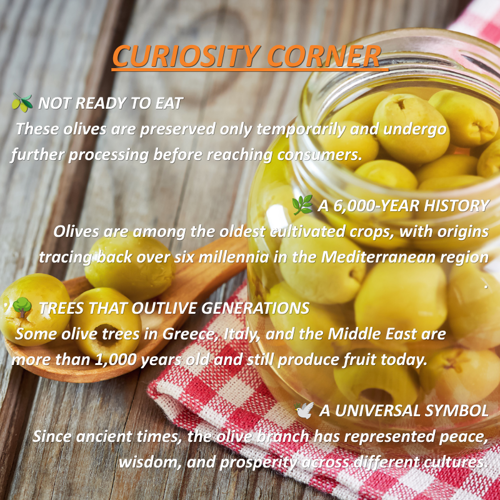
Unlike ready-to-eat table olives, provisionally preserved olives are not intended for immediate consumption. They are temporarily stored in brine or other preserving solutions to prevent spoilage while awaiting further processing. This intermediate stage allows producers to transport large quantities across international markets before the olives are sorted, fermented, flavored, or packaged.
Olive trees are among the oldest cultivated plants in human history. Archaeological evidence suggests that olive cultivation began in the Eastern Mediterranean more than 6,000 years ago, making olives one of humanity's longest-traded agricultural products.
Another fascinating aspect is the extraordinary longevity of olive trees. Some specimens found in Greece, Italy, and the Middle East are estimated to be over 1,000 years old, with certain trees still producing fruit today.
Finally, olives are deeply intertwined with culture and symbolism. Throughout history they have represented peace, wisdom, prosperity, and victory. The famous olive branch remains one of the most recognized symbols of peace worldwide, demonstrating how a simple agricultural product can carry profound cultural significance far beyond its commercial value.
CONCLUSION
The global market for provisionally preserved olives highlights the enduring importance of Mediterranean agriculture within modern international trade. Although relatively small in value compared with many other agricultural commodities, the sector benefits from specialized expertise, growing global appreciation for Mediterranean cuisine, and increasingly sophisticated food-processing supply chains.
Countries such as Egypt, Spain, and Greece continue to dominate exports through a combination of favorable climatic conditions, established olive-growing traditions, and robust processing capabilities. At the same time, major importing nations, including Spain, the United States, and Italy, demonstrate the importance of cross-border trade in supporting food manufacturing and consumer demand.
Despite its low product complexity, the trade of provisionally preserved olives illustrates how agricultural products can create value through processing, logistics, and international specialization. As global interest in healthy diets and Mediterranean food culture continues to expand, provisionally preserved olives are likely to remain an important component of the worldwide olive industry.
