
PRODUCT CLASSIFICATION
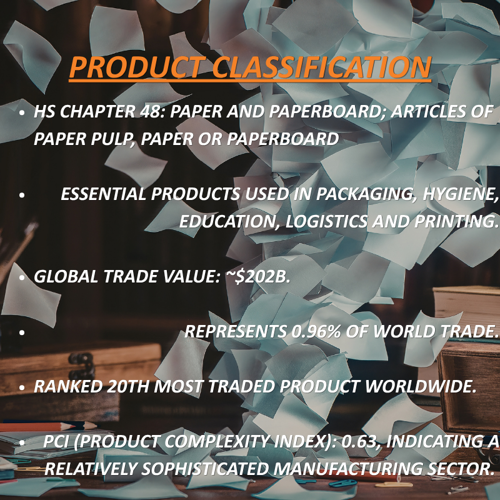
Paper articles are among the most essential products supporting modern economies and everyday life. From packaging and printing materials to hygiene products, notebooks, labels, and industrial paper solutions, these goods are deeply integrated into global supply chains. Despite the rapid rise of digital technologies, paper-based products remain indispensable for commerce, logistics, education, healthcare, and food distribution.
From a trade perspective, paper articles belong to the Paper Goods sector and are classified under HS Chapter 48: Paper and paperboard; articles of paper pulp, paper or paperboard. This category includes a wide range of products such as paper containers, toilet paper, coated paper, cellulose fiber paper, notebooks, and other converted paper products.
Paper articles represent one of the largest segments of the global paper industry, generating approximately $202B in international trade and accounting for around 0.96% of total world trade. Among the products tracked by the Harmonized System, paper articles rank among the world's most traded industrial goods.
Although paper products are often perceived as mature and traditional commodities, they display a relatively solid level of sophistication. According to the Product Complexity Index (PCI), paper articles score approximately 0.63, ranking among the more complex products within the global manufacturing landscape. This reflects the advanced industrial processes, specialized machinery, quality standards, and logistics networks required to produce and distribute them efficiently.
A significant share of demand is driven by packaging applications, particularly due to the expansion of e-commerce, food delivery services, and sustainability initiatives encouraging the replacement of plastic packaging with recyclable paper-based alternatives. These long-term trends continue to strengthen the strategic importance of paper articles in global trade.
EXPORT
The global export market for paper articles is dominated by highly industrialized economies with advanced manufacturing capabilities, well-developed forestry sectors, and efficient transportation networks.
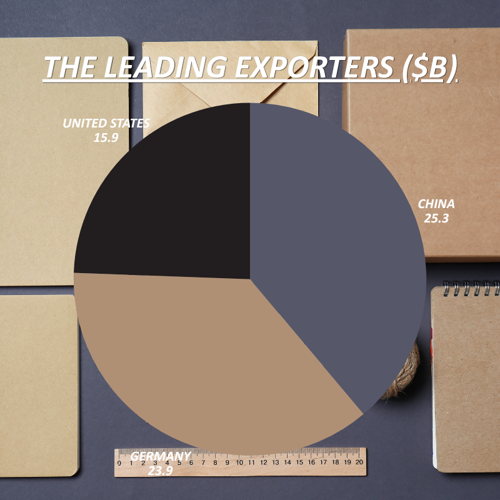
The leading exporters are:
• China: approximately $25.3B, representing about 12.5% of global exports.
• Germany: approximately $23.9B, equal to around 11.8% of world exports.
• United States: approximately $15.9B, accounting for roughly 7.9% of global trade.
China's leadership is supported by its massive industrial base, diverse paper manufacturing sector, and strong position in packaging materials. Germany benefits from advanced industrial production and a central role within European trade networks, while the United States combines abundant raw materials with a highly developed paper-processing industry.
Other important exporters include:
• Sweden: approximately $9.82B.
• Italy: approximately $8.56B.
Countries recording the largest trade surpluses include:
• China: +$16.8B
• Germany: +$8.84B
• Sweden: +$7.94B
• Finland: +$7.31B
• Indonesia: +$3.21B
These surpluses highlight the competitiveness of nations combining strong domestic production, access to raw materials, technological know-how, and efficient export infrastructure.
IMPORT
Demand for paper articles is widespread across both developed and emerging economies, reflecting the universal use of packaging, printed materials, tissue products, and industrial paper applications.
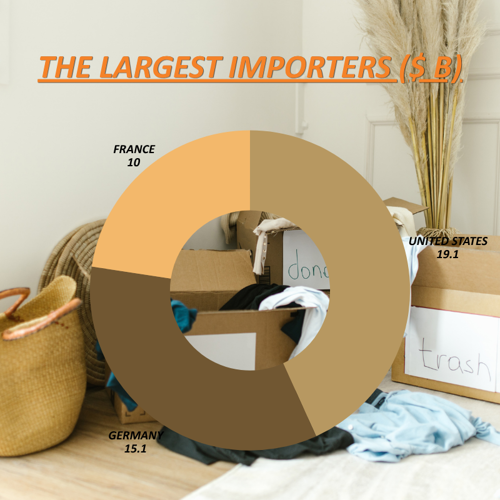
The largest importers are:
• United States: approximately $19.1B, representing about 9.5% of global imports.
• Germany: approximately $15.1B, or roughly 7.5% of world imports.
• France: approximately $10B, corresponding to nearly 5% of global demand.
Additional major importing markets include:
• China: approximately $8.5B
• United Kingdom: approximately $8.17B
These countries maintain strong import volumes due to large consumer markets, diversified manufacturing sectors, and sustained demand for packaging and paper-based consumer goods.
The largest trade deficits are recorded by:
• United Kingdom: −$5.25B
• Mexico: −$3.7B
• United States: −$3.18B
• France: −$3.05B
• Australia: −$2.03B
Such deficits illustrate the dependence of major consumer economies on imported paper products to complement domestic production and meet internal demand.
CURIOSITY CORNER: THE PAPER INDUSTRY THAT POWERS MODERN LIFE
Paper articles are so common that they often go unnoticed, yet they are among the foundations of modern commerce. Every day, billions of paper-based items move through global supply chains, from shipping boxes and food packaging to receipts, books, labels, tissues, and office supplies.
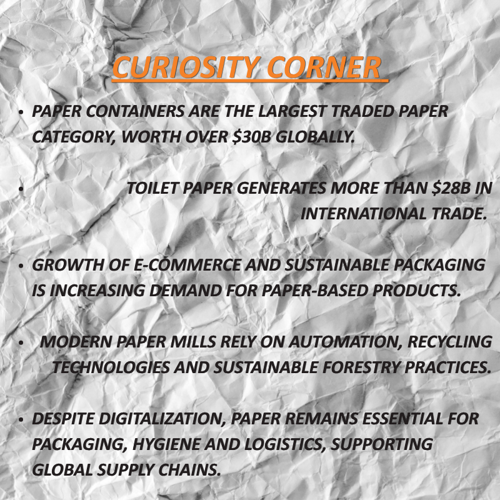
One of the fastest-growing segments of the industry is paper packaging. As governments, businesses, and consumers seek alternatives to single-use plastics, paper containers and recyclable cardboard solutions have become increasingly important. In fact, paper containers are the most traded category within paper articles, generating more than $30B in global trade.
Another surprising fact is that toilet paper is one of the world's most valuable traded paper products, accounting for more than $28B in international trade. The category gained worldwide attention during the pandemic, when sudden spikes in demand exposed the importance of resilient supply chains.
Despite increasing digitalization, paper consumption remains remarkably resilient. While demand for certain printing products has declined, growth in e-commerce packaging, food delivery, hygiene products, and sustainable materials continues to create new opportunities for the industry.
Finally, modern paper manufacturing is highly technological. Advanced mills use sophisticated automation systems, quality-control technologies, recycling processes, and sustainable forestry management practices, making paper production far more complex than many consumers realize.
CONCLUSION
Paper articles remain a cornerstone of global trade and industrial activity. Their importance extends far beyond traditional printing applications, supporting packaging, logistics, hygiene, education, and countless everyday activities.
Led by major exporting nations such as China, Germany, and the United States, the sector benefits from a combination of manufacturing expertise, technological innovation, and extensive distribution networks. Meanwhile, large consumer markets including the United States, Germany, France, and the United Kingdom continue to drive strong import demand.
With growing emphasis on sustainability, recyclable materials, and eco-friendly packaging solutions, paper articles are well positioned to maintain their relevance in the coming years. Although often viewed as a mature industry, the sector continues to evolve, demonstrating how traditional products can remain vital within an increasingly modern and interconnected global economy.
