OVERVIEW
Despite being one of Africa’s smallest economies, Burundi presents a fascinating case study of resilience, agricultural specialization, and untapped trade potential. Located in the heart of East Africa, the country relies heavily on agriculture, which remains the backbone of employment, exports, and rural livelihoods. Coffee and tea have long shaped Burundi’s presence in international markets, while minerals have increasingly contributed to export revenues.
With a GDP of approximately $3.1 billion, Burundi ranks among the world's lower-income economies, yet its strategic position within the East African region offers opportunities for greater trade integration and economic diversification. The country's trade profile reflects an economy that remains strongly dependent on a limited number of export products while requiring substantial imports to support domestic consumption and development.
What makes Burundi particularly interesting is the contrast between its rich agricultural potential and the challenges of building a more diversified industrial base. As regional connectivity improves and investment opportunities expand, the country’s long-term growth prospects remain closely tied to its ability to add value to primary commodities and reduce reliance on imported goods.
ECONOMIC PROFILE AND COMPLEXITY
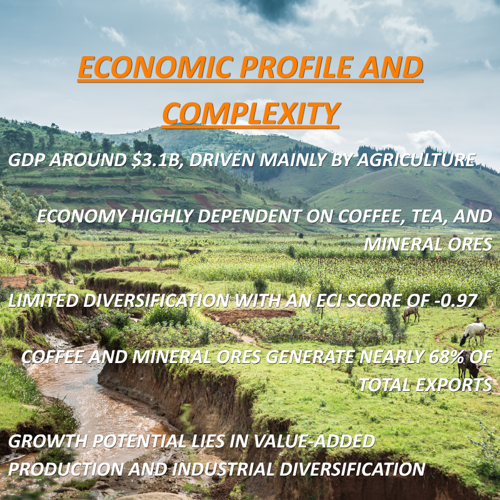
Burundi’s economy is characterized by a high concentration in primary commodities. Agriculture accounts for the majority of economic activity, with coffee and tea remaining the country's most recognizable exports. Mineral products, particularly tantalum, niobium, zirconium, and tin ores, have also gained importance in recent years.
According to the Observatory of Economic Complexity (OEC), Burundi ranks among the least economically diversified countries globally, with an Economic Complexity Index (ECI) score of approximately-0.97, placing it near the lower end of international rankings.
This limited diversification means that fluctuations in commodity prices, agricultural yields, or external demand can have a significant impact on national export earnings. At the same time, it highlights an opportunity: even modest expansion into processing industries, manufacturing, or higher-value agricultural products could deliver meaningful economic gains.
The country's export basket remains heavily concentrated, indicating both dependence and specialization. While this concentration creates vulnerabilities, it also provides a clear roadmap for future development through value-added production and broader participation in regional and global supply chains.
EXPORTS
Burundi's exports are strongly centered on agricultural and mineral commodities. Total merchandise exports amount to roughly $68.2 million.
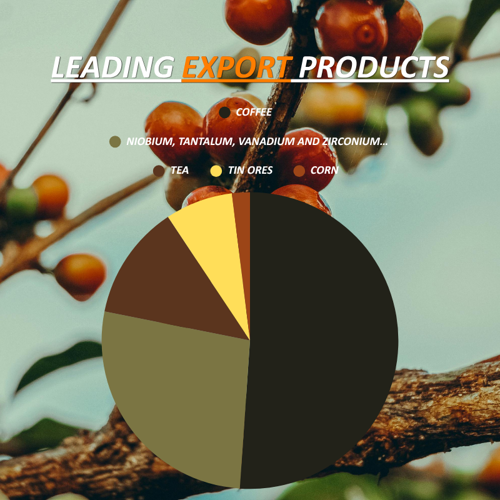
The leading export products are:
• Coffee: $30.3 million, representing approximately 44.4% of total exports.
• Niobium, Tantalum, Vanadium and Zirconium Ores: $16.0 million, around 23.5% of exports.
• Tea: $7.43 million, approximately 10.9%.
• Tin Ores: $4.38 million, about 6.4%.
• Corn: $1.15 million, close to 1.7%.
Together, coffee and mineral ores account for nearly 68% of Burundi’s export value, underlining the country's reliance on a narrow group of products.
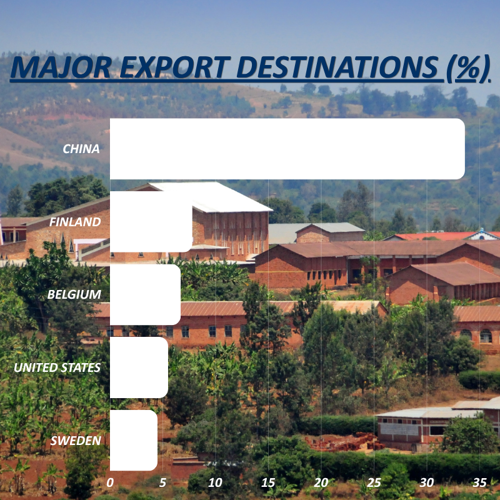
Export destinations are similarly concentrated. Major markets include:
• China: $22.9 million, roughly 33.6% of exports.
• Finland: $5.33 million, around 7.8%.
• Belgium: $4.57 million, approximately 6.7%.
• United States: $3.78 million, about 5.5%.
• Sweden: $3.04 million, nearly 4.5%.
The dominance of China reflects strong demand for Burundi’s mineral resources, while European markets continue to play an important role in absorbing coffee and tea exports.
IMPORTS
While Burundi’s exports are concentrated in a small number of agricultural and mineral products, its import profile is far more diversified. The country depends heavily on foreign markets to meet domestic demand for consumer goods, industrial inputs, machinery, fuel, and essential commodities. This reliance highlights both the limitations of local production and the importance of international trade in supporting economic activity.
Total imports amount to approximately $484 million, vastly exceeding export revenues and underlining Burundi’s dependence on external suppliers. Imports are more than seven times larger than exports, illustrating the country's need for products that are not produced domestically or are available only in limited quantities.
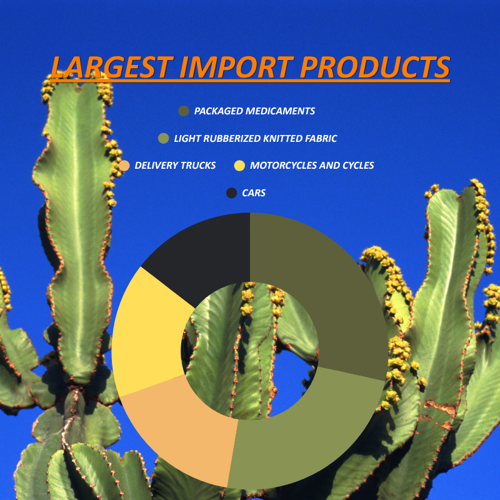
The largest imported products include:
• Packaged Medicaments: $28.6M (5.9% of total imports)
• Light Rubberized Knitted Fabric: $24.2M (5.0%)
• Delivery Trucks: $16.8M (3.5%)
• Motorcycles and Cycles: $15.9M (3.3%)
• Cars: $14.4M (3.0%)
Together, these five categories account for roughly 20.7% of Burundi’s total imports, demonstrating strong demand for healthcare products, transportation equipment, and manufactured goods.
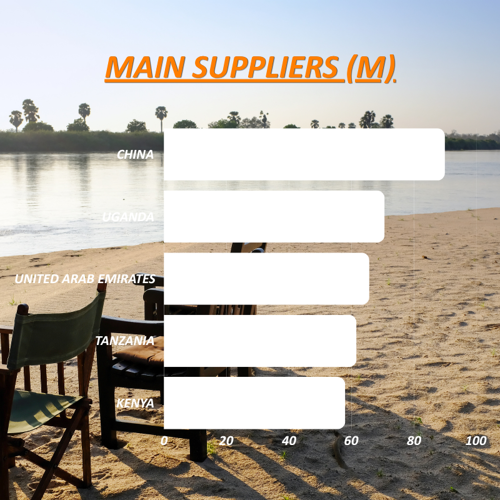
Burundi sources its imports primarily from regional and international trade partners. The main suppliers are:
• China: $89.8M (18.6% of total imports)
• Uganda: $70.6M (14.6%)
• United Arab Emirates: $65.7M (13.6%)
• Tanzania: $61.6M (12.7%)
• Kenya: $58.0M (12.0%)
These five countries alone provide approximately 71.5% of all goods imported into Burundi, reflecting the strategic importance of both regional trade networks and global manufacturing hubs.
The prominence of China as Burundi’s leading supplier highlights the country's dependence on imported manufactured products, machinery, and consumer goods. At the same time, neighboring Uganda, Tanzania, and Kenya play a critical role in facilitating trade flows across East Africa, serving as key gateways for goods entering the Burundian market.
From a business perspective, Burundi's import structure reveals significant opportunities in sectors such as healthcare, transportation, consumer products, industrial equipment, and infrastructure development. The continued reliance on external suppliers also suggests considerable potential for local production and import substitution initiatives in the years ahead.
TRADE BALANCE
One of the most striking aspects of Burundi’s trade profile is its substantial trade deficit.
With exports valued at approximately $68.2 million and imports reaching $484 million, the country records a trade deficit of roughly $415.8 million.
This means imports are equivalent to about 710% of export value, highlighting the structural gap between domestic production and national demand.
Burundi records its strongest positive trade balances with:
• Finland: +$4.74 million
• Sweden: +$2.55 million
• Malaysia: +$2.52 million
• Pakistan: +$2.36 million
Meanwhile, its largest trade deficits are with:
• Uganda:-$70.5 million
• China:-$66.8 million
• Tanzania:-$60.5 million
• Kenya:-$56.1 million
• Belgium:-$31.3 million
These figures emphasize the importance of regional suppliers and major international trading partners in meeting Burundi’s domestic needs.
CURIOSITY CORNER
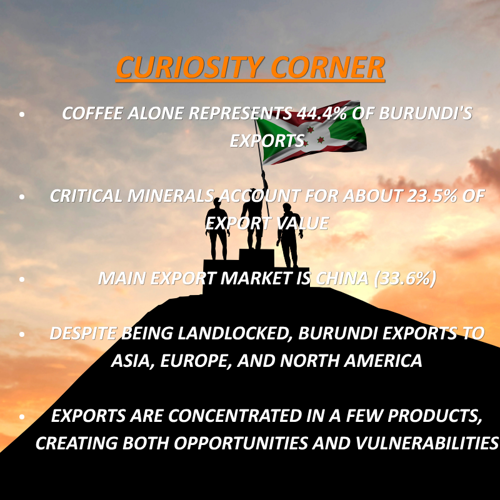
One of the most surprising facts about Burundi is how dominant coffee remains within its export economy. Despite representing a relatively small share of global coffee production, coffee alone generates nearly 45% of the country's export earnings.
Another interesting feature is the growing importance of critical minerals. Ores containing tantalum, niobium, and zirconium, materials widely used in electronics and advanced technologies, account for almost one-quarter of national exports. This gives Burundi a connection to global industries ranging from smartphones to aerospace manufacturing.
Burundi also illustrates how geography does not necessarily restrict global market reach. Products leaving this landlocked nation ultimately find their way to customers in Asia, Europe, and North America, demonstrating the increasingly interconnected nature of international trade.
CONCLUSION
Burundi's market is defined by a combination of agricultural tradition, mineral resources, and significant development potential. While the country faces challenges related to economic diversification and a persistent trade deficit, it also possesses valuable export strengths that offer a foundation for future growth.
Coffee, tea, and strategic minerals continue to drive export performance, while strong trade relationships with China, Europe, and regional partners help connect Burundi to the global economy. Looking ahead, investments in value-added industries, infrastructure, and export diversification could play a key role in transforming the country's economic landscape.
For businesses, investors, and trade professionals, Burundi represents a market where opportunities are closely tied to agriculture, natural resources, and the gradual evolution of a more diversified economic structure.
