
OVERVIEW
Turkey occupies one of the most strategically important positions in global trade. Located at the crossroads of Europe, Asia, and the Middle East, the country has evolved into a major manufacturing, logistics, and commercial hub that serves multiple regions simultaneously. With a GDP exceeding $1.3 trillion and total exports reaching approximately $270 billion, Turkey is one of the world's largest economies and an increasingly important player in international supply chains.
Its unique geographical position has helped Turkey become a natural bridge between developed European markets and fast-growing economies across the Middle East, Central Asia, and North Africa. Combined with a diversified industrial base, a large domestic market, and significant investments in infrastructure, the country has built an economy capable of competing across a broad range of sectors.
Today, Turkey's success is driven not only by its location, but also by its ability to transform imported raw materials and components into competitive, value-added products that are exported around the world.
ECONOMIC PROFILE AND COMPLEXITY
Unlike economies that rely heavily on a single industry, Turkey benefits from a balanced economic structure that combines manufacturing, services, agriculture, construction, and trade. This diversification has been a key factor behind its resilience and long-term growth.
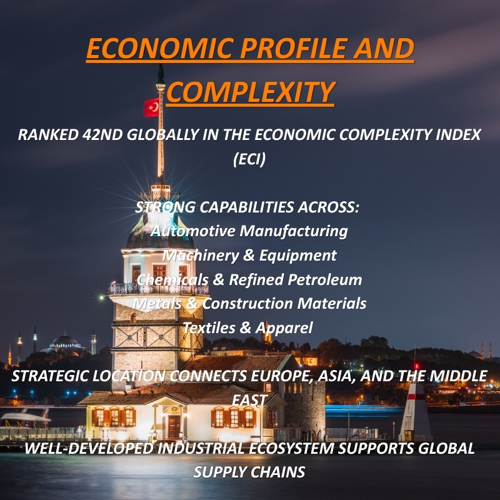
According to the Observatory of Economic Complexity (OEC), Turkey ranks as the world's 42nd most complex economy, a position that reflects its ability to manufacture and export a wide range of sophisticated products requiring advanced industrial capabilities, skilled labor, and integrated supply chains.
Several industries contribute to this complexity:
• Automotive manufacturing
• Machinery and industrial equipment
• Chemicals and refined petroleum products
• Textiles and apparel
• Metals and construction materials
• Consumer goods and Electronics
The country's industrial ecosystem allows businesses to source components, manufacture products, and distribute goods efficiently to international markets. As a result, Turkey has become an important production hub for global manufacturers seeking access to both European and regional markets.
EXPORTS
Turkey's export sector is one of the primary engines of the national economy. Total exports amount to approximately $270 billion, placing the country among the world's leading exporting nations. Export growth has been supported by strong industrial production, diversified manufacturing capabilities, and access to multiple international markets.
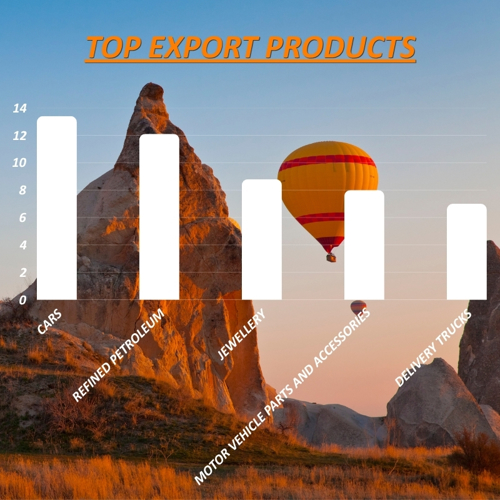
The composition of exports demonstrates the country's transition toward higher-value industrial production. Cars represent approximately 5% of total exports, making them Turkey's largest export product. Refined petroleum products account for around 4.5%, followed by jewellery at 3.3%, motor vehicle parts and accessories at 3%, and delivery trucks at 2.7% of total exports. The remaining share is spread across a broad range of products, highlighting the diversity of Turkey's export portfolio.
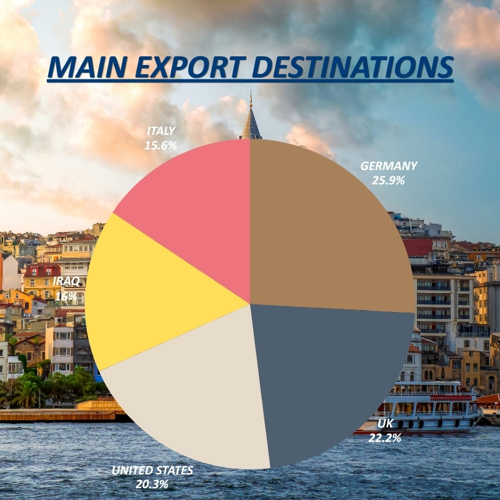
Turkey's export destinations are equally diversified. Germany remains the country's largest foreign market, absorbing approximately 7.9% of total exports. The United Kingdom follows with about 6.5%, while the United States accounts for roughly 6.1%. Iraq and Italy remain key partners, representing approximately 4.8% and 4.7% respectively. Together, these markets illustrate Turkey's ability to combine strong European trade relationships with expanding commercial ties across North America and the Middle East.
Beyond large-scale manufacturing, Turkey also maintains global leadership in several specialized sectors. The country is the world's largest exporter of hand-woven rugs and holds leading positions in products such as wheat flour, borates, raw iron bars, and natural stones including marble and travertine. These sectors continue to reinforce Turkey's reputation as both a modern industrial economy and a country with deep-rooted manufacturing traditions.
IMPORTS
Turkey's industrial strength is supported by significant imports of energy, machinery, raw materials, and intermediate goods. Total imports amount to approximately $313 billion, reflecting the needs of a large manufacturing economy deeply integrated into global value chains.
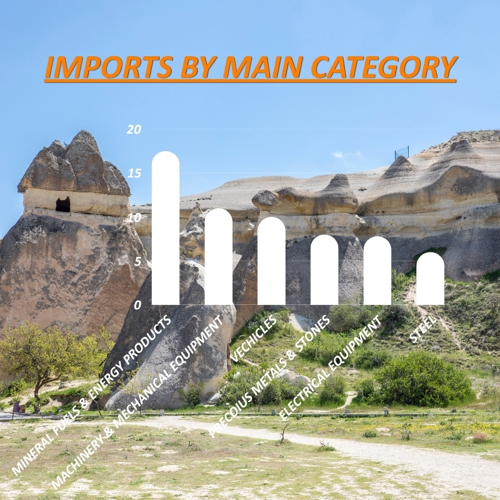
Energy products remain the largest import category, accounting for around 17.5% of total imports. Machinery and mechanical equipment represent approximately 11.1%, while vehicles account for 9.8%. Precious metals and stones contribute nearly 8%, electrical equipment approximately 7.8%, and steel around 6.2%. These figures highlight Turkey's dependence on imported industrial inputs that are later transformed into finished products and re-exported to international markets.
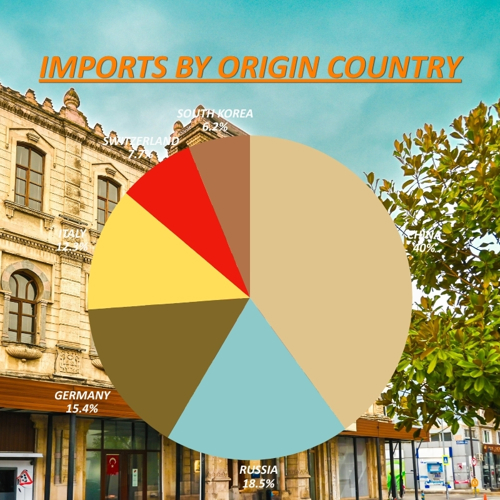
Looking at the main suppliers, China stands out as Turkey's largest source of imports, accounting for approximately 13% of total inbound trade. Russia follows with about 5.6%, largely driven by energy imports. Germany contributes roughly 4.8%, while Italy supplies around 3.9%. Switzerland and South Korea account for approximately 2.5% and 2.4% respectively, reflecting their importance in sectors such as technology, chemicals, machinery, and precious metals.
This import profile demonstrates that Turkey operates not merely as a consumer market but as an industrial transformation hub, importing strategic inputs and converting them into higher-value exports for global markets.
TRADE BALANCE
Turkey's trade balance highlights both the opportunities and challenges of a rapidly growing industrial economy.
With exports totaling approximately $270 billion and imports reaching around $313 billion, the country operates with a merchandise trade deficit of roughly $43 billion.
However, a closer examination reveals important differences across trading partners. Turkey records its strongest trade surpluses with Iraq and the United Kingdom, showcasing the competitiveness of Turkish products in regional and European markets. Romania, Greece, and the Netherlands also generate positive trade balances for Turkey.
Conversely, the country experiences substantial trade deficits with China, Russia, South Korea, Switzerland, and Italy, reflecting its reliance on imported energy, machinery, advanced technology, and industrial inputs.
Rather than indicating weakness, this pattern reflects a common characteristic of advanced manufacturing economies: importing strategic resources and components while exporting finished goods with greater added value.
Turkey's ability to participate effectively in this cycle remains one of its strongest competitive advantages.
CURIOSITY CORNER
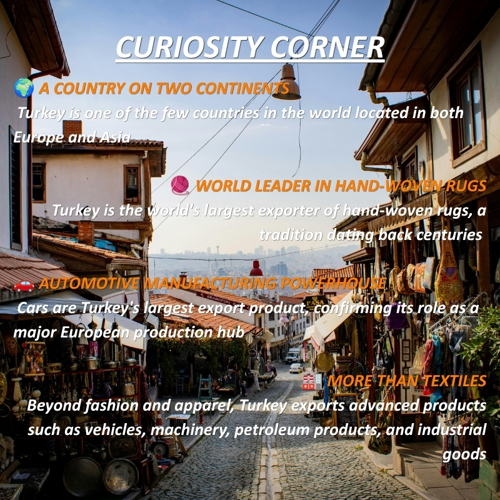
A Nation on Two Continents
Turkey is one of the few countries in the world that physically spans two continents. This unique position has shaped its history, culture, and economic development for centuries, making it a natural gateway between Europe and Asia.
The World's Largest Exporter of Hand-Woven Rugs
While Turkey is often recognized for its modern industrial sectors, it also remains the global leader in hand-woven rug exports. This reflects the country's ability to combine traditional craftsmanship with international commercial success.
An Automotive Giant Few People Talk About
Many people associate Turkey with tourism, yet the automotive industry represents one of the country's most powerful export engines. Cars, vehicle parts, and commercial vehicles collectively account for a significant share of Turkish exports and place the country among Europe's key manufacturing centers.
More Than Textiles
Although Turkish textiles enjoy worldwide recognition, they represent only part of a much broader industrial story. Refining, machinery, chemicals, metals, logistics, and automotive manufacturing have all become pillars of Turkey's international competitiveness.
CONCLUSION
Turkey has successfully established itself as one of the most strategically positioned and economically diversified countries in global trade. Combining a strong manufacturing base, sophisticated industrial capabilities, and unparalleled geographic access to major international markets, the country continues to strengthen its role as a regional and global commercial hub.
Its trade model is particularly effective: Turkey imports energy, machinery, and strategic industrial inputs, transforms them through an advanced manufacturing ecosystem, and exports competitive finished products across Europe, North America, the Middle East, and beyond. This combination of industrial complexity, logistical advantages, and diversified trade relationships provides a solid foundation for continued international relevance.
For businesses seeking opportunities in manufacturing, distribution, sourcing, or market expansion, Turkey represents far more than a regional economy. It stands as a critical gateway connecting continents, supply chains, and industries on a global scale.