PRODUCT CLASSIFICATION
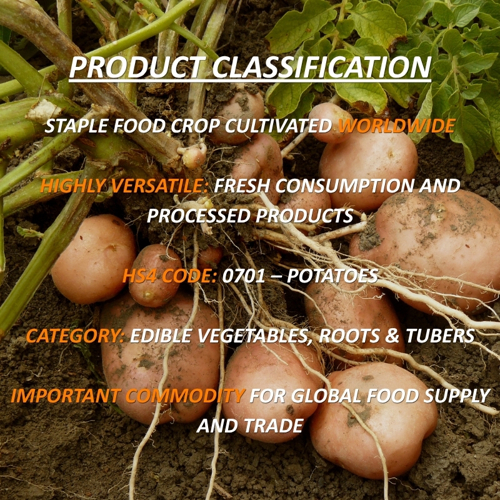
Potatoes are one of the most important food crops in the world and a cornerstone of global food security. Cultivated across every inhabited continent, they are valued for their versatility, affordability, high yields, and nutritional benefits. From fresh consumption to processed products such as fries, chips, starches, and flakes, potatoes are deeply embedded in modern food systems and international supply chains.
From a trade perspective, potatoes belong to the Vegetable Products sector and are classified under HS Chapter 07: Edible vegetables, roots & tubers, specifically within HS4 0701 – Potatoes. This category includes both fresh potatoes for consumption and seed potatoes used in agricultural production.
Although potatoes are considered a low-complexity agricultural product, they generate substantial trade volumes worldwide due to their widespread consumption and their strategic importance for both food security and food-processing industries. According to the Product Complexity Index (PCI), potatoes score approximately-0.75, reflecting their relatively simple production process compared to more technologically advanced goods.
Among the thousands of products traded internationally, potatoes maintain a significant position thanks to their role as a staple food and as a key raw material for numerous value-added food products.
EXPORT
International potato exports are dominated by a group of highly productive agricultural economies, particularly in Europe.
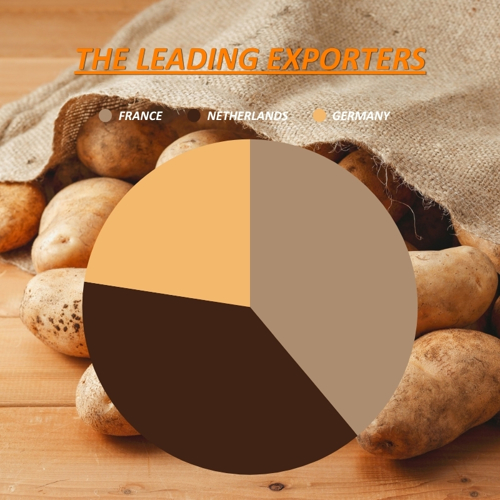
The leading exporters are:
• France – approximately 19.8% of global potato exports
• Netherlands – approximately 19.8%
• Germany – approximately 11.6%
Together, France and the Netherlands account for nearly 40% of worldwide potato exports, highlighting the strategic importance of Northwestern Europe in the global potato market.
France benefits from extensive agricultural land, favorable growing conditions, and strong integration with European food industries. The Netherlands combines efficient production with world-class logistics infrastructure and is also a global leader in seed potato exports. Germany complements this leadership position through large-scale cultivation and its central role within European distribution networks.
Other major exporters include:
• Canada – 5.8%
• Egypt – 5.8%
• Belgium – 4.9%
• United States – 4.8%
• China – 3.4%
• United Kingdom – 3.3%
• Spain – 3.2%
These figures demonstrate how potato production and exports are concentrated in countries that combine strong agricultural capabilities with efficient storage, transportation, and distribution systems.
IMPORT
Potato imports are concentrated in a relatively small group of countries, many of which are also leading players in potato processing and food manufacturing. International trade is driven not only by consumer demand but also by the need to supply large-scale industries producing frozen fries, chips, starches, and other value-added products.
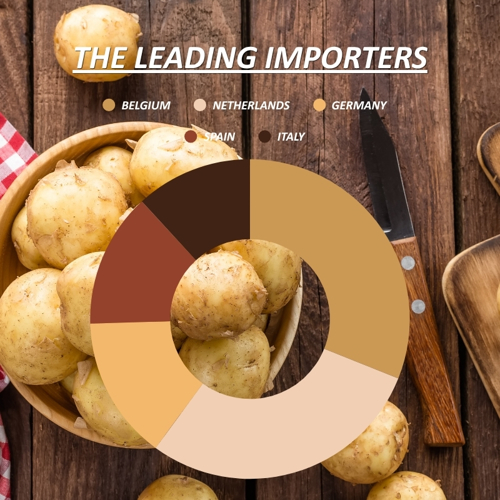
The leading importers are:
• Belgium – approximately 10.5% of global potato imports
• Netherlands – approximately 9.8%
• Germany – approximately 4.9%
• Spain – approximately 4.6%
• Italy – approximately 4.0%
Together, these five countries represent roughly 34% of worldwide potato imports, underlining Europe's dominant role in global potato trade.
Belgium presents one of the most interesting examples of modern agricultural trade. Despite being among the world's leading exporters, it also imports large quantities of potatoes to feed its globally renowned processing industry, particularly for the production of frozen french fries.
The Netherlands follows a similar model, acting simultaneously as a major producer, importer, processor, and re-exporter. Germany, Spain, and Italy import potatoes to complement domestic production, cover seasonal gaps, and satisfy the demand of both retail consumers and industrial processors.
These trade patterns show how today's potato market is increasingly shaped by integrated supply chains, where production, processing, packaging, and final consumption often take place in different countries.
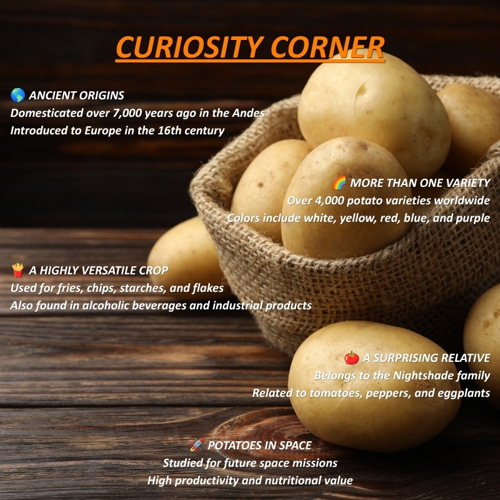
CURIOSITY CORNER: THE HIDDEN STORY BEHIND POTATOES
Few crops have had as much influence on human history as the potato.
Originally domesticated in the Andes Mountains of present-day Peru and Bolivia more than 7,000 years ago, potatoes were introduced to Europe during the 16th century and eventually transformed agriculture across the continent. Their ability to provide high yields on relatively small areas of land helped support population growth and improve food availability in many regions.
Today, there are more than 4,000 known potato varieties, ranging from traditional white and yellow potatoes to striking red, blue, and purple cultivars. The crop's remarkable adaptability has allowed it to thrive in climates ranging from high-altitude mountain regions to temperate agricultural plains.
Potatoes are also surprisingly versatile. Beyond fresh consumption, they are used to produce fries, chips, dehydrated flakes, starches, alcoholic beverages, industrial ingredients, and even biodegradable materials. Their importance extends far beyond the dinner table.
Another fascinating fact is that potatoes belong to the nightshade family, making them close relatives of tomatoes, peppers, and eggplants. Yet unlike their relatives, the edible part of the potato is an underground tuber that stores nutrients for the plant's growth cycle.
The potato has even played a role in space research. Scientists have long considered it a promising crop for future space missions due to its productivity, nutritional value, and relatively efficient use of resources.
CONCLUSION
The global potato trade demonstrates how a seemingly simple agricultural product can sustain a sophisticated and highly interconnected international market. Led by exporters such as France, the Netherlands, and Germany, the sector relies on efficient logistics, modern storage systems, and strong food-processing industries. Together, France and the Netherlands account for almost 40% of global exports, confirming their dominant position in the market.
On the import side, countries such as Belgium, the Netherlands, Germany, Spain, and Italy highlight the growing importance of integrated supply chains in which production, processing, and consumption are often separated geographically. These five countries alone account for around 34% of global imports, emphasizing Europe's central role in the international potato economy
Despite its relatively low product complexity, the potato remains one of the world's most essential agricultural commodities. Its versatility, affordability, and importance to both consumers and food industries ensure that it will continue to play a vital role in global trade for years to come.