PRODUCT CLASSIFICATION
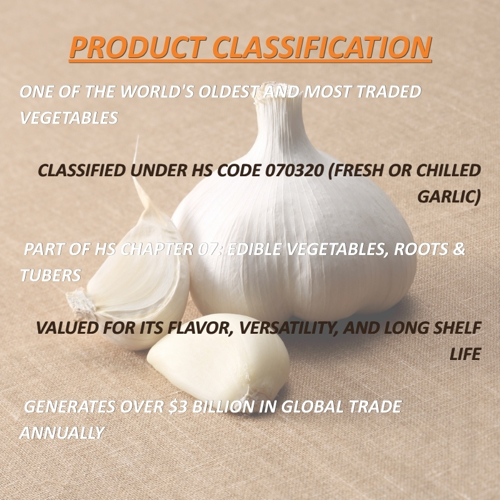
Garlic is one of the world’s most ancient and widely traded agricultural products. Valued for its distinctive flavor, medicinal reputation, and versatility in both fresh and processed foods, garlic is a staple ingredient across countless cuisines. Beyond its culinary role, garlic is also associated with health-conscious consumer trends due to its natural antioxidant compounds and traditional use in herbal remedies.
From a trade perspective, garlic belongs to the Vegetable Products category and is classified under HS Code 070320: Garlic, fresh or chilled, within HS Chapter 07 (Edible vegetables, roots and tubers). Like onions and shallots, garlic is considered a low-complexity agricultural commodity, yet it represents a significant segment of international fresh produce trade thanks to its universal demand and relatively long storage life.
Global trade in fresh and chilled garlic exceeds $3 billion annually, making it one of the most valuable vegetable commodities traded worldwide. Despite its simplicity as an agricultural product, garlic benefits from highly specialized international supply chains connecting major producing regions with consumer markets across Asia, Europe, North America, and the Middle East.
EXPORT
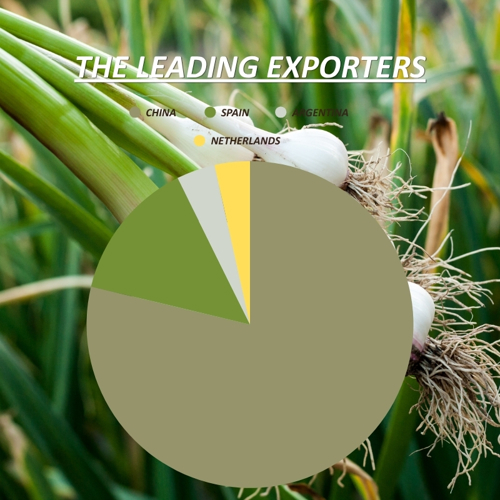
The global garlic export market is highly concentrated, with a small number of countries accounting for the majority of worldwide shipments.
The leading exporters are:
• China: ap
proximately 70% of global garlic exports
• Spain: approximately 12.4%
• Argentina: approximately 3.4%
• Netherlands: approximately 3.1%
• Mexico: approximately 1.2%
China's dominance is unparalleled. The country benefits from massive production volumes, favorable growing conditions, competitive labor costs, and well-established export networks. Chinese garlic reaches virtually every major consuming market and serves as the benchmark supplier for the global industry.
Spain has established itself as the leading exporter within Europe, supplying premium-quality garlic to EU member states and international buyers. Argentina plays a strategic role by serving markets during seasonal gaps in Northern Hemisphere production, while the Netherlands functions as a major redistribution hub thanks to its advanced logistics infrastructure.
Countries where garlic represents a particularly meaningful share of total exports include:
• Argentina: around 0.17% of total national exports
• Spain: around 0.10%
• Egypt: around 0.09%
These percentages illustrate the importance of garlic as a specialized export crop for several agricultural economies.
For chart purposes, the approximate global export share distribution is:
• China: 70%
• Spain: 12.4%
• Argentina: 3.4%
• Netherlands: 3.1%
• Mexico: 1.2%
• Rest of the world: 9.9%
IMPORT
Demand for imported garlic is concentrated in populous countries where domestic production is insufficient to satisfy consumption needs throughout the year.
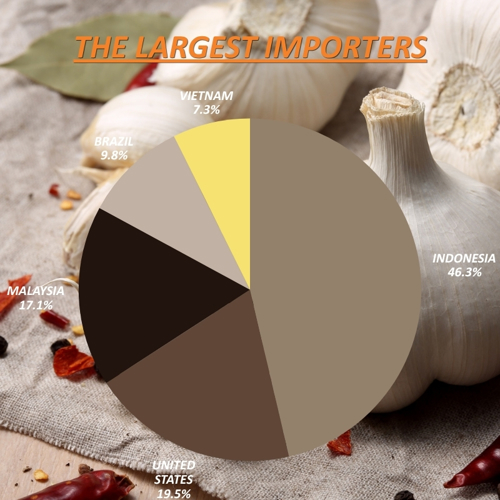
The largest importers are:
• Indonesia: about 19% of global imports
• United States: about 8%
• Malaysia: about 7%
• Brazil: about 4%
• Vietnam: about 3%
Indonesia stands out as the world's largest garlic importer. Domestic production covers only a fraction of national demand, making the country heavily dependent on international suppliers, particularly China.
The United States imports significant volumes despite maintaining domestic production. Imports help ensure stable year-round availability and satisfy consumer demand for different varieties and price segments. Malaysia and Vietnam similarly rely on imports to support both household consumption and food-processing industries.
For graphical analysis, the approximate share of global imports can be represented as follows:
• Indonesia: 19%
• United States: 8%
• Malaysia: 7%
• Brazil: 4%
• Vietnam: 3%
• Rest of the world: 59%
CURIOSITY CORNER: THE HIDDEN STORY BEHIND GARLIC
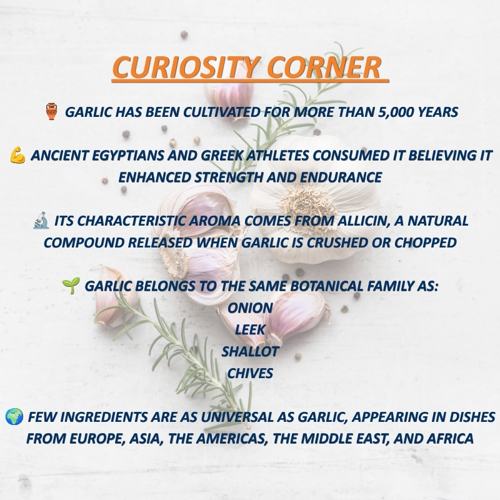
Garlic has accompanied human civilization for thousands of years. Ancient Egyptians, Greeks, Romans, Indians, and Chinese cultures all cultivated and consumed garlic long before the modern global trade system existed.
Historically, garlic was valued not only as food but also as a symbol of strength and protection. Ancient laborers building the Egyptian pyramids were reportedly given garlic as part of their diet, while Greek athletes consumed it before competitions believing it would enhance performance.
One of garlic’s most remarkable characteristics is its natural sulfur compounds, particularly allicin, which is released when cloves are crushed or chopped. This compound is responsible for garlic’s unmistakable aroma and many of the health benefits often associated with the vegetable.
Another fascinating fact is that garlic belongs to the same botanical family as onions, leeks, shallots, and chives. Although commonly used as a seasoning, garlic is technically a vegetable and can be cultivated in a wide range of climates, from Mediterranean regions to parts of Asia and South America.
Perhaps most impressive of all is garlic’s global reach. Few agricultural products enjoy such universal consumption. Whether in Italian pasta, Chinese stir-fries, Indian curries, Middle Eastern sauces, or Latin American dishes, garlic has become one of the truly global ingredients of modern cuisine.
CONCLUSION
The international garlic market demonstrates how a relatively simple agricultural commodity can achieve enormous global significance. Supported by steady consumer demand, long-established production traditions, and efficient international supply chains, garlic remains one of the most traded vegetables in the world.
China continues to dominate exports with around 70% of global market share, while countries such as Spain, Argentina, and the Netherlands maintain important positions through quality production and strategic logistics. On the demand side, large importing nations including Indonesia, the United States, Malaysia, Brazil, and Vietnam highlight the widespread reliance on international garlic supplies.
As consumers continue to value natural flavors, healthy diets, and authentic culinary experiences, garlic is likely to remain a cornerstone of global agricultural trade, proving that even one of the oldest cultivated crops still plays a vital role in the modern economy.
Source: The Observatory of Economic Complexity