
OVERVIEW
Spain is one of Europe's most dynamic trading nations, combining a strategic geographic position with a highly diversified industrial base. Located at the crossroads of Europe, Africa, and the Atlantic trade routes, the country has evolved into a major international commercial hub, supported by modern infrastructure, competitive manufacturing, and strong integration within the European Single Market.
Today, Spain ranks among the world's leading exporters, shipping approximately $397 billion worth of goods annually while importing around $453 billion. Its commercial relationships extend across every continent, although Europe remains the core of its trade ecosystem.
What makes Spain particularly interesting is the diversity of its economic model. The country is globally recognized for sectors such as automotive manufacturing, pharmaceuticals, refined petroleum products, machinery, and premium agricultural goods, creating a balanced trade portfolio that helps strengthen resilience against market fluctuations.
ECONOMIC PROFILE AND COMPLEXITY
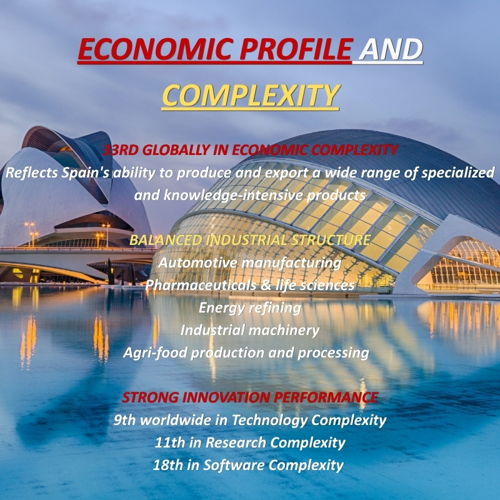
Spain is not simply a large economy; it is also a sophisticated one. According to the Observatory of Economic Complexity, Spain ranks 33rd globally in Economic Complexity, reflecting its ability to manufacture and export a broad range of advanced and specialized products.
Economic complexity is a useful indicator because it measures the knowledge and capabilities embedded within an economy. Countries with higher complexity rankings tend to produce goods that require advanced skills, industrial know-how, and innovation.
Spain's position is supported by a highly diversified production structure that combines:
• Advanced automotive manufacturing
• Pharmaceuticals and life sciences
• Energy refining and processing
• Industrial machinery and components
• Agricultural excellence and food processing
The country also performs strongly in technology, research, and software-related complexity rankings, demonstrating its ongoing transition toward higher-value sectors while maintaining competitiveness in traditional industries.
This combination of industrial depth and diversification makes Spain one of Europe's most versatile economies and an attractive destination for businesses seeking access to both manufacturing expertise and international markets.
EXPORTS
Spain exports approximately $397 billion worth of goods and ranks among the world's top exporting nations. The country's export success is built on a combination of industrial capabilities and globally recognized consumer products.
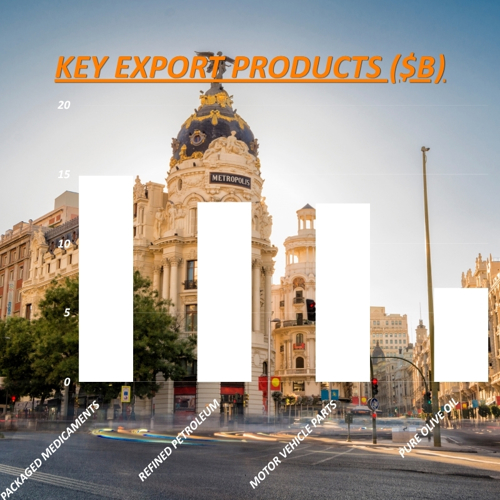
The automotive industry remains the cornerstone of Spanish exports. Cars account for $42.6 billion, representing approximately 10.7% of total exports. Spain is one of Europe's leading vehicle manufacturing centers, supplying both regional and international markets.
Other key export products include:
• Packaged Medicaments: $14.9B (3.8% of exports)
• Refined Petroleum: $13.0B (3.3%)
• Motor Vehicle Parts & Accessories: $12.9B (3.2%)
• Pure Olive Oil: $6.8B (1.7%)
One of the most striking aspects of Spain's export profile is the coexistence of advanced industrial exports with iconic agricultural products. Few countries manage to combine sophisticated manufacturing and global leadership in food products as effectively as Spain.
MAIN EXPORT DESTINATIONS
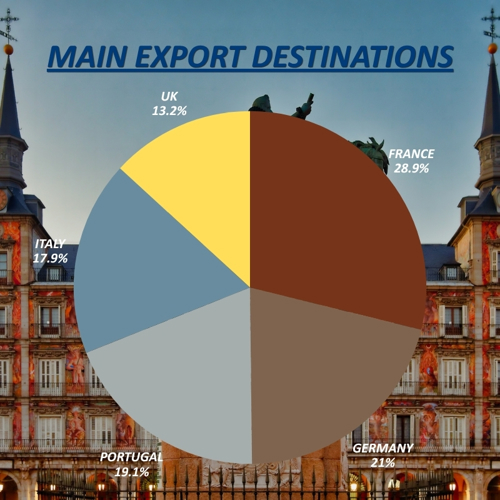
Spanish exports are heavily oriented toward Europe, where integrated supply chains and geographic proximity create strong commercial connections. The country's top export markets are:
• France: $55.6B (14.0% of total exports)
• Germany: $40.4B (10.2%)
• Portugal: $36.9B (9.3%)
• Italy: $34.4B (8.7%)
• United Kingdom: $25.4B (6.4%)
Together, these five markets account for nearly 49% of all Spanish exports, highlighting the country's deep integration within the European economic landscape.
For future visualizations, a compelling chart would show how close to half of Spain's exports are concentrated in just five European partner countries.
IMPORTS
As one of Europe's largest economies, Spain imports approximately $453 billion worth of goods every year. These imports support domestic consumption, industrial production, and participation in global manufacturing supply chains.
Spain's import structure is strongly influenced by energy requirements and industrial demand.
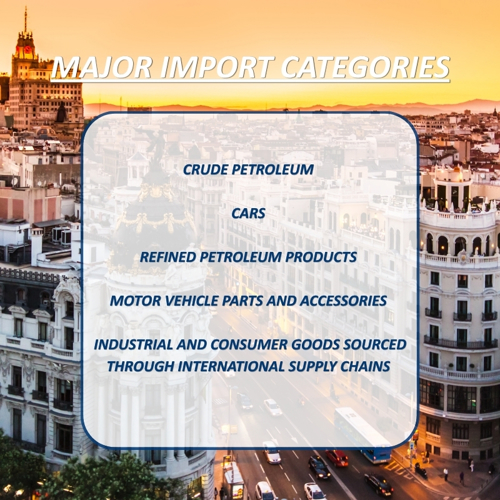
The country's major import categories include:
• Crude Petroleum (largest import category)
• Cars
• Refined Petroleum Products
• Motor Vehicle Parts and Accessories
• Industrial and consumer goods sourced through international supply chains
The prominence of both vehicle exports and vehicle imports illustrates Spain's central role in international automotive production networks, where components and finished products regularly cross borders before reaching consumers.
MAIN IMPORT PARTNERS
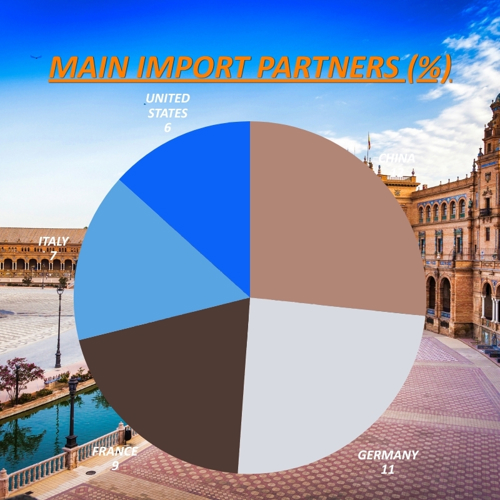
Spain sources goods from a mix of European partners and global manufacturing hubs:
• China: approximately 11-12% of total imports
• Germany: approximately 11%
• France: approximately 9%
• Italy: approximately 7%
• United States: approximately 6%
Collectively, these five suppliers account for roughly 45% of Spain's total imports, demonstrating the country's reliance on both regional European partners and global production centers.
China's position as Spain's largest supplier reflects the growing importance of Asian manufacturing in supporting European consumption and industrial activity.
TRADE BALANCE
Spain maintains an overall trade deficit, with imports exceeding exports. However, the aggregate figure tells only part of the story. A closer look reveals significant differences across trading partners.
Spain generates substantial trade surpluses with several key markets, particularly:
• Portugal: +$18.2B
• United Kingdom: +$14.5B
• France: +$12.8B
• Morocco: +$2.5B
• Panama: +$2.2B
Conversely, the country's largest trade deficits are recorded with:
• China: -$37.5B
• Germany: -$11.8B
• Netherlands: -$8.4B
• United States: -$7.3B
• Nigeria: -$6.1B
These figures highlight Spain's dual identity as both a highly competitive exporter within Europe and a major importer of energy resources and manufactured goods from global suppliers.
CURIOSITY CORNER
🚗 Spain Is an Automotive Giant
When people think of Spain, tourism, food, and sunny beaches often come to mind first. Yet cars represent the country's largest export category, generating more than $42 billion in international sales.
🫒 Olive Oil Is a Global Business
Spain's olive oil industry is not just a cultural symbol. With exports worth nearly $7 billion, the country remains one of the world's dominant players in the premium olive oil market.
🌍 Nearly Half of Exports Go to Five Countries
France, Germany, Portugal, Italy, and the United Kingdom together receive almost one out of every two dollars exported by Spain, demonstrating the importance of regional trade integration.
🏭 A Diversified Economy Means Greater Resilience
Unlike countries heavily dependent on a single industry, Spain's export mix spans automotive manufacturing, energy products, pharmaceuticals, machinery, and agriculture. This diversity helps reduce vulnerability to shocks affecting individual sectors.

CONCLUSION
Spain stands out as one of Europe's most diversified and strategically positioned trading nations. With nearly $400 billion in exports, a strong presence in advanced manufacturing, growing pharmaceutical capabilities, and internationally recognized agricultural products, the country has built a remarkably balanced economic model.
Its export strength is supported by deep commercial ties within Europe, where France, Germany, Portugal, Italy, and the United Kingdom absorb almost half of all Spanish exports. At the same time, Spain remains deeply connected to global supply chains through major import partners such as China and the United States.
For businesses evaluating international opportunities, Spain offers far more than access to a large domestic market. It serves as a gateway between continents, a sophisticated manufacturing hub, and a resilient economy whose trade performance is built on diversification, complexity, and strong international connectivity.