PRODUCT CLASSIFICATION
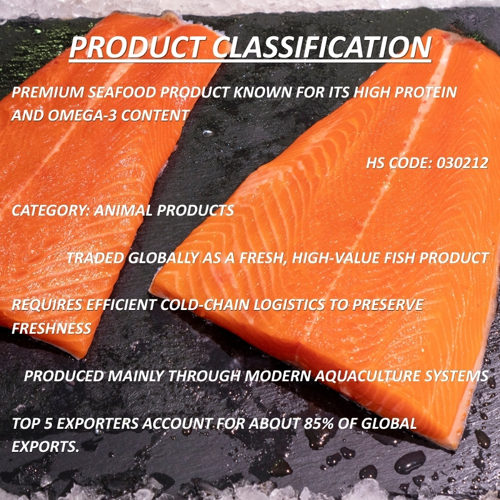
Fresh or chilled whole salmon is one of the most valuable seafood products traded internationally. Appreciated for its rich flavor, high protein content, and abundance of omega-3 fatty acids, salmon has evolved from a regional delicacy into a global staple across retail, foodservice, and premium dining channels. Its growing popularity is closely linked to consumer interest in healthy diets and high-quality sources of animal protein.
From a trade perspective, fresh/chilled whole salmon belongs to the Animal Products category and is classified under HS Code 030212, within the broader group of non-fillet fresh fish. Unlike many seafood products that are frozen before shipment, fresh salmon relies on highly sophisticated cold-chain logistics, making speed, freshness, and traceability critical competitive factors.
The international salmon market is characterized by a high degree of specialization and strong global demand. Production is concentrated in a limited number of countries with suitable environmental conditions and advanced aquaculture industries, while consumption has expanded rapidly across Europe, North America, and Asia.
EXPORT
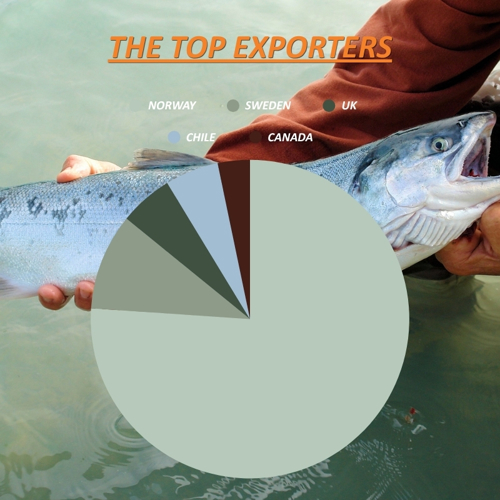
The global export market for fresh and chilled whole salmon is highly concentrated, with only a handful of countries supplying most of the world's demand.
The top exporters are:
• Norway: approximately 70% of global exports
• Sweden: approximately 9%
• United Kingdom: approximately 5%
• Chile: approximately 5%
• Canada: approximately 3%
Together, these five countries account for roughly 85% of worldwide salmon exports, highlighting the strategic importance of a small group of producer nations in the global seafood industry.
Norway dominates international trade thanks to its world-leading aquaculture sector, extensive coastline, strict quality standards, and highly efficient logistics network. Swedish exports benefit from the country's role as both a producer and a major distribution hub within Europe, while the United Kingdom, Chile, and Canada contribute significant volumes through well-established salmon farming industries.
From a regional perspective, Europe overwhelmingly leads global exports, representing approximately 88% of total export value. Latin America contributes around 6%, largely driven by Chile, while North America accounts for roughly 4%. Oceania represents about 2%, with Asia and Africa together contributing less than 1%.
These figures clearly illustrate how concentrated global salmon production remains despite the product's worldwide popularity.
IMPORT
On the demand side, salmon imports are considerably more diversified, reflecting the product's widespread popularity across international markets.
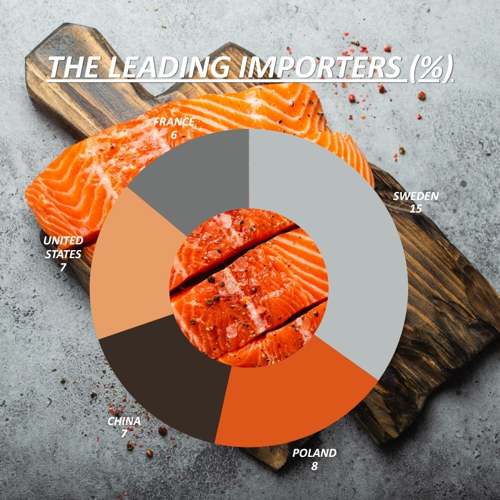
The leading importers are:
• Sweden: approximately 15% of global imports
• Poland: approximately 8%
• China: approximately 7%
• United States: approximately 7%
• France: approximately 6%
Together, these countries account for roughly 45% of global salmon imports, while the remaining 55% is distributed among dozens of consumer markets around the world.
Interestingly, some of the largest importing countries are also major seafood processing centers. Sweden and Poland import substantial quantities of whole salmon which are then processed, filleted, packaged, and redistributed throughout Europe. This creates complex value chains that extend well beyond the initial import transaction.
China has emerged as a key growth market, supported by rising incomes and increasing demand for premium seafood products. Meanwhile, the United States remains one of the world's largest consumers of salmon, relying heavily on imports to satisfy domestic demand.
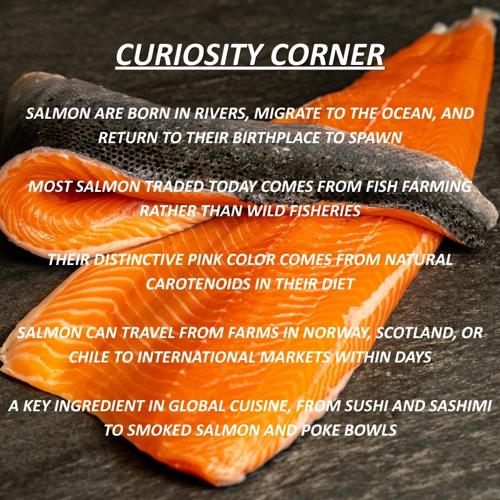
CURIOSITY CORNER: THE REMARKABLE JOURNEY OF SALMON
Salmon is famous not only for its nutritional value but also for one of the most extraordinary migrations in the animal kingdom. Wild salmon are born in freshwater rivers, migrate thousands of kilometers into the ocean, and eventually return to the exact rivers where they were born to spawn.
Another surprising fact is that most salmon traded internationally today comes from aquaculture rather than wild fisheries. Modern salmon farming has transformed the industry, allowing producers to meet growing global demand while reducing pressure on natural populations.
The characteristic pink-orange color of salmon flesh is also fascinating. In the wild, the color comes from a diet rich in crustaceans and marine organisms containing carotenoids. Farmed salmon receive these nutrients through carefully formulated feed that mirrors their natural diet.
Salmon is also one of the most globally connected food products. A fish harvested in Norway, Scotland, or Chile can reach supermarket shelves and restaurant kitchens thousands of kilometers away within just a few days, thanks to advanced refrigerated transportation systems.
Finally, salmon has become a truly international ingredient, playing a central role in cuisines ranging from Japanese sushi and sashimi to Scandinavian smoked salmon, Mediterranean dishes, poke bowls, and modern healthy eating trends.
CONCLUSION
The global trade of fresh/chilled whole salmon demonstrates how a premium seafood product can connect producers and consumers across continents. Supported by advanced aquaculture systems, sophisticated logistics, and strong consumer demand, salmon has become one of the most valuable fish products in international trade.
Exports remain heavily concentrated, with Norway alone accounting for around 70% of global shipments and the top five exporters supplying approximately 85% of the world market. At the same time, demand is becoming increasingly diversified, driven by growing consumption in Europe, North America, and Asia.
As consumers continue to prioritize healthy diets, high-quality proteins, and nutrient-rich foods, fresh salmon is expected to maintain its strategic role in global food trade. Its success story is a powerful example of how innovation, sustainability, and efficient supply chains can transform a traditional fish into a truly global commodity.