PRODUCT CLASSIFICATION
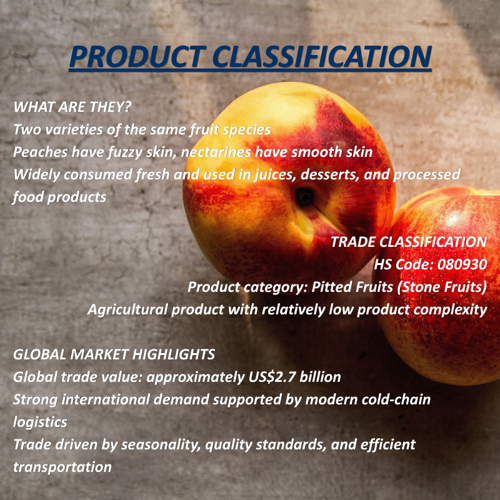
Peaches and nectarines are among the most appreciated stone fruits in the world, celebrated for their sweet flavor, juicy texture, and versatility. Although commercially marketed as different fruits, peaches and nectarines belong to the same species. The main distinction lies in their skin: peaches have a characteristic fuzz, while nectarines have a smooth surface. Their popularity spans fresh consumption, food processing, juices, desserts, and premium retail markets.
From a trade perspective, fresh peaches and nectarines are classified under HS Code 080930 and belong to the broader category of Pitted Fruits. Despite being highly seasonal and perishable products, they represent one of the most valuable segments of the global fresh fruit trade due to strong consumer demand and expanding international distribution networks.
Global trade in fresh peaches and nectarines is valued at approximately US$2.7 billion, placing the product among the most significant internationally traded fresh fruits. Trade has shown steady long-term growth, supported by improvements in cold-chain logistics, better post-harvest handling, and increasing demand for healthy, fresh produce.
In terms of product sophistication, peaches and nectarines are considered low-complexity agricultural goods. Nevertheless, successful trade depends heavily on efficient logistics, refrigeration infrastructure, quality standards, and timing, making competitiveness far more complex than cultivation alone.
EXPORT
The global export market for fresh peaches and nectarines is highly concentrated, with Mediterranean countries playing a dominant role.
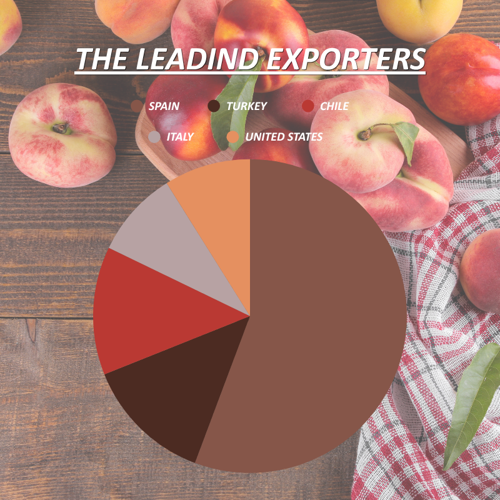
The leading exporters are:
• Spain: approximately 40% of global exports
• Türkiye: approximately 9.5% of global exports
• Chile: approximately 6.4% of global exports
• Italy: approximately 6.4% of global exports
• United States: approximately 6.2% of global exports
Spain is the undisputed global leader thanks to its favorable climate, advanced fruit-growing sector, and privileged access to European markets. Türkiye has strengthened its position through increasing production volumes and competitive pricing, while Chile benefits from its ability to supply Northern Hemisphere markets during the opposite season. Italy and the United States remain important suppliers thanks to strong domestic production and established export networks.
From a regional perspective, export activity is dominated by Europe, which accounts for approximately 58% of worldwide peach and nectarine exports. Asia follows with around 25%, while Latin America contributes nearly 7%. North America represents roughly 6%, with Africa and Oceania accounting for smaller shares.
These percentages highlight the extraordinary importance of the Mediterranean basin, where climate conditions, production expertise, and logistics infrastructure have created one of the most competitive fruit-export industries in the world.
IMPORT
Demand for fresh peaches and nectarines is geographically more diversified than supply, although Europe remains the dominant consuming region.
The main importing countries are:
• Germany
• France
• United Kingdom
• Italy
• Poland
Germany stands out as the world's largest importer, supported by a large consumer market and strong demand for fresh fruit throughout the year. France and the United Kingdom also represent major destinations, while Italy simultaneously acts as both a leading producer and importer due to regional supply dynamics and seasonal demand.
The five largest importing markets together account for approximately 45% of global imports, demonstrating a relatively concentrated demand structure.
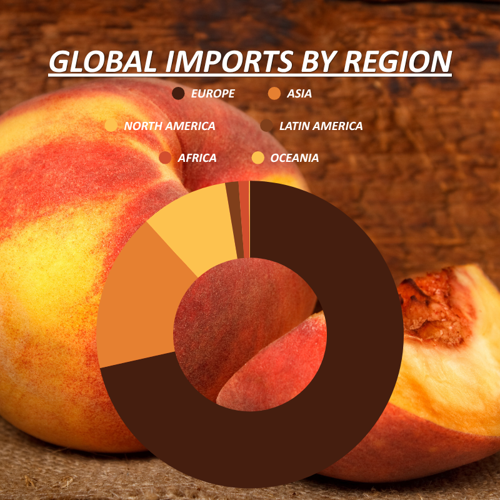
On a continental level:
• Europe absorbs roughly 71.5% of world imports.
• Asia represents approximately 16.7%.
• North America accounts for about 9.2%.
• Latin America contributes around 1.4%.
• Africa represents about 1.1%.
• Oceania accounts for less than 0.1%.
CURIOSITY CORNER: THE SWEET RIVALRY BETWEEN PEACHES AND NECTARINES
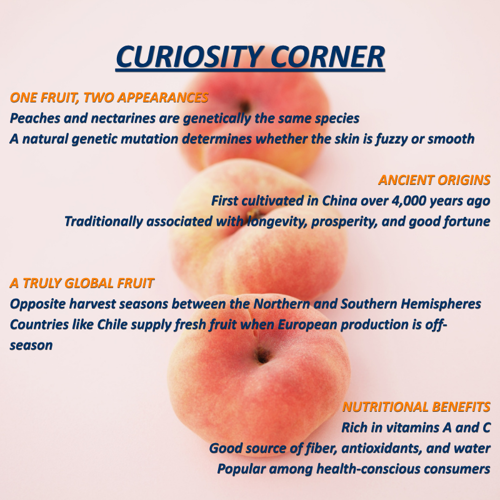
Many consumers believe peaches and nectarines are different species, but they are actually the same fruit. A simple genetic mutation determines whether the skin develops the familiar fuzzy texture of a peach or the smooth surface of a nectarine.
Peaches originated in China more than 4,000 years ago, where they became symbols of longevity, prosperity, and good fortune. Over centuries, cultivation spread along ancient trade routes into Persia, the Mediterranean region, and eventually the Americas. Today, China remains the world's largest producer, even though much of its harvest is consumed domestically rather than exported.
Another fascinating aspect is seasonality. The global trade of peaches and nectarines benefits from the opposite harvest schedules of the Northern and Southern Hemispheres. Countries such as Chile can supply fresh fruit when European orchards are out of season, helping retailers offer year-round availability.
Nutritionally, both fruits are rich in vitamins A and C, antioxidants, dietary fiber, and water, making them particularly attractive to health-conscious consumers seeking natural and refreshing snacks.
CONCLUSION
The international market for fresh peaches and nectarines demonstrates how a highly seasonal fruit can become a truly global product through modern logistics and sophisticated supply chains. Spain remains the dominant exporter, while Europe is both the largest exporting and importing region, accounting for the majority of global trade flows.
Although peaches and nectarines are relatively simple agricultural products, their commercial success depends on timing, quality management, refrigeration, transportation efficiency, and market access. As consumers continue to prioritize fresh and healthy foods, demand for premium fruit is expected to remain strong, supporting the long-term relevance of peaches and nectarines in international agricultural trade.