OVERVIEW
Nestled at the crossroads of Europe and Asia, Armenia may be relatively small in geographic size, but its role in regional and international trade has become increasingly significant. Known for its rich cultural heritage, strong diaspora networks, and strategic location between major markets, the country has steadily diversified its economic relationships while strengthening its position in global value chains.
As a landlocked nation, Armenia faces unique logistical challenges. However, it has leveraged strong commercial ties with countries such as Russia, the United Arab Emirates, China, and several European markets to expand its trade footprint. Today, trade represents a substantial component of the Armenian economy, highlighting its openness and integration into global commerce.
ECONOMIC PROFILE AND COMPLEXITY
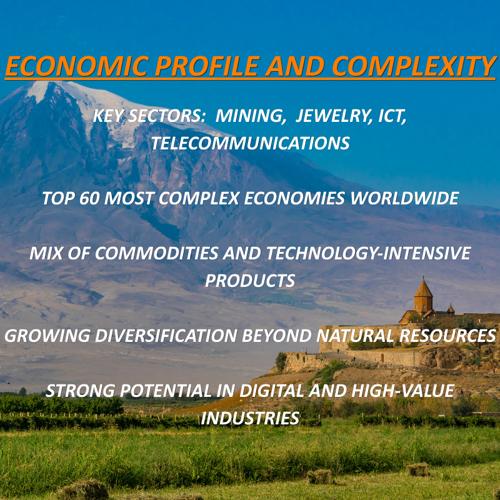
Armenia has evolved from a largely resource-based economy into a more diversified market with growing capabilities in manufacturing, technology, and services. While mining remains an important pillar, sectors such as information technology, engineering, jewelry production, and telecommunications have gained increasing relevance over time.
One useful way to evaluate a country's productive sophistication is through the Economic Complexity Index (ECI).
Armenia ranks among the world's mid-level complex economies, reflecting a production structure that combines traditional commodities with a growing number of manufactured and technology-related products. Its ability to export products such as telephones, jewelry, and processed metals alongside raw materials suggests an economy gradually moving up the value chain.
The country's economic structure remains influenced by natural resources, particularly copper and precious metals, but emerging sectors continue to improve the diversity and resilience of exports. Armenia's rapidly developing ICT industry is also becoming an important engine of growth and international competitiveness.
KEY ECONOMIC INDICATORS
• Economic Complexity Index ranking: Top 60 globally
• Major growth sectors: ICT, telecommunications, jewelry, manufacturing
• Strong natural resource base: Copper, gold, and other metals
• Strategic trade links across Europe, the Middle East, and Eurasia
EXPORTS
Armenia's export profile is characterized by a mix of mineral resources, precious metals, and increasingly sophisticated manufactured goods. Precious metals and mining products remain dominant, reflecting the country's abundant natural resources and established extraction industry.
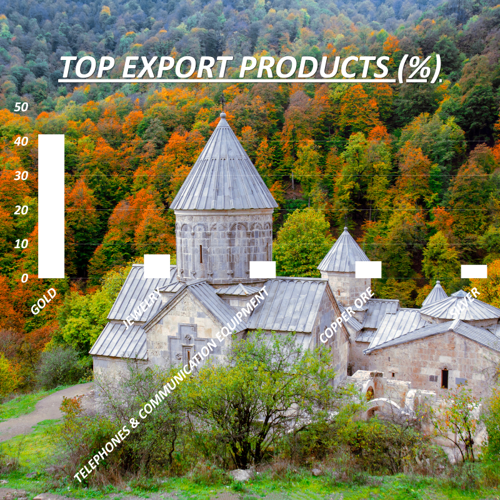
Among Armenia's leading export products are:
• Gold: approximately 42% of total exports
• Jewelry: around 7%
• Telephones and communication equipment: around 5%
• Copper ore: nearly 5%
• Silver: around 4%
This composition reveals an interesting duality. On one hand, Armenia benefits from strong commodity exports that generate significant foreign exchange revenues. On the other, the growing importance of telecommunications equipment and manufactured products demonstrates increasing participation in higher-value industries.
MAIN EXPORT DESTINATIONS
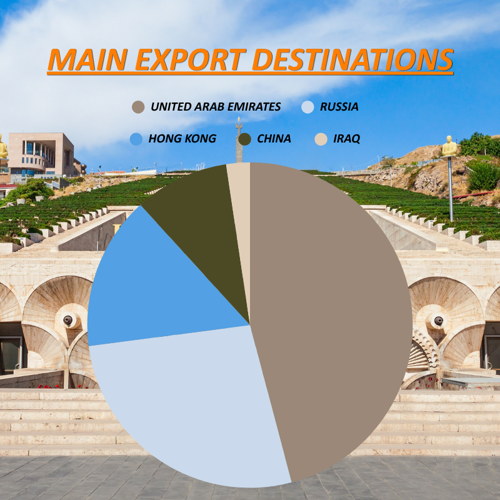
The country's exports are concentrated in several key markets:
1. United Arab Emirates (around 39% of exports)
2. Russia (approximately 23%)
3. Hong Kong (approximately 13%)
4. China (around 8%)
5. Iraq (around 2%)
The prominence of the UAE reflects Armenia's growing role in precious metals and jewelry trade, while Russia remains a vital economic partner due to historical, geographic, and political ties.
IMPORTS
Armenia relies heavily on imports to satisfy domestic demand, support industrial activity, and provide inputs for export-oriented industries. Energy products, consumer goods, technology equipment, and precious materials dominate the import basket.
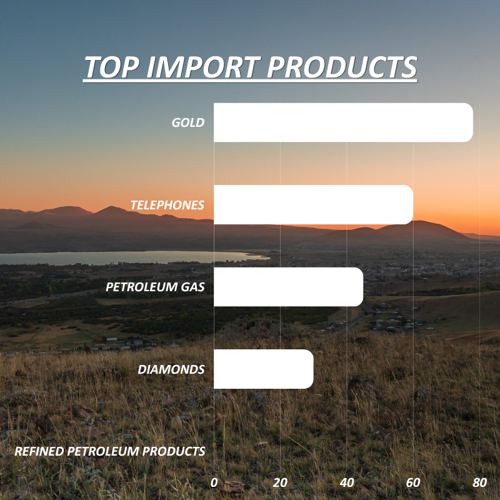
The leading imported products include:
• Gold: approximately 34% of imports
• Telephones: about 5%
• Petroleum gas: around 3%
• Diamonds: nearly 3%
• Refined petroleum products: roughly 3% . A significant share of imported gold, diamonds, and technology products is subsequently processed, transformed, or incorporated into export activities, illustrating Armenia's role in regional trade and value-added production chains.
MAIN IMPORT ORIGINS
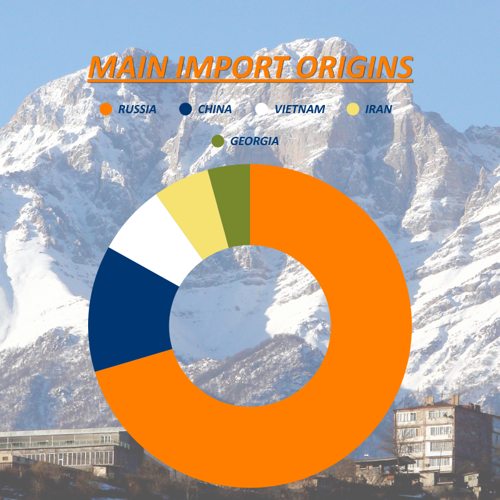
Armenia sources most of its imports from:
1. Russia (over 50% of total imports)
2. China (around 9%)
3. Vietnam (approximately 5%)
4. Iran (around 4%)
5. Georgia (around 3%)
Russia's dominance reflects Armenia's energy dependence and close economic integration within the Eurasian region. Meanwhile, China's growing share highlights the increasing importance of Asian manufacturing supply chains.
TRADE BALANCE
Despite strong export growth, Armenia typically records a trade deficit, meaning imports exceed exports. This pattern is common among developing and emerging economies that require substantial imports of energy, machinery, technology, and industrial inputs.
Several factors contribute to this situation:
• High dependence on imported energy products
• Significant purchases of machinery and technology
• Strong domestic demand for consumer goods
• Limited scale of the domestic industrial sector compared to larger economies
However, Armenia's expanding export base and growth in technology-related activities provide opportunities to gradually improve trade performance over the long term. The development of higher-value industries could help reduce reliance on commodity exports and strengthen the country's external position.
CURIOSITY CORNER
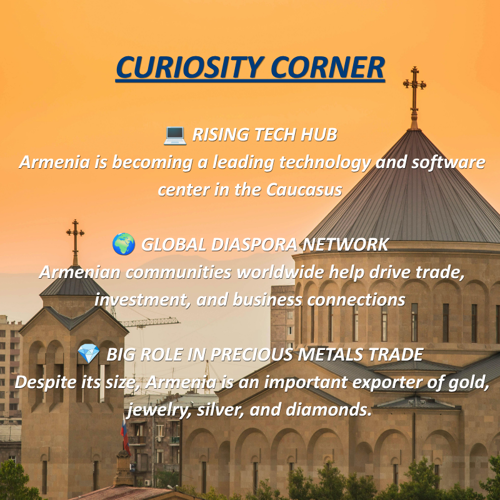
Armenia is Becoming a Technology Hub
While many international observers associate Armenia with mining and precious metals, one of the country's most fascinating developments is the rapid rise of its technology sector. Armenia has built a strong reputation in software development, engineering, and digital services, earning recognition as an emerging tech hub in the Caucasus region.
A Nation of Traders
Armenia's global diaspora has played a crucial role in shaping commercial relationships around the world. Armenian business communities across Europe, the Middle East, North America, and Asia have historically facilitated investment, entrepreneurship, and international trade connections.
Precious Metals Drive Global Connections
Few countries of Armenia's size participate so prominently in the trade of gold, jewelry, diamonds, and silver. These products connect Armenia to major commercial centers across the Middle East and Asia, giving the country a much larger presence in global trade than its population size might suggest.
CONCLUSION
Armenia presents a compelling example of how a small, landlocked economy can build international relevance through strategic trade relationships, natural resource advantages, and increasing economic diversification. While mining and precious metals continue to dominate exports, the country is steadily expanding into technology, telecommunications, and higher-value manufacturing activities.
Its trade network stretches across Eurasia, the Middle East, and Asia, creating opportunities for continued growth despite geographical constraints. With a growing technology sector, improving economic complexity, and a strong entrepreneurial tradition, Armenia is positioning itself as a dynamic and increasingly sophisticated player in international trade.