
PRODUCT CLASSIFICATION
Natural rubber is one of the world’s most strategically important raw materials, serving as a critical input for industries ranging from automotive manufacturing and transportation to healthcare and consumer goods. Harvested primarily from the Hevea brasiliensis tree, natural rubber is valued for its elasticity, durability, and resistance to wear, making it indispensable in the production of tires, medical equipment, industrial components, and countless everyday products.
From a trade perspective, rubber belongs to the Plastics and Rubbers section and is classified under HS 4001: Natural rubber, balata, gutta-percha, guayule, chicle and similar gums; in primary forms or in plates, sheets, or strips. Despite being a relatively low-complexity commodity, rubber remains a cornerstone of global manufacturing supply chains due to its widespread industrial applications and the limited geographic areas suitable for large-scale cultivation.
Global trade in natural rubber is valued at approximately $16.9 billion, representing around 0.074% of total world trade. Over recent years, the sector has shown steady long-term growth, supported by rising demand from the automotive, construction, healthcare, and consumer goods industries.
Among internationally traded products, rubber ranks among the most important agricultural-industrial commodities, although its Product Complexity Index (PCI) of -2.21 reflects the relatively straightforward nature of its production compared with highly engineered manufactured goods.
EXPORT
The global export market for natural rubber is highly concentrated, with Southeast Asia and West Africa accounting for the majority of worldwide supply.
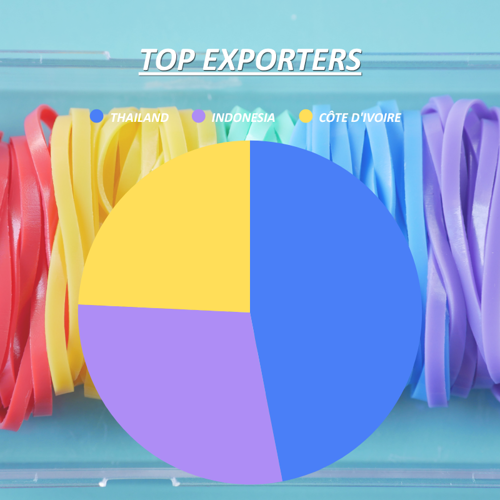
The leading exporters are:
• Thailand – approximately 31% of global rubber exports
• Indonesia – approximately 19% of global rubber exports
• CÔTE D'IVOIRE – approximately 16% of global rubber exports
Together, these three countries account for nearly two-thirds of global rubber exports, highlighting the industry's strong geographic concentration. Thailand dominates thanks to favorable climatic conditions, long-established plantations, extensive processing facilities, and a deeply integrated export network serving manufacturers across Asia, Europe, and North America. Indonesia benefits from vast plantation areas and a long history in rubber production, while Côte d'Ivoire has emerged as Africa's leading rubber exporter through significant investment in agricultural development and processing capacity.
Countries with the highest share of rubber within their overall export portfolios include:
• Norfolk Island – 28.3%
• Côte d'Ivoire – 10.5%
• Liberia – 7.07%
These figures demonstrate how central rubber is to the export performance of several producing economies, particularly in tropical regions where cultivation conditions are ideal.
The largest trade surpluses are recorded by:
• Thailand – approximately $5.17B
• Indonesia – approximately $3B
• Côte d'Ivoire – approximately $2.69B
These strong surpluses reflect a combination of abundant natural resources, competitive production costs, and sustained international demand from industrial manufacturing hubs.
IMPORT
Rubber imports are concentrated in countries with major manufacturing sectors, particularly those involved in tire production, automotive assembly, and industrial processing.
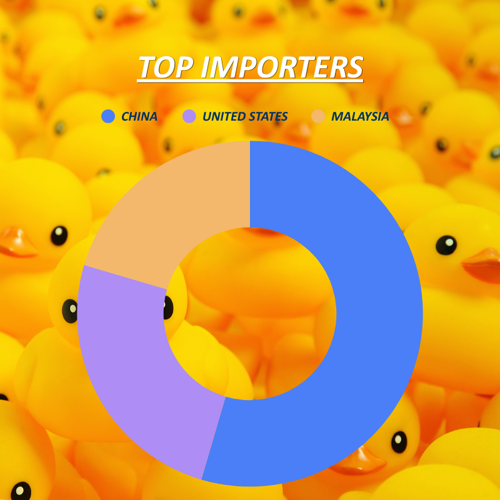
The top importers are:
• China – approximately 24% of global rubber imports
• United States – approximately 11%
• Malaysia – approximately 9%
China stands out as the world's largest importer due to its enormous manufacturing base and dominant position in global tire production. The United States relies heavily on imported natural rubber because domestic cultivation is extremely limited, while Malaysia imports large quantities both for domestic manufacturing and for further processing and re-export activities.
The largest trade deficits are registered by:
• China – approximately-$3.92B
• United States – approximately-$1.73B
• Japan – approximately-$1.22B
These deficits underline the dependence of industrialized economies on rubber-producing nations, creating a global supply chain in which tropical agricultural producers support manufacturing centers around the world.
CURIOSITY CORNER: THE SECRET LIFE OF RUBBER
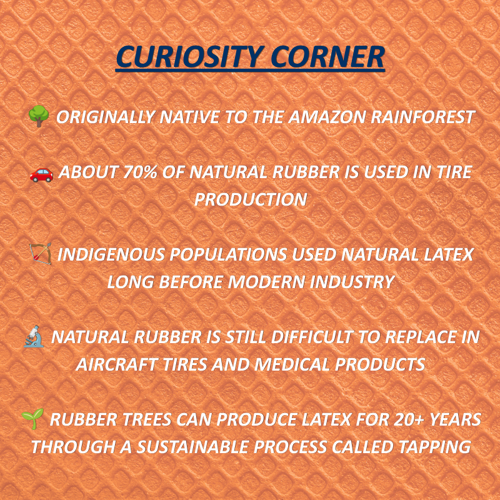
Most people associate rubber with tires, yet nearly every modern industry depends on it in one form or another. In fact, around 70% of the world's natural rubber production is ultimately used by the tire industry, making mobility one of the main drivers of demand.
Natural rubber has a fascinating history. Indigenous peoples in Central and South America were using latex from rubber trees centuries before European explorers arrived. They waterproofed fabrics, created bouncing balls, and developed practical applications long before industrialization transformed rubber into a global commodity.
Another surprising fact is that natural rubber remains difficult to replace despite decades of technological progress. While synthetic rubber can replicate many properties, certain applications, such as aircraft tires, heavy-duty truck tires, and medical products, still rely heavily on natural rubber because of its unique elasticity and resistance to fatigue.
Rubber trees are also remarkably productive. A single tree can produce latex for more than twenty years, and the harvesting process, known as "tapping," involves carefully removing small amounts of bark to collect the sap without damaging the tree itself.
Finally, although the rubber industry is strongly associated with Southeast Asia today, the rubber tree originally comes from the Amazon rainforest. It was only in the late nineteenth century that seeds were transported to Asia, where ideal growing conditions eventually transformed the region into the global center of rubber production.
CONCLUSION
Natural rubber remains one of the world's most important industrial commodities, linking agricultural producers in tropical regions with manufacturing centers across the globe. The market is characterized by a high concentration of supply, with Thailand, Indonesia, and Côte d'Ivoire playing dominant roles in international exports, while China, the United States, and Malaysia lead global demand.
Although rubber exhibits relatively low product complexity, its economic significance extends far beyond agriculture. It is a critical raw material for transportation, healthcare, construction, and industrial manufacturing, making it essential to global economic activity. As demand for mobility, infrastructure, and consumer goods continues to grow, natural rubber is expected to remain a strategic commodity, balancing agricultural production, industrial innovation, and international trade.