
Sweden represents one of Europe’s most compelling economic success stories: a relatively small country that has built a globally competitive, export-driven economy rooted in innovation and industrial excellence. With a GDP of approximately $585 billion and a deeply international outlook, Sweden’s strength lies in its ability to combine openness, specialization, and resilience.
AN ECONOMY BUILT ON TRADE
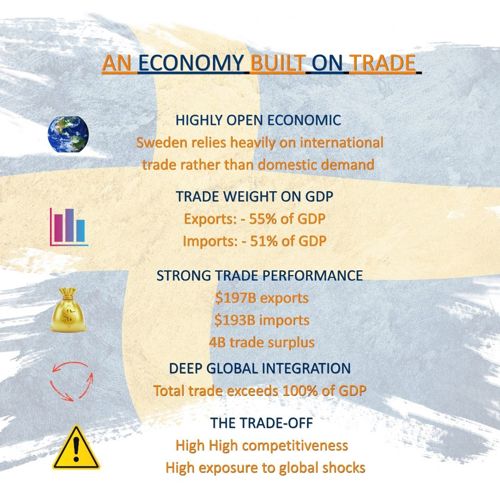
One of the defining characteristics of Sweden is its extreme openness to international trade. Unlike larger economies that rely heavily on domestic demand, Sweden depends strongly on external markets.
• Exports of goods and services: ~55% of GDP
• Imports of goods and services: ~51% of GDP
In 2023, the country recorded:
• $197 billion in exports
• $193 billion in imports
• A trade surplus of around $4 billion
Even more telling, total trade exceeds 100% of GDP, a clear indicator of how tightly Sweden is integrated into global value chains.
This export-oriented model has been a key driver of growth, but it also makes the Swedish economy particularly sensitive to global shocks and demand fluctuations.
A SOPHISTICATED EXPORT ENGINE
Sweden’s export structure reflects a highly advanced, value-added economy rather than a resource-dependent one.
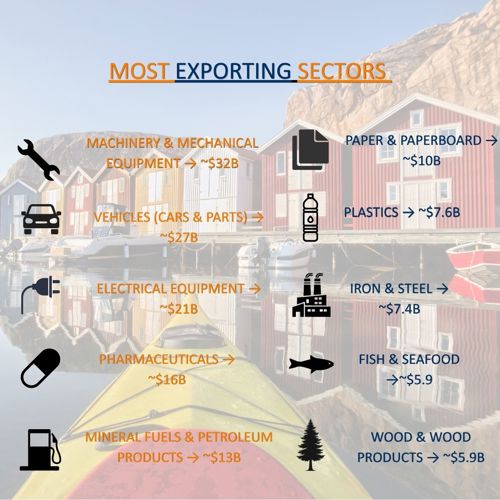
The main export sectors are:
• Machinery and transport equipment: ~44.6%
• Chemicals and pharmaceuticals: ~15.3%
• Mineral products: ~10.3%
• Wood, paper, and pulp: ~9.1%
At a more granular level, key exported products include:
• Refined petroleum products (~5.4%)
• Pharmaceuticals (~3.4%)
• Passenger vehicles and automotive components (~2–3%)
• Wood pulp and paper-related goods
This combination tells an important story: Sweden has successfully evolved from its traditional strengths in forestry and raw materials into a knowledge-intensive industrial economy, where innovation and technology drive competitiveness.
TRADING PARTNERS: A EUROPEAN CORE WITH GLOBAL CONNECTIONS
Geography still plays a fundamental role in Sweden’s trade patterns.• The European Union accounts for 54.2% of exports and 66.9% of imports
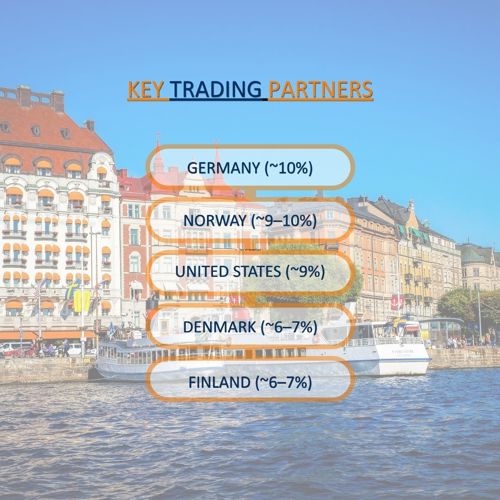
Top export destinations include:
• Germany (~10%)
• Norway (~9–10%)
• United States (~9%)
• Denmark and Finland (each ~6–7%)
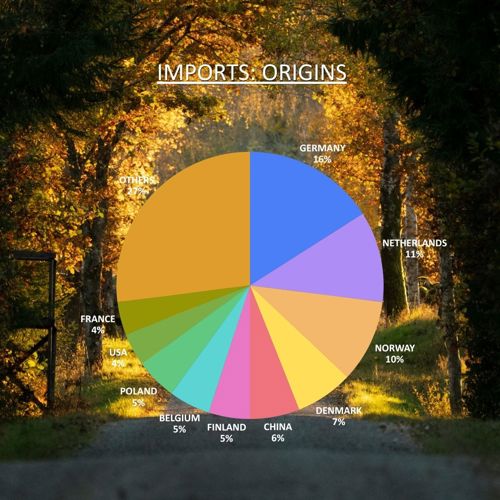
On the import side:
• Germany alone supplies about 16% of imports
• Followed by the Netherlands (~11%) and Norway (~10%)
This structure highlights a dual positioning:
• Deep regional integration within Europe
• Strategic global outreach, particularly toward the United States
IMPORTS: FUELING INDUSTRY AND CONSUMPTION
Sweden’s import profile complements its industrial base and high-income economy.
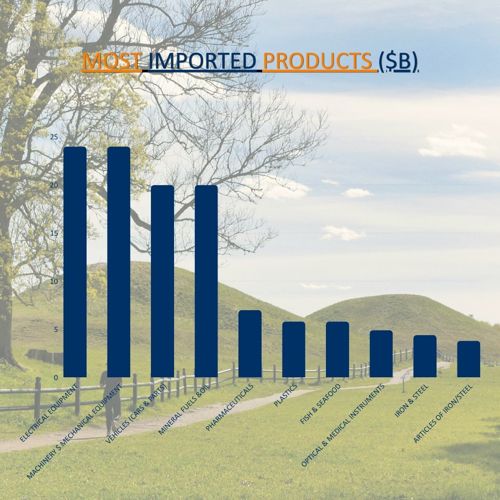
Main imports include:
• Machinery and transport equipment: ~43.8%
• Chemicals and rubber products: ~13.3%
• Food and beverages: ~11.4%
• Energy products: ~10.3%
Energy imports, especially petroleum products, remain significant, even as Sweden continues to invest heavily in renewable energy and sustainability.
GLOBAL POSITION AND TRADE PERFORMANCE
On the global stage, Sweden ranks as:
• #32 largest exporter worldwide
• #32 largest importer worldwide
• Total trade volume of approximately $376 billion
This consistent surplus reinforces Sweden’s reputation as a stable and competitive trading nation, capable of maintaining balance even in volatile economic conditions.
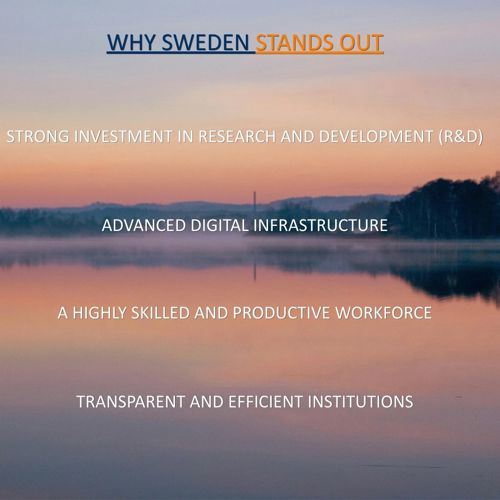
WHY SWEDEN STANDS OUT
Beyond the numbers, Sweden’s competitiveness is rooted in structural strengths:
• Strong investment in research and development (R&D)
• Advanced digital infrastructure
• A highly skilled and productive workforce
• Transparent and efficient institutions
These elements create a business environment that is both innovative and predictable, making Sweden an attractive destination for international companies and investors.
RISKS AND FUTURE OUTLOOK
However, Sweden’s strengths come with exposure. Its heavy reliance on international trade makes it vulnerable to:
• Global supply chain disruptions
• Geopolitical uncertainty
• Fluctuations in external demand
Recent economic projections suggest moderate growth:
• +1.1% GDP growth in 2025
• +1.9% in 2026
While growth remains steady, it reflects a cautious recovery path shaped by global conditions.
CONCLUSION
Sweden offers a clear example of how a small, open economy can achieve global relevance through specialization and innovation.
Key takeaways:
• Trade exceeds 100% of GDP, highlighting deep international integration
• Export structure dominated by high-value manufacturing (~45%)
• Strong dependence on the European market (over 50%)
• Consistent trade surplus and global competitiveness
Ultimately, Sweden is not just an export-driven economy, it is also a model of how innovation, industry, and openness can work together to sustain long-term economic success.