Risk Factors 2026: The 5 Emerging Risks International Traders Must Monitor
Global trade is navigating one of its most volatile and fragmented phases in decades. Environmental shocks, geopolitical tensions, digital vulnerabilities, and competition over strategic resources are reshaping how – and where – companies operate. The World Economic Forum’s Global Risks Report 2026 highlights that global stability is increasingly under pressure as multilateral cooperation weakens and geopolitical confrontation intensifies.
In this evolving landscape, companies engaged in international trade must pay close attention to five major risk factors that will shape competitiveness and supply chain resilience throughout the year.
1. Climate Risk: Extreme Weather as a Systemic Disruptor
Climate‑related disruptions remain one of the most significant threats to global trade. The 2026 Global Risks Report identifies extreme weather events as one of the top global risks likely to cause material crises in the short term.
Critical trade infrastructure (ports, logistics hubs, shipping routes) faces increased exposure to climate‑driven shocks. Floods, heatwaves, and storms are disrupting freight lanes and increasing insurance and operational costs. As a result, companies must strengthen supply chain resilience, diversify logistics routes, and consult predictive climate‑risk analytics to anticipate disruptions before they cascade across global networks.
2. Cyber Risk Across Global Supply Chains
Cybersecurity is no longer an isolated IT issue, it is a structural risk embedded in every tier of global supply chains. In many emerging regions, cybersecurity has already risen to the top of national business risks. The Africa Risk in Focus 2026 report notes that cyber insecurity is a leading concern for several countries, creating vulnerabilities for companies relying on suppliers in these regions.
Meanwhile, broader analyses of 2026 supply chains underscore that cyber threats have become a systemic, multi‑tier challenge amplified by digitization and rapid AI adoption. The KYU Supply Chain Risk Barometer stresses that cyber risk is one of the core meta‑risks shaping value chains worldwide.
For international traders, this means investing in multi‑tier visibility, harmonizing cybersecurity standards across partners, and addressing weak links among SMEs and upstream suppliers.
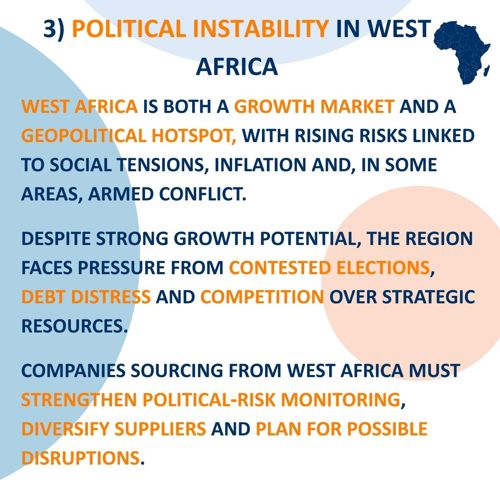
3. Political Instability in West Africa
West Africa remains both a growth opportunity and a geopolitical hotspot. Several West African economies face rising risks linked to unemployment, social tensions, inflation and, in some cases, armed conflict, making the region one of the most politically fragile for global supply chains in 2026.
At the same time, the Economist Intelligence Unit’s Africa Outlook 2026 indicates that although Africa is poised to be the fastest‑growing region globally, this growth will be uneven and threatened by contested elections, debt distress, and geopolitical rivalry over strategic resources.
Companies sourcing raw materials, agricultural goods, or mining outputs from West Africa must strengthen political‑risk monitoring, develop contingency plans, and diversify sourcing to maintain operational continuity.
4. Unpredictable Regulations: The Escalating U.S.–China Trade Rivalry
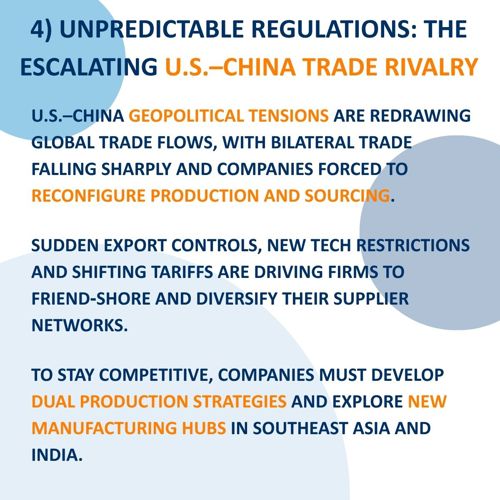
Regulatory volatility driven by U.S.–China competition is reshaping global trade patterns. The geopolitical rivalry between the two countries has already reduced bilateral trade by around 30%, pushing companies to reconfigure production and sourcing.
This realignment includes:
- sudden changes in export controls,
- new technology‑related restrictions,
- shifting tariff regimes,
- growing pressure to “friend‑shore” or diversify suppliers.
For many firms, navigating this landscape will require developing dual production strategies, identifying alternative manufacturing hubs in Southeast Asia or India, and building regulatory foresight into long‑term planning.
5. Dependence on Critical Raw Materials
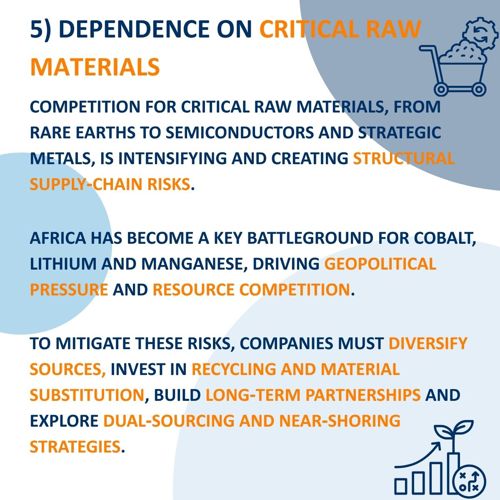
Competition for critical raw materials is intensifying and becoming a structural risk. The 2026 Supply Chain Risk Barometer highlights shortages in rare earths, semiconductors, and critical metals as persistent rather than cyclical, reshaping cost structures and production planning.
The EIU also notes that Africa is emerging as a central battleground for strategic minerals such as cobalt, lithium, and manganese, with global powers intensifying their competition for access.
To mitigate these risks, companies must:
- diversify sources of critical inputs,
- invest in recycling and material‑substitution technologies,
- engage in long‑term partnerships directly with upstream producers,
- explore dual‑sourcing and near‑shoring strategies.
Conclusion: Resilience as a Competitive Advantage
In 2026, resilience is not just a defensive strategy, it is a central driver of competitiveness. Climate risk, cyber threats, geopolitical instability, regulatory volatility, and pressure on critical resources form an interconnected ecosystem of challenges that international traders can no longer treat as isolated issues.
The companies that will thrive in this environment are those able to:
- anticipate emerging risks,
- build diversified and flexible supply chains,
- invest in technology and data‑driven risk intelligence,
- maintain strong relationships with strategically important suppliers,
- incorporate geopolitical awareness into decision‑making.
In a global economy where stability can no longer be taken for granted, proactive risk management becomes the most valuable asset for any international business.
Sources: The Global Risks Report 2026 | World Economic Forum , WEF Global Risks Report 2026: Analysis of West Africa’s top risks - FactSpace West Africa , 2026 Africa Risk in Focus Report English , Supply Chain Risks in 2026: How Companies Must Adapt - DirectIndustry e-Magazine , Africa outlook 2026 - Economist Intelligence Unit , The future of global trade in 2026 | McKinsey , EU 2025 Sustainability Regulation Outlook | Deloitte Insights , ESG regulations and frameworks businesses need on their radar