PRODUCT CLASSIFICATION
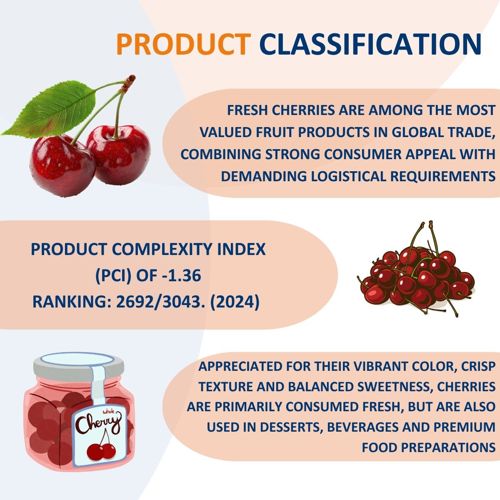
Fresh cherries are among the most valued fruit products in global trade, combining strong consumer appeal with demanding logistical requirements. Appreciated for their vibrant color, crisp texture, and balanced sweetness, cherries are primarily consumed fresh but are also used in desserts, beverages, and premium food preparations. Their short harvest window and high sensitivity to temperature and handling make them a quintessential example of high-value, time-sensitive agricultural trade.
Within international trade classifications, fresh cherries fall under the Vegetable Products section. More specifically, they are classified in HS Chapter 08: Edible fruits, nuts & fruit peels, under HS4 Pitted Fruits. Although biologically simple, cherries require sophisticated cold-chain logistics, rapid transportation, and strict quality controls to preserve freshness from orchard to consumer markets.
In 2024, global trade in fresh cherries reached $6.54 billion, representing a remarkable 39.8% increase compared to 2023, when trade totaled $4.68 billion. Over the past five years, this market has expanded at an annualized growth rate of 9.22%, reflecting rising global demand, particularly in Asian consumer markets, and the growing ability of exporters to serve distant destinations efficiently.
Among 5,024 products traded worldwide in 2024, fresh cherries ranked 575th in global trade value, accounting for 0.029% of total world trade. According to the Product Complexity Index (PCI), cherries ranked 2692nd out of 3043 products, with a PCI value of –1.36, indicating limited processing complexity but high logistical and seasonal sensitivity.
EXPORT
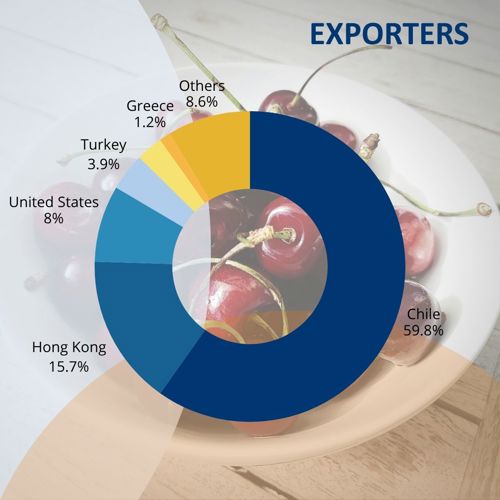
In 2024, the global export landscape for fresh cherries was dominated by a small number of highly specialized suppliers:
• Chile – $3.91B
• Hong Kong – $1.03B
• United States – $522M
Chile firmly consolidated its position as the world’s leading cherry exporter, accounting for the majority of global supply. Its success is rooted in large-scale orchards, counter-seasonal production relative to the Northern Hemisphere, and deep trade integration with Asian markets, particularly China. Hong Kong plays a strategic role as both a re-export hub and a distribution gateway for East Asia, while the United States benefits from strong domestic production, especially in Washington, California, and Oregon.
Countries where fresh cherries represented the highest share of total export portfolios in 2024 were:
• Chile – 3.81%
• Hong Kong – 0.7%
• Syria – 0.7%
For Chile, cherries are not only a top agricultural export but also a strategic asset that influences logistics, trade policy, and seasonal employment. The relevance of cherries in the export mix of smaller or trade-oriented economies highlights how niche agricultural products can play an outsized economic role.
The largest trade surpluses in fresh cherries in 2024 were recorded by:
• Chile – $3.91B
• Hong Kong – $463M
• United States – $388M
These surpluses underscore the export-driven nature of cherry-producing countries, supported by climatic advantages, technological investment in post-harvest handling, and strong international demand during peak consumption periods.
IMPORT
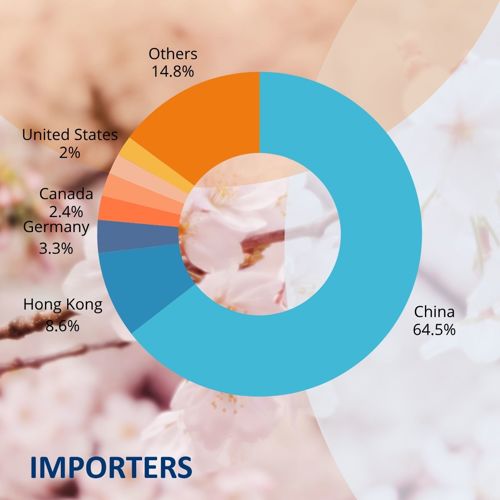
On the import side, demand for fresh cherries remains heavily concentrated in a few high-consumption markets. In 2024, the leading importers were:
• China – $4.22B
• Hong Kong – $564M
• Germany – $216M
China stands out as the undisputed largest importer, absorbing the majority of global cherry exports. Cherries enjoy premium status in the Chinese market, often associated with gifting, celebrations, and high-income consumption patterns. Hong Kong’s import volumes reflect its function as both a consumer market and a redistribution center, while Germany represents Europe’s largest import hub for fresh cherries, driven by seasonal demand and limited domestic supply.
Countries with the largest trade deficits in fresh cherries in 2024 were:
• China – –$4.22B
• Germany – –$186M
• Russia – –$149M
These deficits are a direct consequence of strong consumer demand combined with production constraints linked to climate, seasonality, or geopolitical factors. In particular, China’s deficit reflects its role as a structurally import-dependent market despite some domestic production.
CURIOSITY CORNER: CHERRIES BETWEEN NATURE, LOGISTICS, AND CULTURE
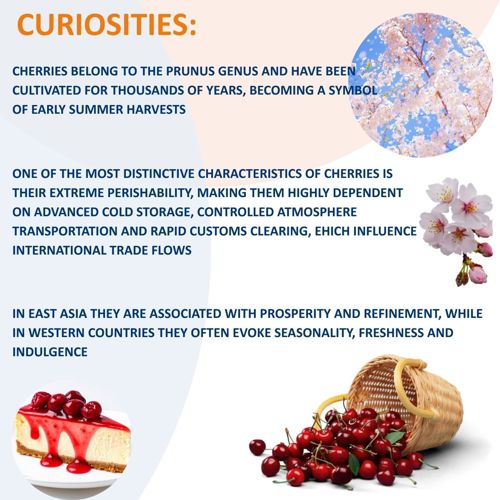
Cherries belong to the Prunus genus and have been cultivated for thousands of years, with historical origins traced back to regions around the Black Sea and Asia Minor. Over centuries, they spread across Europe, Asia, and eventually the Americas, becoming a symbol of early summer harvests.
One of the most distinctive characteristics of cherries is their extreme perishability. Unlike many other fruits, cherries continue to lose firmness and sugar content rapidly after harvest. This makes them highly dependent on advanced cold storage, controlled atmosphere transportation and rapid customs clearance, factors that significantly influence international trade flows.
Culturally, cherries carry strong symbolic value. In East Asia, they are associated with prosperity and refinement, while in Western countries they often evoke seasonality, freshness and indulgence. Their visual appeal has also made them iconic in branding, advertising, and luxury fruit packaging, especially in export markets where presentation can be as important as taste.
CONCLUSION
The global trade of fresh cherries in 2024 highlights how a seemingly simple fruit can become a high-value commodity at the intersection of agriculture, logistics, and consumer culture. With trade volumes exceeding $6.5 billion and year-on-year growth nearing 40%, cherries stand out as one of the most dynamic segments within fresh fruit trade.
Export powerhouses such as Chile, Hong Kong, and the United States leverage climatic advantages and efficient supply chains, while major importers like China and Germany illustrate the growing global appetite for premium fresh produce. Despite low product complexity, the cherry market remains highly sensitive to timing, quality control, and transport efficiency.
As global consumers continue to prioritize freshness, seasonality, and premium food experiences, cherries are likely to maintain their prominent role in international trade, offering a clear example of how agricultural excellence and global demand align in modern food supply chains.