
OVERVIEW
Chile stands as one of Latin America’s most stable, export‑driven, and internationally integrated economies. With a GDP of $330B in 2024, the country ranks as the 45th largest economy worldwide, the 41st largest exporter, and 71st in GDP per capita.
In December 2025, Chile recorded:
· Exports: $10.2B
· Imports: $7.06B
· Positive trade balance: $3.12B
Compared with December 2024, exports surged by 13.2%, driven primarily by copper, gold, and mineral products, while imports increased more moderately by 2.06%, reflecting stable internal demand for medical instruments, electronics, and vehicles.
Chile’s economy is shaped by its world‑leading mining sector, its strong agricultural output, and its strategic trade relations with major Asian markets, particularly China.
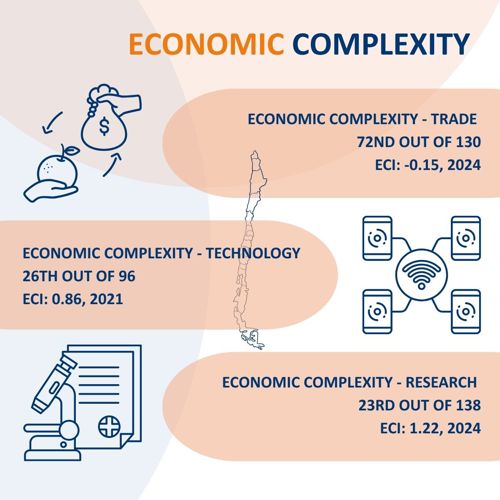
ECONOMIC PROFILE AND COMPLEXITY
Chile’s export structure is highly specialized and centered on:
- mining and minerals,
- agriculture and fruit production,
- pulp and wood products,
- and increasingly, processed industrial goods.
The country is the world’s largest producer of copper, and this metal, together with refined copper and mineral‑based goods, continues to dominate its economic landscape. Meanwhile, Chile’s geographic diversity supports an important agricultural sector, exporting fruit, fish products, and high‑quality wood pulp globally.
The economy is deeply integrated into Asian supply chains, especially through its long‑standing commercial partnerships with China, Japan, South Korea, and India.
EXPORTS
In 2024, Chile exported $101B, maintaining its position as the 41st largest exporter. Over the last five years, exports increased by $30.6B, rising from $70.5B in 2019, an expansion fueled by minerals, agriculture, and wood products.
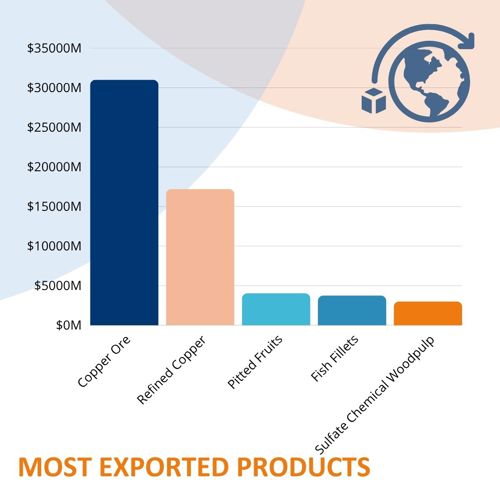
Top Export Products (2024)
- Copper Ore – $31B
- Refined Copper – $17.2B
- Pitted Fruits – $4.04B
- Fish Fillets – $3.76B
- Sulfate Chemical Woodpulp – $3.02B
This export mix highlights Chile’s dual specialization in mining and agri‑food commodities, supported by strong international demand and competitive natural advantages.
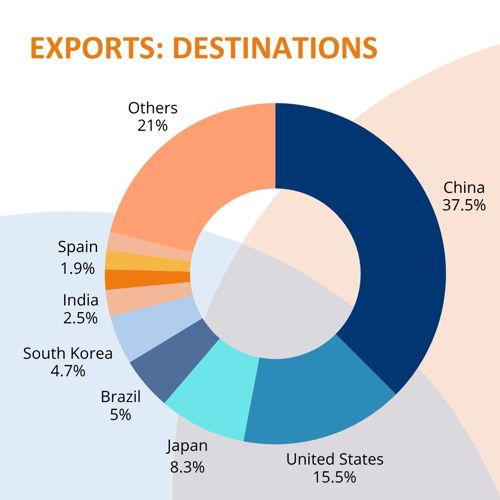
Top Export Destinations (2024)
- China – $37.9B
- United States – $15.7B
- Japan – $8.38B
- Brazil – $5.07B
- South Korea – $4.71B
China remains Chile’s most important partner by a wide margin, particularly due to copper ore and refined copper exports.
Monthly Export Highlights (Dec 2025)
Exports came primarily from:
- Las Condes – $3.88B
- Santiago – $2.24B
- Puerto Montt – $433M
Top destinations in December 2025:
- China – $4.24B
- United States – $1.45B
- Japan – $623M
- India – $583M
- South Korea – $363M
Export Growth Drivers (Dec 2025)
Significant increases were observed toward:
- China (+12.8%)
- India (+139%)
- Switzerland (+141%)
Key products boosting growth:
- Copper Ore (+31.2%)
- Gold (+301%)
- Iron Ore (+108%)
IMPORTS
In 2024, Chile imported $82.1B, positioning it as the 46th largest importer in the world. Over the past five years, imports increased by $13.1B, supported by rising demand for refined petroleum, technology, vehicles, and medical products.
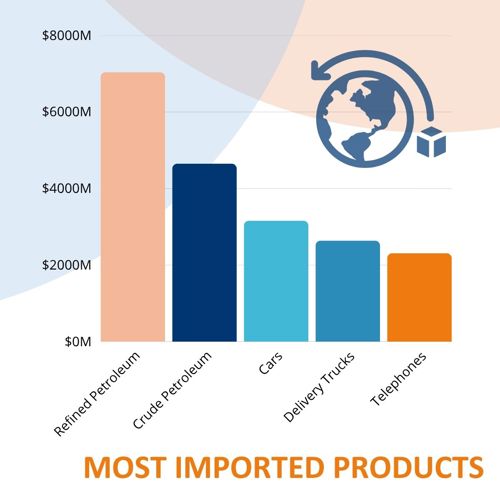
Top Import Products (2024)
- Refined Petroleum – $7.04B
- Crude Petroleum – $4.65B
- Cars – $3.16B
- Delivery Trucks – $2.64B
- Telephones – $2.31B
These imports indicate Chile’s need for energy products and consumer goods, reflecting its growing urban population and expanding middle class.
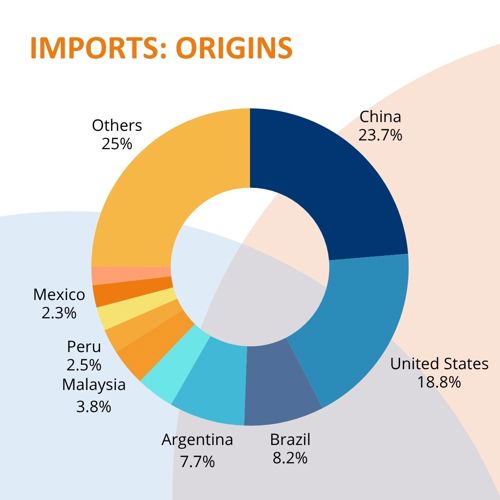
Top Import Origins (2024)
- China – $20.2B
- United States – $16B
- Brazil – $6.97B
- Argentina – $6.57B
- Germany – $3.33B
Monthly Import Trends (Dec 2025)
Imports came mainly from:
- United States – $2.45B
- Switzerland – $729M
- Brazil – $560M
- China – $485M
Notable growth drivers:
- United States (+34.6%)
- Germany (+23.6%)
- Italy (+38.3%)
Key rising imports:
- Orthopedic Appliances (+51.2%)
- Transmissions (+87.7%)
- Iron Fasteners (+62%)
TRADE BALANCE
In 2024, Chile’s strongest positive trade balances were with:
- China – +$17.7B
- Japan – +$6.32B
- South Korea – +$3.09B
- Netherlands – +$1.35B
- India – +$1.28B
The largest deficits were recorded with:
- Argentina – –$5.75B
- Germany – –$2.06B
- Brazil – –$1.9B
- Vietnam – –$898M
- Peru – –$709M
The data highlights Chile’s reliance on energy and automotive imports while maintaining strong surpluses in mineral exports.
CURIOSITY CORNER: CHILE’S UNIQUE ECONOMIC & GEOGRAPHIC TRAITS
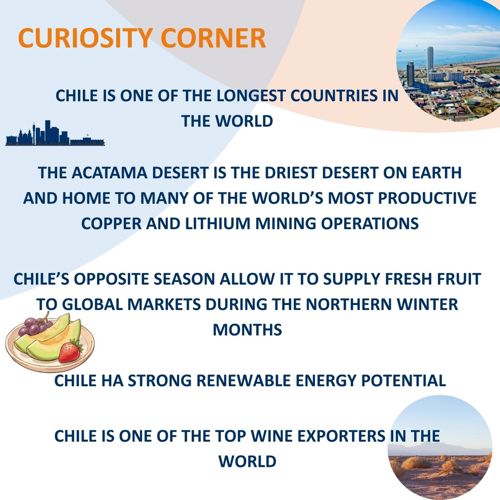
1. One of the Longest Countries in the World
Stretching more than 4,000 km from north to south, Chile’s geographic diversity, from the Atacama Desert to Patagonia, supports unique agricultural micro‑climates and rich mineral deposits.
2. The Atacama Desert: A Global Mining Hub
The Atacama is the driest desert on Earth and home to many of the world’s most productive copper and lithium mining operations, making it a critical region for global energy transition supply chains.
3. A Major Fruit Exporter to the Northern Hemisphere
Chile’s opposite seasons allow it to supply fresh fruit, especially cherries, grapes, and berries, to global markets during the northern winter months, generating billions in annual exports.
4. Strong Renewable Energy Potential
Chile is rapidly expanding solar and wind capacity, especially in the Atacama, which receives some of the strongest solar radiation on the planet.
5. A Global Leader in Wine Exports
Chile is one of the top wine exporters in the world, with renowned valleys (such as Maipo and Colchagua) driving international sales and tourism.
CONCLUSION
Chile’s economy is shaped by powerful export engines (mining, agriculture, and wood products) combined with expanding global trade links, particularly in Asia. Its strong performance in copper, refined metals, fruit, and pulp underscores the country’s competitive natural advantages and global relevance.
At the same time, growing imports of machinery, vehicles, medical goods, and energy products show a dynamic domestic market and deep integration with global supply chains.
With rising trade flows, diversification efforts, and ongoing investment in renewable energy and high‑value production, Chile continues to strengthen its position as one of Latin America’s most stable and globally connected economies.