
OVERVIEW
China remains one of the most influential and interconnected economies in the global landscape. With a GDP of $18.7T in 2024, it stands as the 2nd largest economy worldwide, the 1st in total exports, and ranks 81st in GDP per capita.
In December 2025, China recorded:
- Exports: $358B
- Imports: $244B
- Trade Balance: + $114B
Compared to December 2024, exports increased by 6.59% (+$22.1B), while imports rose by 5.57% (+$12.9B), reflecting solid external demand and sustained domestic industrial needs.
China’s economic power lies in its manufacturing depth, extensive industrial supply chains, and central role in global electronics, machinery, automotive, and energy markets.
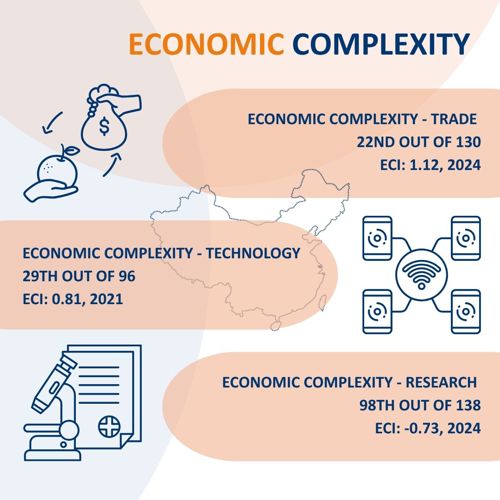
ECONOMIC PROFILE AND COMPLEXITY
China’s industrial and trade structure is characterized by:
- advanced electronics and high‑tech manufacturing,
- automotive production,
- machinery and equipment,
- resource‑intensive imports fueling domestic production, and
- increasing competitiveness in renewable energy technologies (e.g., batteries).
Integrated circuits, telephones, and computers form the backbone of China’s export portfolio. At the same time, the country’s heavy reliance on imported crude petroleum, ores, and high‑value semiconductors highlights the scale and complexity of its production ecosystem.
Regional specialization is a key feature:
- Guangdong leads in electronics and light manufacturing exports,
- Jiangsu and Zhejiang dominate machinery, electrical equipment, and components,
- Shanghai and Beijing concentrate advanced services, finance, and high-end industrial activity.
EXPORTS
In 2024, China exported $3.59T, keeping its position as the largest exporter in the world. Over five years, exports grew by $943B, rising from $2.65T in 2019.
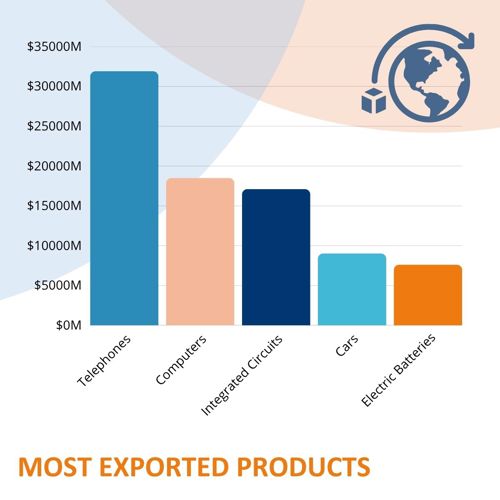
Top Export Products (2024)
- Telephones – $319B
- Computers – $185B
- Integrated Circuits – $171B
- Cars – $90.3B
- Electric Batteries – $76.2B
These reflect China’s dominance in global electronics, EV supply chains, and ICT equipment.
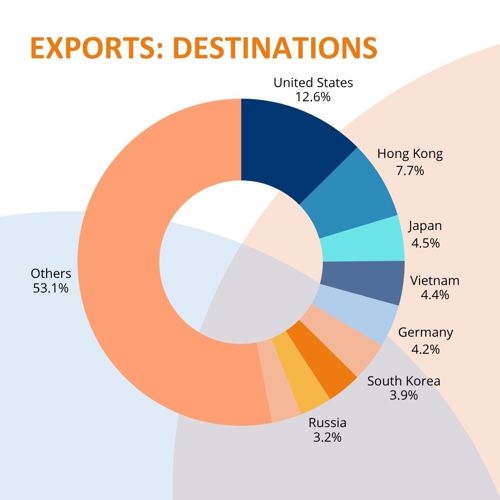
Top Export Destinations (2024)
- United States – $453B
- Hong Kong – $278B
- Japan – $162B
- Vietnam – $159B
- Germany – $151B
Export Growth Drivers (Dec 2025)
Strongest YoY growth:
- Hong Kong (+$8.44B, +31.2%)
- Vietnam (+$3.22B, +20.5%)
- India (+$2.31B, +22.1%)
Key product increases:
- Integrated Circuits (+$7.07B, +47.6%)
- Cars (+$5.82B, +78%)
- Office Machine Parts (+$2.53B, +76.7%)
These figures highlight China’s expanding role in semiconductors, automotive exports, and component manufacturing.
IMPORTS
In 2024, China imported $2.07T, ranking as the second-largest importer globally. Over five years, imports increased by $385B, rising from $1.68T in 2019.
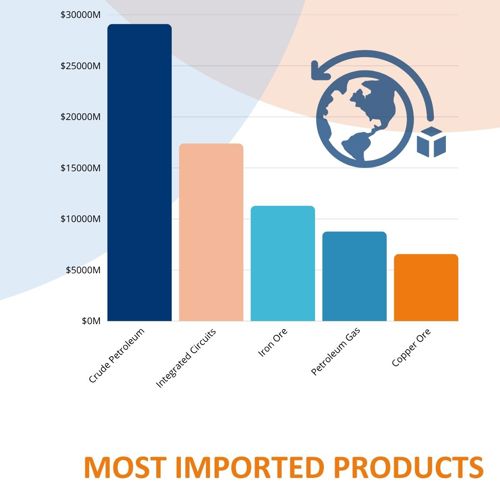
Top Import Products (2024)
- Crude Petroleum – $291B
- Integrated Circuits – $174B
- Iron Ore – $113B
- Petroleum Gas – $87.8B
- Copper Ore – $65.7B
These inputs support China’s industrial production in energy, metals, and advanced electronics.
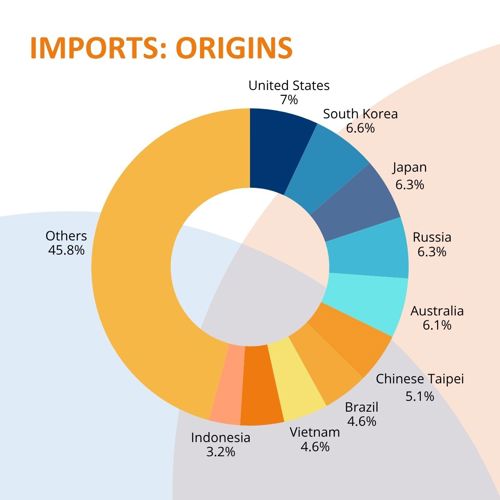
Top Import Origins (2024)
- United States – $145B
- South Korea – $137B
- Japan – $130B
- Russia – $130B
- Australia – $126B
Import Growth (Dec 2025)
Strongest increases:
- Brazil (+$3.06B, +38.6%)
- Hong Kong (+$2.04B, +126%)
- Russia (+$2.01B, +18.9%)
Key product increases:
- Integrated Circuits (+$6.07B, +16.6%)
- Office Machine Parts (+$2.61B, +116%)
- Copper Ore (+$2.04B, +33.2%)
These trends underline China’s dependence on raw materials and high-tech inputs for domestic production.
TRADE BALANCE
In 2024, the countries generating China’s highest trade surpluses were:
- United States – +$309B
- Hong Kong – +$246B
- India – +$106B
- Mexico – +$90.7B
- United Kingdom – +$75B
Countries with the largest Chinese deficits:
- Australia – –$51.7B
- Chinese Taipei – –$27.5B
- Oman – –$25.2B
- Brazil – –$24.9B
- Switzerland – –$24B
These patterns reflect China’s role as a global manufacturing hub and large importer of energy, minerals, and semiconductors.
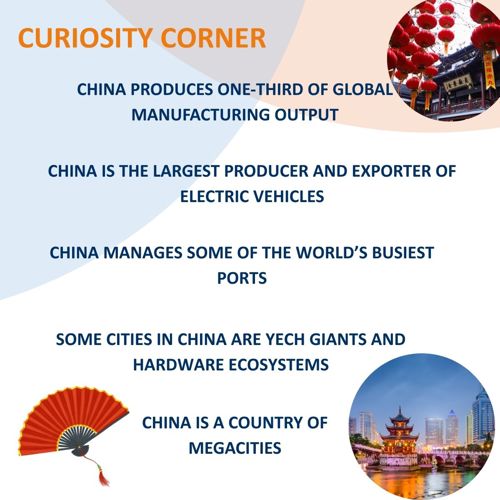
CURIOSITY CORNER
- The Factory of the World
China produces over one-third of global manufacturing output, with regions like Guangdong specializing in electronics clusters known worldwide. - The EV Capital
China is the largest producer and exporter of electric vehicles, supported by its leadership in battery manufacturing. - A Logistics Superpower
China manages some of the world’s busiest ports, with Shanghai continuously ranking #1 in container throughput. - Tech Giants and Hardware Ecosystems
Cities like Shenzhen host massive hardware ecosystems, enabling rapid prototyping and global-scale electronics production. - A Country of Megacities
China has more than 100 cities with over 1 million residents, creating powerful internal consumer markets.
CONCLUSION
China’s economic strength lies in its industrial scale, diversified manufacturing capacity, and deep integration into global trade networks. As the world’s largest exporter and a leading importer of energy and raw materials, China remains essential for global supply chains, from electronics and machinery to automotive and renewable energy technologies.
With rising export volumes, strong provincial specialization, growing automotive and semiconductor capabilities, and persistent trade surpluses with major economies, China continues to shape global commerce and remains one of the most strategically important markets in the world.