
OVERVIEW
When thinking about global trade, small island nations rarely come to mind as major players. Yet, Seychelles, an archipelago in the Indian Ocean, presents a fascinating case of how geography, specialization, and global connectivity can shape a highly open economy.
With a population of just over 100,000 and a GDP of approximately $2.17 billion, Seychelles ranks among the smallest economies in the world.
Despite its size, the country plays an active role in international trade, exporting around $900 million worth of goods in 2024, while importing roughly $1.63 billion, highlighting its reliance on external markets.
This imbalance is not necessarily a weakness, it reflects a service-driven economy, strong tourism sector, and a strategic position in global supply chains, particularly in fisheries.
ECONOMIC PROFILE AND COMPLEXITY
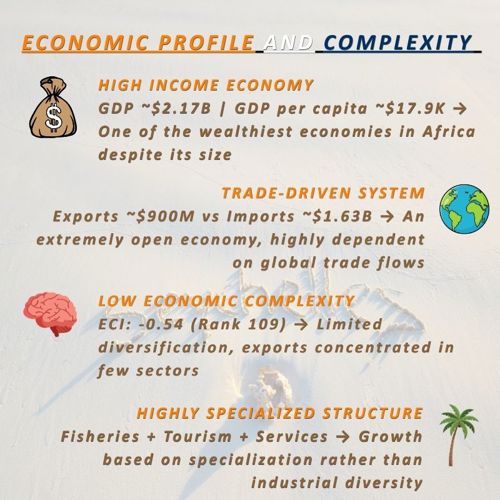
Seychelles is classified as a high-income economy, largely driven by tourism, fisheries, and financial services; its GDP per capita stands at around $17,900, placing it well above many African peers.
However, when it comes to productive diversification, the country faces structural limitations; according to the Economic Complexity Index (ECI), Seychelles ranks around 109th globally with a score of -0.54, indicating a relatively low level of export diversification.
This means that while the country generates a solid income, its economic structure depends heavily on a narrow range of products and industries, a common characteristic among small island economies.
Still, Seychelles compensates for this with high trade openness; exports account for a significant share of GDP, and imports are even higher, reflecting the country’s dependence on foreign goods and inputs.
EXPORTS
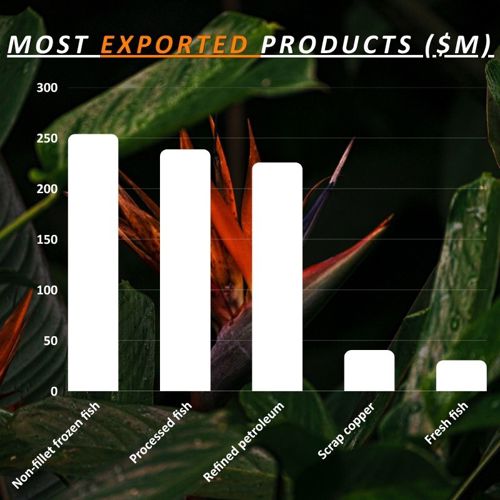
Seychelles’ export structure is highly concentrated, with fisheries dominating the landscape.
Key Export Figures
• Total exports: ~$900M
• Top categories:
o Non-fillet frozen fish: $254M
o Processed fish: $239M
o Refined petroleum: $226M
o Scrap copper: $40.5M
o Fresh fish: $30.5M
Fish-related products alone account for a majority of total exports, underlining the critical importance of the fishing industry. In fact, broader estimates suggest up to 90% of exports are linked to fisheries.
Main Export Destinations
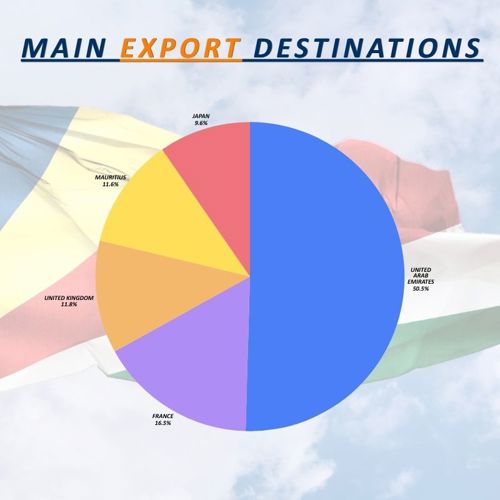
• United Arab Emirates: ~$278M
• France: ~$91M
• United Kingdom: ~$65M
• Mauritius: ~$64M
• Japan: ~$53M
A notable highlight is the rapid growth of trade with the UAE, which has become the largest export partner, largely due to petroleum re-exports and strategic trade flows.
IMPORTS
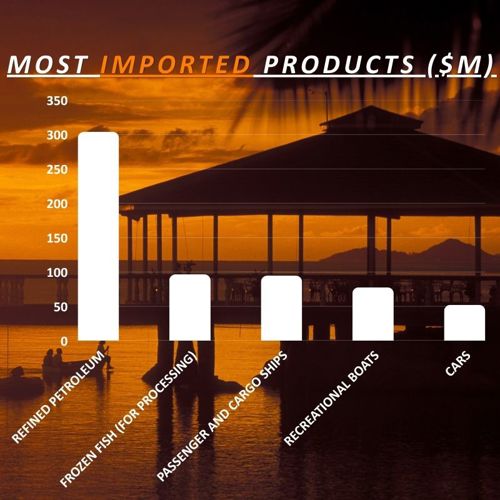
While exports are concentrated, imports are broad and diversified, reflecting domestic consumption needs and limited local production.
Key Import Figures
• Total imports: ~$1.63B
Main Imported Products
• Refined petroleum: $304M
• Frozen fish (for processing): $96.6M
• Passenger and cargo ships: $94.6M
• Recreational boats: $77.7M
• Cars: $52.1M
The presence of imported fish may seem counterintuitive, but it highlights Seychelles' role as a processing hub, where imported raw fish is transformed and re-exported.
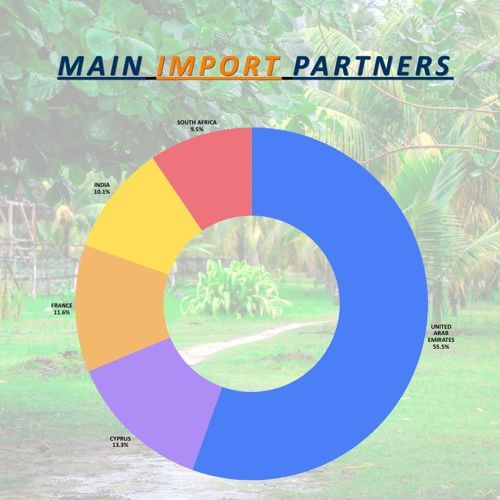
Main Import Partners
• United Arab Emirates: $529M
• Cyprus: $127M
• France: $111M
• India: $96.5M
• South Africa: $90.5M
TRADE BALANCE
Seychelles consistently runs a trade deficit in goods.
• Exports (2024): ~$900M
• Imports (2024): ~$1.63B
• Trade balance: حوالي-$730M
This negative balance is typical for island economies that rely heavily on imports for energy, food, and manufactured goods.
However, the picture changes when including services, especially tourism.
Services exports (travel and tourism) significantly offset the goods deficit, making the overall external balance more sustainable.
CURIOSITY CORNER
Beyond the numbers, Seychelles reveals a series of fascinating dynamics that make its economy genuinely unique in the global landscape.
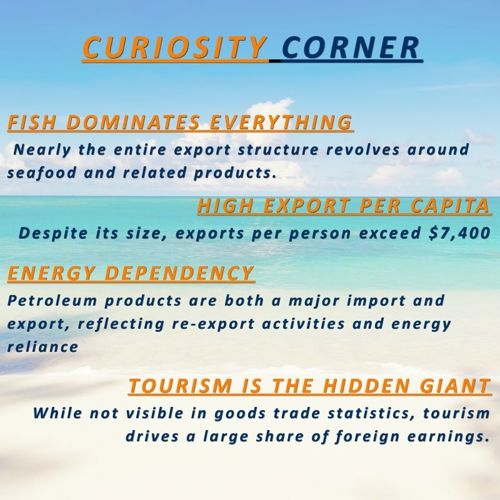
One of the most striking aspects is its extraordinary dependence on fish. Seafood is not just an export category, but it is also the backbone of the country’s entire trade identity; frozen and processed fish alone account for more than half of total exports, and when including related products, the sector dominates almost entirely.
This level of specialization is rare and makes Seychelles highly efficient in what it does, but also exposed to risks, such as fluctuations in global fish prices, climate change, and overfishing concerns.
Another interesting paradox lies in the country’s fish trade loop; Seychelles exports large quantities of fish, yet it also imports significant volumes of frozen fish.
This is because the country acts as a processing hub; raw fish is imported, processed locally (adding value through packaging and transformation), and then re-exported. This model allows Seychelles to maximize its strategic location in the Indian Ocean and position itself within global supply chains despite limited natural resources.
From a per capita perspective, Seychelles punches well above its weight. With exports per capita exceeding $7,400, it ranks surprisingly high globally, especially considering its small population.
This highlights how even a small economy can achieve significant international presence when it specializes effectively.
Energy tells another compelling story. Refined petroleum appears both among the top imports and top exports, reflecting a mix of domestic demand and re-export activity.
On one hand, the country depends heavily on imported fuel to sustain transport, electricity, and tourism infrastructure. On the other, it leverages trade relationships, particularly with the United Arab Emirates, to redistribute petroleum products across the region.
Finally, there is the “invisible giant” of the economy: tourism. While not captured in goods trade statistics, tourism plays a massive role in balancing the economy; the steady influx of international visitors generates foreign currency that helps offset the structural trade deficit in goods, making the overall economic model more resilient than it might initially appear.
CONCLUSION
At first glance, Seychelles may seem like a marginal player in the global economy due to its size. However, a closer look reveals a country that has successfully built a highly interconnected and outward-looking economic model.
Its strengths are clear:
• A globally competitive fisheries sector
• Strong integration into international trade routes
• A high-income profile supported by tourism and services
• Impressive exports per capita relative to population size
At the same time, structural challenges remain. The economy is highly concentrated, with limited diversification and a strong dependency on imports, particularly for energy, manufactured goods, and capital equipment.
This makes Seychelles vulnerable to external shocks, whether from global price fluctuations, supply chain disruptions, or environmental pressures.
The persistent trade deficit in goods (around -$700M) reinforces this vulnerability, even though it is partially offset by services such as tourism.
Looking forward, the key question is not whether Seychelles can compete globally, it already does, but how it can evolve its model. Potential strategic directions include:
• Expanding into higher value-added processing industries
• Diversifying exports beyond fisheries
• Investing in sustainable blue economy initiatives
• Strengthening resilience against climate and supply chain risks
In many ways, Seychelles represents the future of small-state economies: lean, specialized, globally connected, and service-oriented.
Its story shows that economic relevance is not determined by size, but by the ability to adapt, specialize, and integrate into global systems.