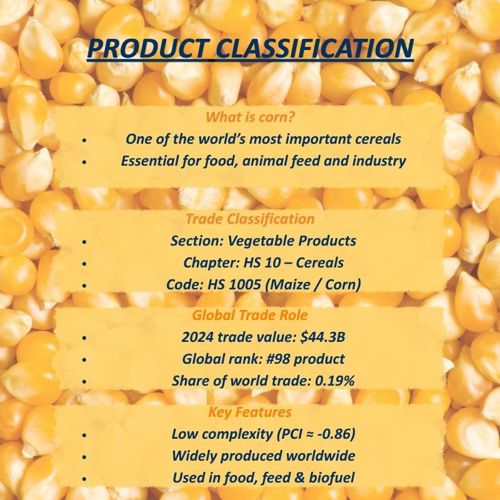
PRODUCT CLASSIFICATION
Corn, also known as maize, is one of the world’s most important agricultural commodities. Recognizable by its golden kernels and distinctive cobs, corn plays a central role not only in human diets but also in animal feed and industrial production. Rich in carbohydrates and widely adaptable, it is a cornerstone of global food systems, supporting everything from tortillas and cereals to biofuels and processed ingredients.
From a trade perspective, corn belongs to the Vegetable Products section, specifically under HS Chapter 10: Cereals, classified under HS Code 1005. Unlike niche crops, corn stands out for its versatility; it is consumed directly as food, processed into derivatives like starch and syrup, and used extensively in livestock feed and energy production.
In 2024, global trade in corn reached $44.3B, although this represented a 21.3% decrease from 2023 ($56.4B), reflecting price corrections and shifting demand dynamics. Over the past five years, however, corn trade has maintained a positive annual growth rate of 2.84%, confirming its long-term relevance in global markets.
Among traded goods, corn ranked 98th worldwide, accounting for about 0.19% of global trade. In terms of sophistication, it is a relatively simple product, with a Product Complexity Index (PCI) of –0.86, consistent with its nature as a widely cultivated staple.
EXPORT
Global corn exports are dominated by large-scale agricultural producers with vast land availability and advanced farming systems.
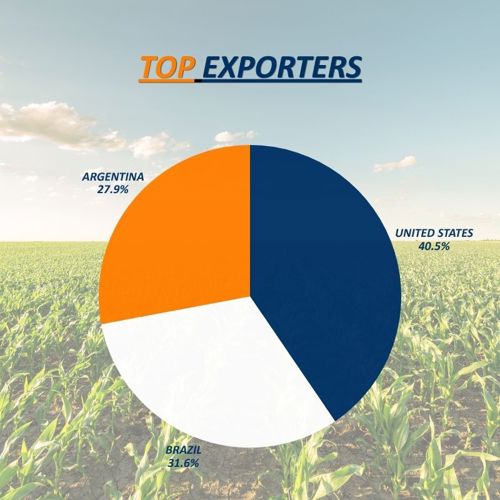
The top exporters are:
• United States – $10.6B
• Brazil – $8.41B
• Argentina – $7.22B
The United States leads the global market thanks to its high yields, advanced mechanization, and strong logistics infrastructure. Brazil and Argentina, key players in Latin America, benefit from favorable climates and expanding agricultural frontiers, enabling them to compete strongly on price and volume.
Countries where corn represents a significant share of exports tend to be highly specialized agricultural economies, where cereal production is a major economic driver; these include countries in South America and Eastern Europe, where corn exports contribute meaningfully to trade balances.
The largest trade surpluses in 2024 were recorded by:
• United States – $10.4B
• Brazil – $8.11B
• Argentina – $7.18B
These figures highlight the concentration of supply in a few powerhouse exporters, whose production surpluses feed global demand.
IMPORT
On the demand side, corn imports are driven largely by countries with strong livestock industries, food-processing sectors, or limited domestic production capacity.
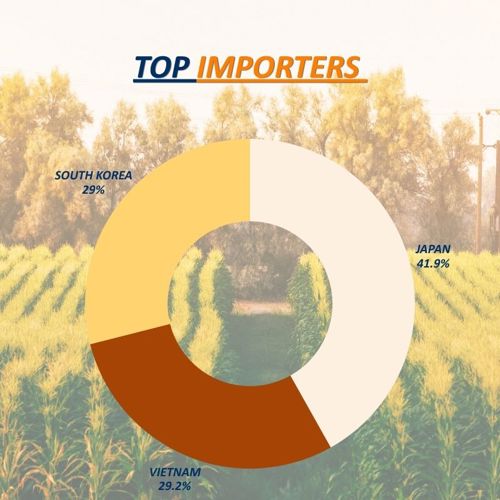
The top importers are:
• Japan – $3.6B
• Vietnam – $2.51B
• South Korea – $2.49B
Japan and South Korea rely heavily on imported corn for animal feed and food processing, as their domestic agricultural land is limited. Vietnam has emerged as a rapidly growing importer due to expanding feed demand linked to its livestock sector.
The largest trade deficits were registered by:
• Japan – –$3.6B
• South Korea – –$2.48B
• Vietnam – –$2.42B
These deficits reflect structural dependence on external supply, particularly in regions where domestic production cannot meet demand due to climate, land constraints, or economic specialization.
CURIOSITY CORNER: THE GLOBAL STORY OF CORN
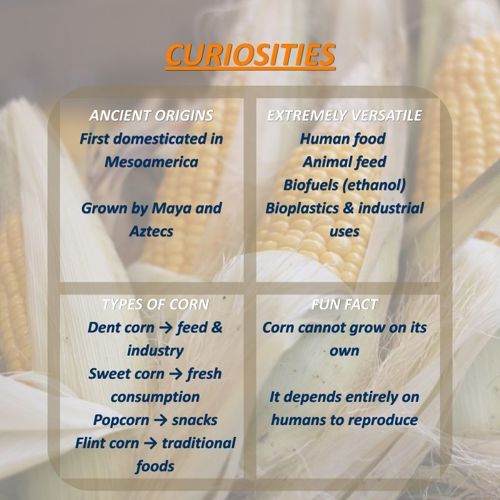
Corn has a fascinating history that stretches back thousands of years. Originally domesticated in Mesoamerica, it was cultivated by ancient civilizations like the Maya and Aztecs long before becoming a global commodity; today, it is grown on every continent except Antarctica.
One of corn’s most surprising features is its versatility; beyond food, it is used to produce ethanol (biofuel), biodegradable plastics, and even pharmaceutical ingredients. In fact, a large share of global corn production never reaches the dinner table directly but is instead used as animal feed or industrial input.
There are also many different varieties of corn, each suited to specific uses:
• Dent corn for feed and industrial processing
• Sweet corn for human consumption
• Popcorn for snacks
• Flint corn for traditional dishes like polenta
Another curious fact: corn cannot reproduce without human intervention. Its kernels are tightly wrapped in husks and do not disperse naturally, meaning the plant depends entirely on farmers to propagate, making it one of the most human-dependent crops in agriculture.
CONCLUSION
The global corn trade highlights both the scale and the complexity of one of the world’s most essential commodities. Despite a temporary decline in trade value, corn remains a pillar of international agriculture, driven by its multifunctional role in food, feed, and industry.
Major exporters such as the United States, Brazil, and Argentina continue to dominate supply, leveraging large-scale production and efficient logistics. At the same time, key importers in Asia, including Japan, Vietnam, and South Korea, reflect strong and consistent demand tied to industrial and livestock needs.
Although corn is classified as a low-complexity product, its global trade depends on highly coordinated supply chains, climatic conditions, and evolving consumption patterns. As demand for food security, biofuels, and livestock production grows, corn is expected to remain at the heart of agricultural trade, simple in form, yet indispensable in function.