
COUNTRY OVERVIEW
South Africa is one of the most diversified and industrialized economies in Africa, often seen as a natural entry point into the broader sub-Saharan market. Its strategic geographic position, developed infrastructure, and established financial system make it a key player in regional and global trade.
With a GDP of around $400 billion, the country ranks among the largest economies globally and continues to maintain a relevant position in international commerce.
Despite internal structural challenges, South Africa remains a crucial hub for companies seeking both market access and trade connectivity across Africa and beyond.
ECONOMIC PROFILE AND COMPLEXITY
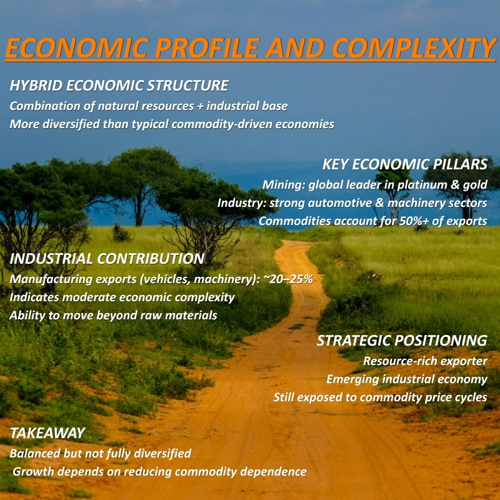
South Africa’s economic profile reflects a hybrid structure, combining natural resource wealth with a relatively advanced industrial base.
Mining plays a central role, with the country being one of the world’s leading producers of platinum, gold, and other mineral resources; these sectors form the backbone of exports and contribute significantly to trade performance.
At the same time, South Africa demonstrates a moderate level of economic complexity, thanks to its ability to export manufactured goods such as vehicles and machinery, which account for roughly 20–25% of total exports.
Overall, commodities, including precious metals and minerals, make up just over 50% of exports, highlighting a strong dependence on natural resources but also a degree of diversification compared to more traditional commodity-driven economies.
This dual structure positions South Africa as:
• More advanced than resource-dependent economies
• Yet still sensitive to global commodity cycles
TRADE PROFILE
South Africa is deeply integrated into global trade flows, with exports exceeding $150 billion and imports around $100 billion, resulting in a consistent trade surplus.
EXPORTS
Exports are largely driven by the mining sector, supported by a solid industrial component.
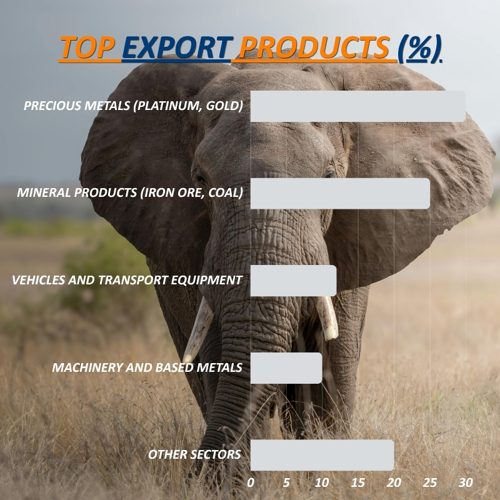
A simplified export composition is:
• Precious metals (platinum, gold): ~25–30%
• Mineral products (iron ore, coal): ~20–25%
• Vehicles and transport equipment: ~10–12%
• Machinery and base metals: ~8–10%
• Other sectors: ~20%
This confirms that while South Africa is strongly resource-oriented, it also benefits from a competitive manufacturing sector, particularly in automotive production.
Among these, platinum stands out as a strategic export, with South Africa holding a significant share of global supply.
IMPORTS
Imports reflect the country’s industrial needs and structural dependencies.
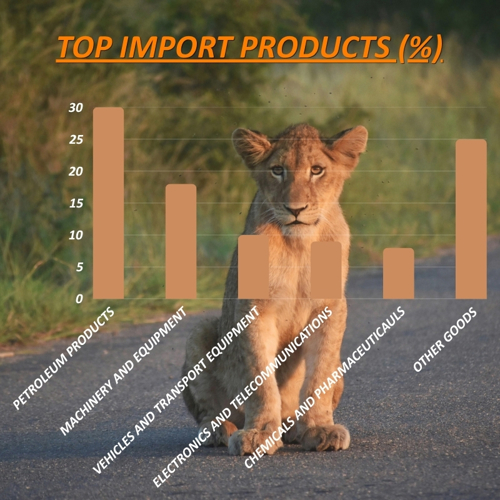
A simplified breakdown is:
• Petroleum products (refined + crude): ~25–30%
• Machinery and equipment: ~15–18%
• Vehicles and transport equipment: ~8–10%
• Electronics and telecommunications: ~7–9%
• Chemicals and pharmaceuticals: ~8–10%
• Other goods: ~25%
Energy imports alone account for close to one-third of total imports, highlighting a key vulnerability in the economic structure.
TRADE PARTNERS
South Africa maintains a well-diversified network of global trade relationships.
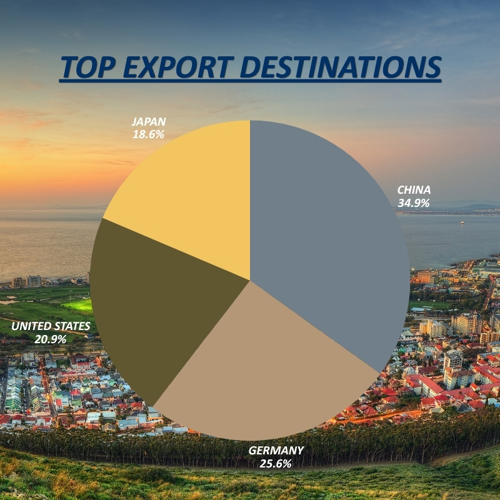
MAIN EXPORT DESTINATIONS
• China (~13–15%)
• Germany (~10–11%)
• United States (~8–9%)
• Japan (~7–8%)
China is the leading destination, particularly for mineral exports.
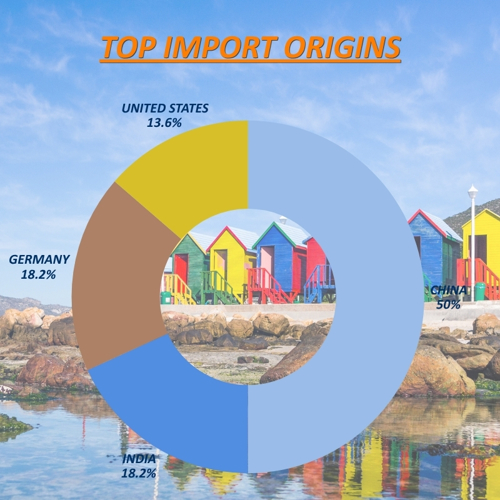
MAIN IMPORT PARTNERS
• China (~20–22%)
• India (~7–8%)
• Germany (~7–8%)
• United States (~5–6%)
China also dominates imports, reinforcing its central role in South Africa’s trade ecosystem.
TRADE TRENDS
South Africa consistently records a positive trade balance, with exports exceeding imports by approximately $50 billion.
Export growth has remained steady, supported by global demand for commodities, while imports grow at a slightly more moderate pace. This dynamic has helped maintain external stability.
However, the country’s performance remains closely tied to international market conditions, particularly commodity prices, which continue to play a decisive role in overall trade trends.
CURIOSITY CORNER
Beyond the key figures, South Africa presents some interesting characteristics that help better understand its economic identity.
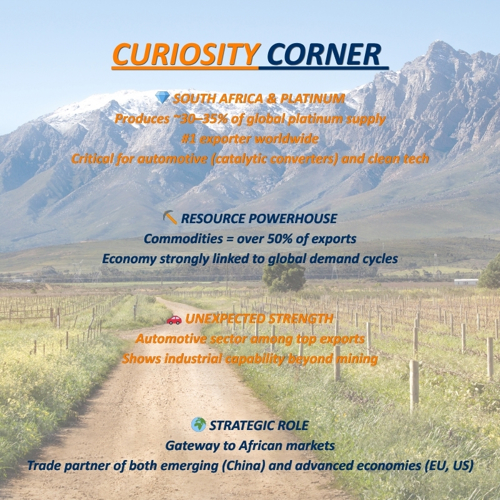
One of the most striking aspects is its dominance in the platinum market. The country is the world’s leading exporter and accounts for a significant share of global supply, making platinum a strategic resource not only for traditional industries but also for emerging technologies, particularly in the automotive and clean energy sectors.
Another notable feature is the contrast within its export structure; while over half of total exports are still linked to commodities, South Africa has managed to develop a competitive automotive sector, which ranks among its top export industries. This highlights a level of industrial capability that is not always associated with resource-driven economies.
Finally, South Africa’s role as a global trade connector is worth noting. The country maintains strong relationships with both advanced economies, such as the United States and Germany, and major emerging markets like China, reinforcing its position as a bridge between different economic regions.
Overall, these elements underline a key takeaway: South Africa is not simply a commodity exporter, but a complex and evolving market, where natural resources, industrial development, and global integration coexist.
CONCLUSION
South Africa is a complex and strategically important market, combining elements of both developed and emerging economies.
Its trade structure, driven by commodities but supported by industrial production, offers clear opportunities, while also requiring careful risk assessment. With strong global connections and regional influence, South Africa continues to play a pivotal role in international trade.