PRODUCT CLASSIFICATION
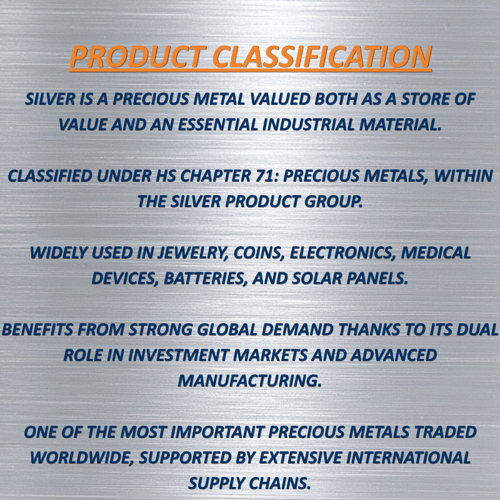
Silver is one of the world’s most valuable and versatile precious metals, prized for its unique combination of beauty, conductivity, durability, and industrial usefulness. While traditionally associated with jewelry, coins, and investment products, silver has become increasingly important in modern technologies, including solar panels, electronics, medical devices, batteries, and advanced manufacturing.
From a trade perspective, silver belongs to the Precious Metals category and is classified under HS Chapter 71: Natural or cultured pearls, precious stones and precious metals, specifically within the silver product group. Unlike many commodities that serve a single purpose, silver occupies a dual role as both an industrial raw material and a store of value, making its market dynamics closely linked to manufacturing activity, technological innovation, and investor sentiment.
Global silver trade exceeds tens of billions of dollars annually, placing it among the most significant mineral-based commodities in international commerce. Its widespread use across multiple industries ensures consistent global demand, while its limited geographical distribution creates extensive cross-border trade flows.
Among thousands of products traded worldwide, silver ranks among the most commercially important precious metal categories. Its Product Complexity Index reflects a product that combines resource extraction, refining expertise, advanced processing capabilities, and sophisticated international trading networks.
EXPORT
Silver exports are dominated by a combination of major refining centers, global trading hubs, and leading mining economies.
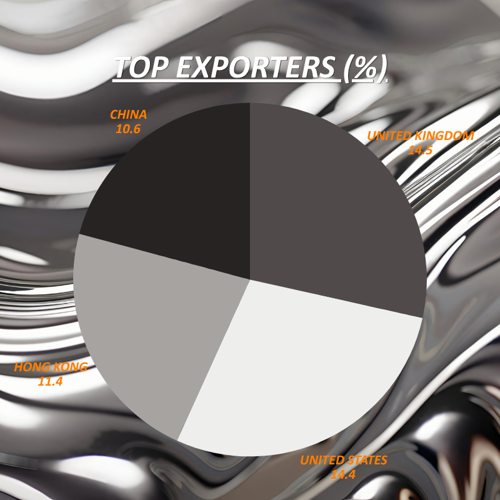
The top exporters are:
• United Kingdom: 14.5% of global silver exports
• United States: 14.4%
• Hong Kong: 11.4%
• China: 10.6%
• Mexico: 6.8%
• Switzerland: 6.4%
• Germany: 6.1%
Together, these seven countries account for more than 70% of worldwide silver exports, highlighting the concentration of international silver trade within a relatively small group of highly specialized markets. The United Kingdom remains the world's leading exporter thanks to London's role as a global bullion trading center, while Hong Kong acts as a strategic gateway for precious metals entering Asian markets. Switzerland continues to leverage its world-renowned refining industry, processing and redistributing large volumes of silver across international supply chains.
Countries where silver represents the largest share of total exports include:
• Bolivia: 4.8%
• Peru: 2.5%
• Mexico: 1.7%
These figures demonstrate the strategic importance of silver mining for several Latin American economies, where the metal remains a significant source of export earnings and economic activity.
IMPORT
Global silver imports are largely driven by industrial demand, investment activity, jewelry manufacturing, and the growing renewable energy sector.
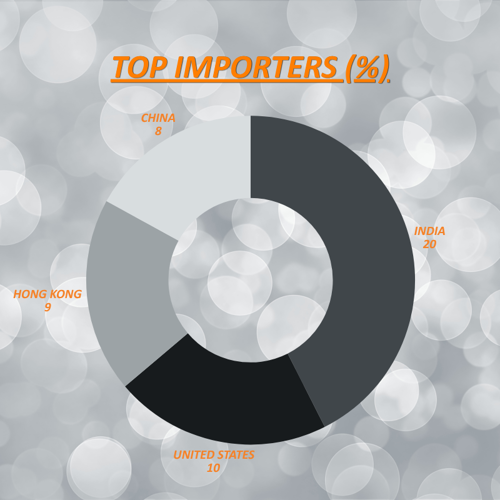
The leading importers are:
• India: approximately 15-20% of global silver imports
• United States: approximately 8-10%
• Hong Kong: approximately 7-9%
• China: approximately 6-8%
India is by far the largest consumer market, supported by strong demand from the jewelry sector, traditional investment purchases, and expanding industrial applications. The United States imports substantial quantities to meet the needs of advanced manufacturing industries, electronics producers, and investors. Meanwhile, Hong Kong and China play crucial roles in distributing silver throughout Asian markets and supporting large-scale industrial production.
The largest trade deficits are generally recorded by India, the United States, and China, reflecting domestic consumption levels that exceed local production capacity and reinforce their dependence on international suppliers.
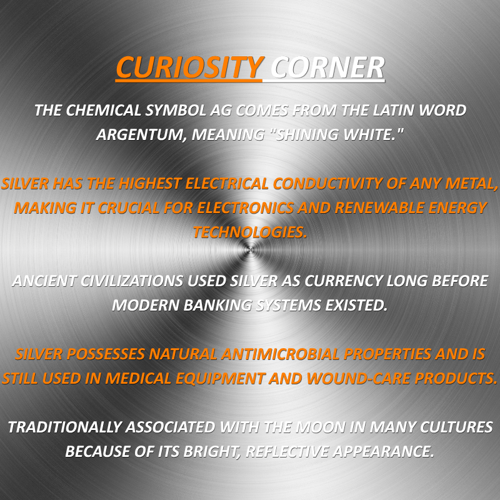
CURIOSITY CORNER: THE SHINING STORY OF SILVER
Despite often living in the shadow of gold, silver has played a critical role in human history for more than 5,000 years. In fact, the word silver appears in numerous ancient languages and was once considered so valuable that it frequently served as money, helping shape the development of international trade.
Silver possesses the highest electrical conductivity of any metal on Earth, making it indispensable in modern electronics and renewable-energy technologies. A typical smartphone contains small amounts of silver, while solar photovoltaic panels rely heavily on silver-based conductive materials.
Another fascinating fact is that silver has remarkable antimicrobial properties. Long before the discovery of modern antibiotics, people used silver containers to preserve water and food. Today, silver is still incorporated into medical equipment, wound dressings, and specialized coatings that help prevent bacterial growth.
Silver also has a strong connection to astronomy and culture. The chemical symbol Ag derives from the Latin word argentum, meaning "shining" or "white." Throughout history, many civilizations associated silver with the moon because of its bright, reflective appearance.
CONCLUSION
Silver remains one of the most strategically important commodities in global trade. Its unique position as both a precious metal and an industrial input allows it to serve a wide range of markets, from jewelry and investment products to cutting-edge technologies and renewable energy systems.
Major exporters such as the United Kingdom, Switzerland, and Hong Kong continue to dominate international distribution networks, while large consumer markets including India, the United States, and China drive global demand. As industries increasingly adopt advanced electronics, electric technologies, and solar energy infrastructure, silver's economic importance is expected to remain strong.
Unlike many traditional commodities, silver combines historical significance with modern relevance, making it a metal that continues to connect financial markets, industrial production, and technological innovation across the global economy.
