
PRODUCT CLASSIFICATION
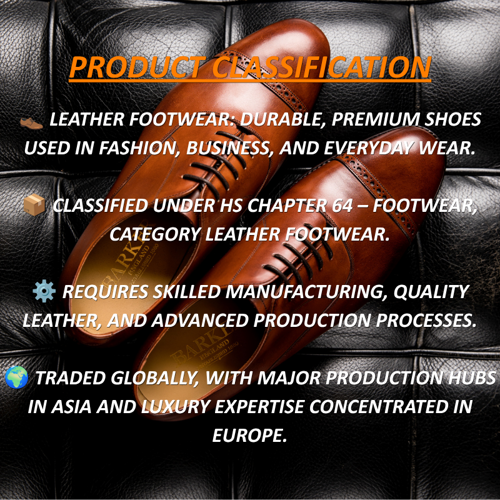
Leather footwear is one of the most iconic and enduring categories within the global fashion and manufacturing industry. Combining craftsmanship, durability, comfort, and style, leather shoes occupy a premium position in both developed and emerging markets. From luxury dress shoes made in Italy to mass-produced footwear exported across Asia, leather footwear remains a cornerstone of international consumer goods trade.
From a commercial perspective, leather footwear is classified under HS Code 6403, covering footwear with outer soles of rubber, plastics, leather, or composition leather and uppers made of leather. It belongs to the Footwear and Headwear section of the Harmonized System and represents one of the most valuable footwear categories traded worldwide. According to the Observatory of Economic Complexity (OEC), leather footwear accounts for approximately 0.26% of total world trade, making it the 76th most traded product globally.
Global trade in leather footwear is valued at around $59.1 billion, reflecting the product's importance within the fashion, retail, and manufacturing sectors. Although the industry has matured in many markets, international trade has continued to expand steadily, with an average annual growth rate of about 1.39% over the past five years.
In terms of economic sophistication, leather footwear records a Product Complexity Index (PCI) of -0.57, ranking 746th among traded products. This position reflects the combination of traditional manufacturing processes, skilled labor requirements, global supply chains, and brand-driven market dynamics that characterize the sector.
EXPORT
The global export landscape for leather footwear is dominated by countries that have developed strong manufacturing capabilities, established supplier networks, and internationally recognized footwear industries.
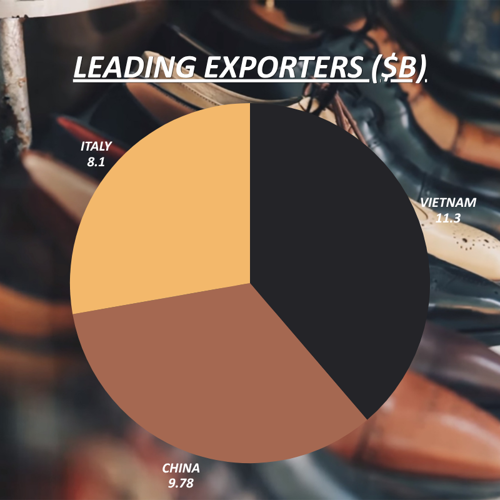
The leading exporters are:
• Vietnam – $11.3B (19.1% of global exports)
• China – $9.78B (16.5%)
• Italy – $8.16B (13.8%)
Together, these three countries account for almost 49.4% of worldwide leather footwear exports, highlighting a highly concentrated production base.
Vietnam has emerged as the global leader thanks to large-scale manufacturing operations, competitive labor costs, and significant foreign investment from major international footwear brands.
China remains a critical player due to its extensive industrial ecosystem and integrated supply chains, while Italy continues to dominate the premium and luxury segments through its reputation for quality craftsmanship, design excellence, and renowned footwear districts.
Other important exporting countries include Indonesia, Germany, India, Portugal, Belgium, and Spain, all of which benefit from strong production capabilities and well-established access to international markets.
The largest trade surpluses are concentrated among major manufacturing economies, reflecting their role as global production hubs and their ability to export far more footwear than they consume domestically.
IMPORT
Demand for leather footwear is largely driven by affluent consumer markets, fashion-conscious populations, and countries with limited domestic production relative to consumption.
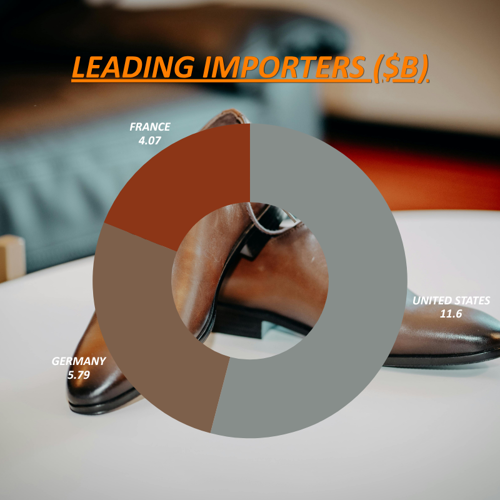
The world's leading importers are:
• United States – $11.6B (19.6% of global imports)
• Germany – $5.79B (9.8%)
• France – $4.07B (6.9%)
Combined, these three markets represent approximately 36.3% of global leather footwear imports, demonstrating the central role of North America and Western Europe in driving international demand.
The United States is the largest importer by a wide margin, supported by a vast retail market and strong demand across all price segments, from mass-market products to luxury brands. Germany serves as Europe's largest footwear distribution and consumption hub, while France's position reflects its importance within the global fashion and luxury industries.
Major trade deficits are typically observed in economies where consumer demand significantly exceeds domestic production capacity. These deficits underscore the dependence of many advanced economies on international supply chains to satisfy market demand for leather footwear.
CURIOSITY CORNER: THE STORY INSIDE A PAIR OF LEATHER SHOES
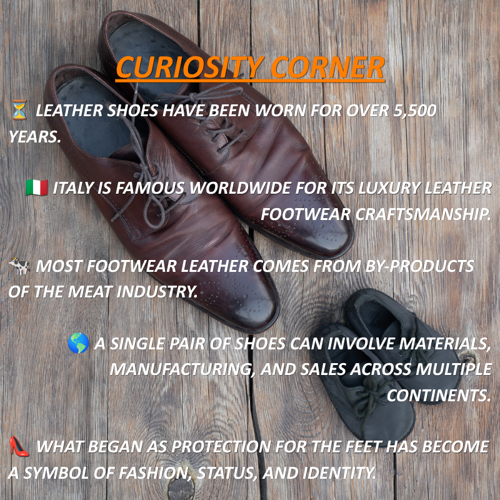
A pair of leather shoes may appear simple, but it is often the result of a remarkably complex international journey. The leather itself might originate from South America, be processed in Asia, assembled in Vietnam, designed in Italy, and ultimately sold in Europe or North America. This global value chain makes leather footwear one of the clearest examples of modern manufacturing globalization.
Interestingly, some of the world's most famous shoe-making traditions date back centuries. Italian regions such as Tuscany and Marche have built global reputations on artisanal leather craftsmanship, while cities like Northampton in the United Kingdom are still celebrated for their heritage of handmade footwear.
Leather footwear also occupies a unique position between fashion and function. Unlike many fast-fashion products, high-quality leather shoes are often viewed as long-term investments due to their durability, repairability, and timeless design.
Another little-known fact is that luxury leather footwear brands often produce relatively small quantities compared to mass-market manufacturers, yet generate substantially higher export values because of premium pricing and brand prestige.
CONCLUSION
Leather footwear remains one of the most valuable and internationally traded products in the global fashion industry. With trade exceeding $59 billion and representing approximately 0.26% of world merchandise trade, the sector continues to connect manufacturers, suppliers, retailers, and consumers across every continent.
Exports are heavily concentrated in manufacturing leaders such as Vietnam (19.1%), China (16.5%), and Italy (13.8%), while demand is driven primarily by the United States (19.6%), Germany (9.8%), and France (6.9%). These figures highlight the strong interdependence between production hubs and consumer markets that defines the modern footwear industry.
Although leather footwear is often associated with tradition and craftsmanship, its global success increasingly depends on sophisticated supply chains, branding strategies, sustainability initiatives, and international logistics networks. As consumers continue to value quality, durability, and design, leather footwear is expected to remain a key product in global trade for years to come.
