OVERVIEW
Greenland is often associated with vast glaciers, Arctic landscapes, and a relatively small population, but behind its remote geography lies an economy deeply connected to international trade. As the world's largest island, Greenland occupies a strategic position between North America and Europe, while its abundant marine resources have shaped its economic development for decades. Despite its limited domestic market, international trade plays a crucial role in supporting economic activity, providing essential imports and generating export revenues through highly specialized industries.
The country maintains a unique economic structure characterized by a strong dependence on fishing and seafood exports, combined with a significant reliance on imported manufactured goods, machinery, fuel, and consumer products. This combination creates both opportunities and challenges, making Greenland one of the most distinctive trading economies in the Arctic region.
ECONOMIC PROFILE AND COMPLEXITY
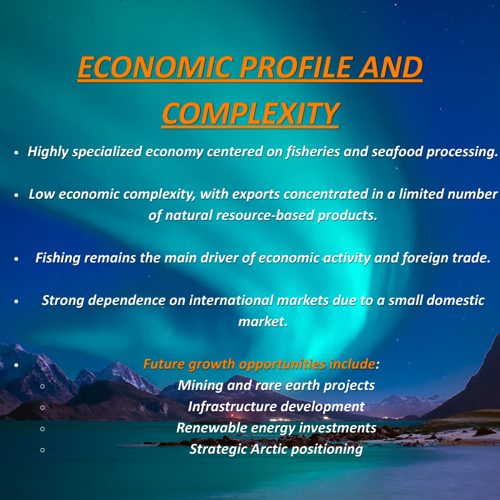
Greenland's economy is relatively small in global terms, but it demonstrates a high degree of specialization. Unlike diversified industrial economies, Greenland's productive capacity is concentrated in a limited number of sectors, particularly fisheries and seafood processing. This specialization allows the country to compete internationally despite its remote location and challenging climatic conditions.
Economic complexity remains comparatively low, reflecting a narrow export basket focused on natural resource-based products rather than advanced manufacturing. Nevertheless, this specialization has enabled Greenland to establish strong commercial relationships with international markets that value premium seafood products sourced from Arctic waters.
Several long-term opportunities could influence Greenland's economic trajectory, including investments in mining, infrastructure development, renewable energy projects, and the growing geopolitical importance of the Arctic region. Together, these factors may gradually contribute to a broader economic base and greater diversification in the future.
EXPORTS
Exports are the backbone of Greenland's economy. Seafood products overwhelmingly dominate outbound trade, highlighting the country's dependence on marine resources and commercial fishing activities.
The leading export category is fish and seafood products, which account for approximately 95% of total exports, confirming Greenland's position as one of the world's most specialized seafood exporters.
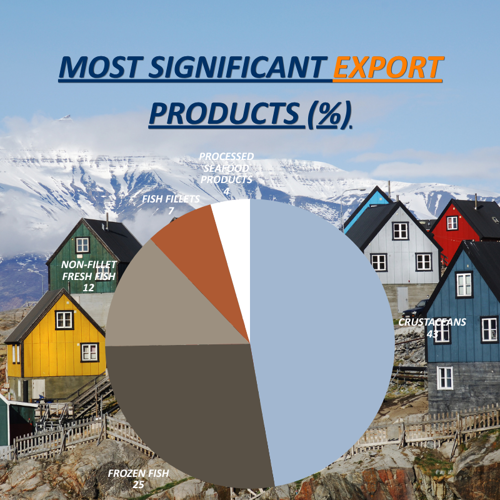
Among the most significant export products are:
• Crustaceans: approximately 43% of total exports
• Frozen Fish: approximately 25%
• Non-fillet Fresh Fish: approximately 12%
• Fish Fillets: approximately 7%
• Processed Seafood Products: approximately 4%
Together, these categories represent more than 90% of Greenland's export value, illustrating the central role of the fishing industry in the national economy.
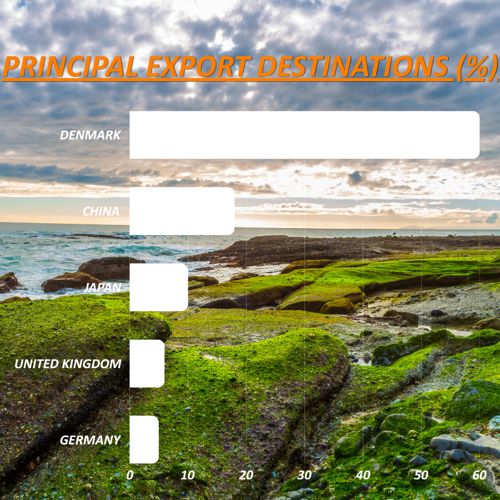
The country's principal export destinations include:
• Denmark: around 55-60% of exports
• China: around 15-18%
• Japan: around 8-10%
• United Kingdom: around 4-6%
• Germany: around 3-5%
These figures underline Greenland's strong commercial ties with both European and Asian markets, where demand for premium seafood products remains particularly robust.
IMPORTS
Due to its limited industrial base and harsh geographical conditions, Greenland depends heavily on imports to meet domestic demand. The country imports a wide range of products, from industrial machinery and transportation equipment to food products and fuel.
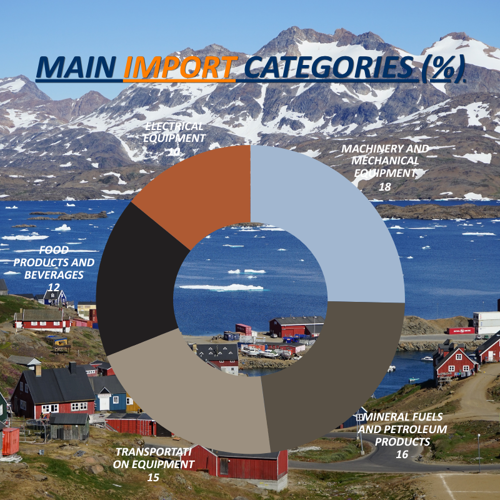
The main import categories include:
• Machinery and mechanical equipment: approximately 18% of total imports
• Mineral fuels and petroleum products: approximately 16%
• Transportation equipment: approximately 15%
• Food products and beverages: approximately 12%
• Electrical equipment: approximately 10%
Combined, these sectors represent more than 70% of Greenland's imports, highlighting the economy's dependence on external suppliers for both industrial and consumer needs.
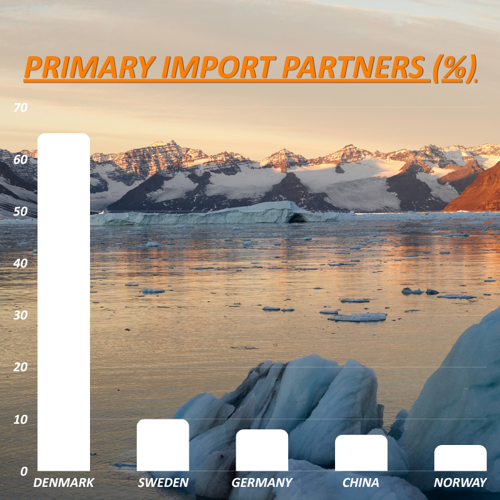
The country's primary import partners are:
• Denmark: roughly 60-65% of imports
• Sweden: around 8-10%
• Germany: around 6-8%
• China: around 5-7%
• Norway: around 3-5%
The dominant role of Denmark reflects historical, economic, and logistical links that continue to shape Greenland's trade network.
TRADE BALANCE
Greenland traditionally records a trade deficit, as imports of machinery, fuel, consumer goods, and infrastructure-related products often exceed export revenues from seafood products.
However, the size of the deficit can fluctuate considerably depending on global seafood prices, fishing volumes, fuel costs, and investment cycles. Strong demand for Arctic seafood products can significantly improve trade performance, while periods of increased infrastructure investment often drive higher import spending.
This dynamic highlights one of Greenland's most important economic characteristics: while the country benefits from a highly competitive fishing sector, it remains exposed to changes in global commodity markets and international demand patterns.
CURIOSITY CORNER
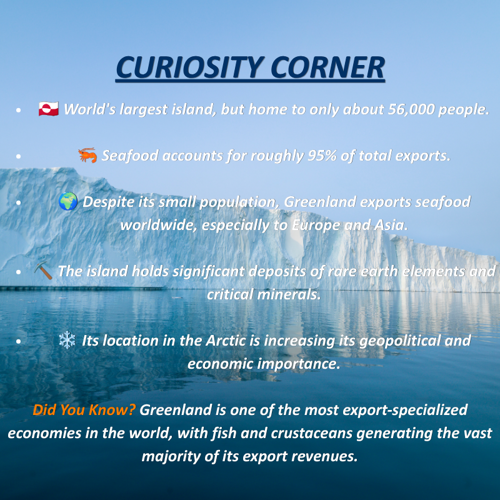
Greenland may be one of the world's least populated territories, but it plays an outsized role in global seafood trade. Despite having a population of only around 56,000 people, the country exports seafood products to markets across Europe, Asia, and North America.
Another fascinating aspect is the extraordinary concentration of its export portfolio. In many diversified economies, the largest export product rarely exceeds 15-20% of total exports. In Greenland, seafood products dominate to such an extent that fish and crustaceans alone account for well over two-thirds of all export revenues.
The island's growing strategic importance is also attracting international attention. Beyond fishing, Greenland possesses significant deposits of rare earth elements and other minerals that could become increasingly important for global supply chains linked to renewable energy technologies and advanced manufacturing.
CONCLUSION
Greenland represents a unique case in international trade: a small Arctic economy whose global relevance far exceeds its size. Its exceptional specialization in seafood exports has enabled the country to establish valuable commercial relationships with major markets across Europe and Asia, while imports remain essential for supporting daily life, industrial operations, and infrastructure development.
Although economic complexity remains limited compared to larger industrialized nations, Greenland's combination of strategic location, rich natural resources, and strong export expertise provides a solid foundation for future growth.
As global interest in Arctic resources and trade routes continues to increase, Greenland is likely to remain an increasingly important player in the northern economy, balancing its traditional strengths in fisheries with emerging opportunities in mining, energy, and international investment.
