OVERVIEW
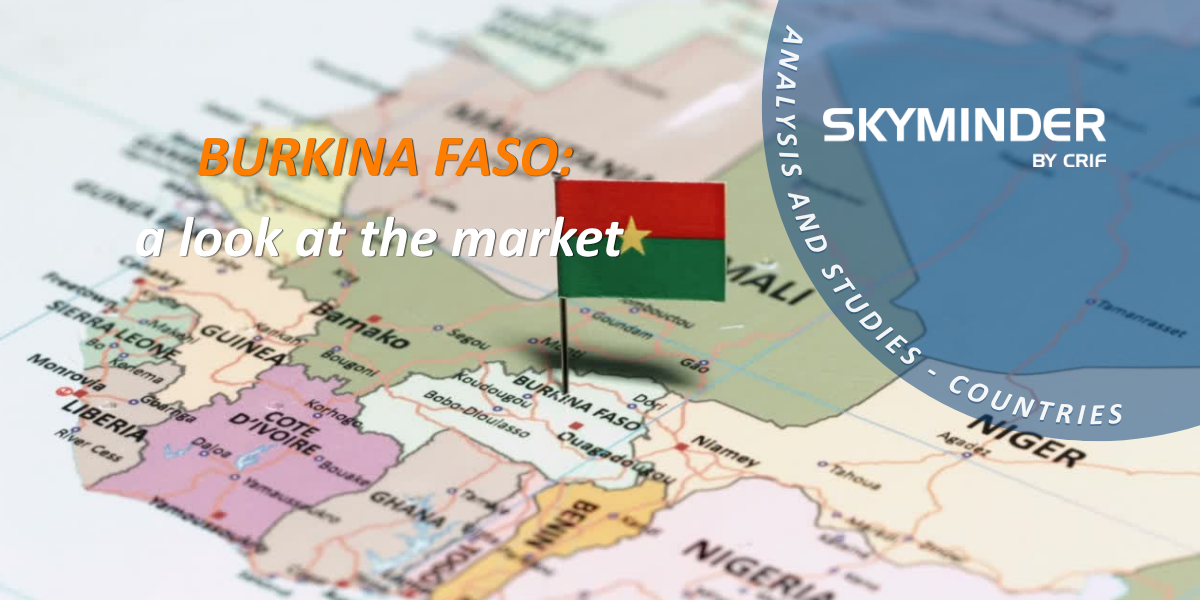
Burkina Faso is a landlocked country located in West Africa, strategically positioned at the heart of the region and sharing borders with six neighboring nations. Despite geographical challenges and limited access to seaports, the country has developed strong trade relationships and established itself as one of Africa’s leading gold-producing nations. Its economy is largely driven by mining, agriculture, and a growing services sector.
With a population of more than 23 million people and a young, rapidly expanding workforce, Burkina Faso offers long-term opportunities in sectors such as agribusiness, mining services, infrastructure, renewable energy, telecommunications, and consumer goods. The country's trade profile highlights both its natural resource wealth and its dependence on imported industrial and consumer products.
ECONOMIC PROFILE AND COMPLEXITY
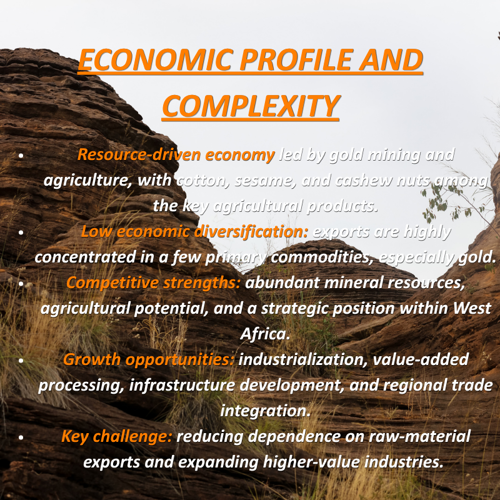
Burkina Faso’s economy is characterized by a strong concentration in commodity exports, particularly gold, which remains the backbone of the country's export sector. Agriculture also plays a significant role, employing a large share of the population and contributing substantially to national income through products such as cotton, sesame seeds, and cashew nuts.
According to the Economic Complexity Index (ECI), Burkina Faso ranks among the less diversified economies globally, reflecting a production structure heavily focused on raw materials rather than high-value manufactured goods. While this presents challenges in terms of economic resilience, it also highlights significant opportunities for industrialization, value-added processing, and export diversification.
The country's trade competitiveness is supported by rich mineral resources and favorable agricultural conditions. However, future growth will likely depend on investments in industrial capacity, infrastructure, technology transfer, and regional integration within the West African market.
EXPORTS
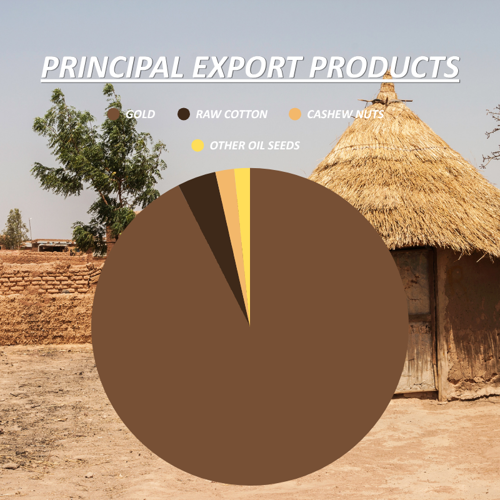
Exports are heavily dominated by gold, making Burkina Faso highly dependent on fluctuations in global commodity prices. The metal accounts for approximately 87% of total exports, underscoring its critical importance to the national economy.
The country's principal export products include:
• Gold: approximately 87% of total exports
• Raw Cotton: around 3.7%
• Cashew Nuts: approximately 1.8%
• Other Oil Seeds: around 1.5%
• Cement: approximately 0.7%
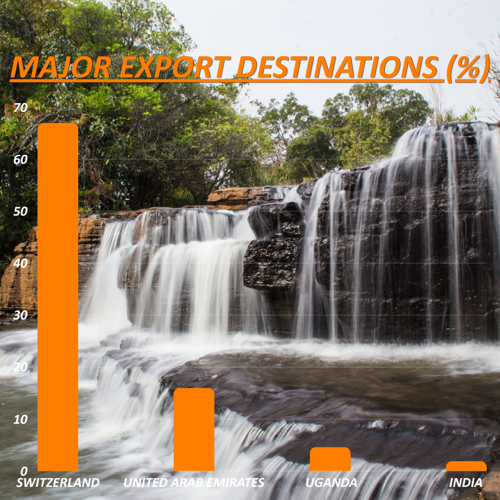
Burkina Faso's export destinations are similarly concentrated:
• Switzerland: about 67% of exports
• United Arab Emirates: approximately 16%
• Uganda: around 4.6%
• India: nearly 1.9%
• Côte d'Ivoire: approximately 1.8%
The dominance of precious metals has allowed Burkina Faso to generate substantial export revenues, but the limited diversification of its export basket exposes the economy to external shocks. Expanding value-added agricultural exports and developing manufacturing capabilities could reduce this dependency over time.
IMPORTS
As a developing economy with growing industrial needs, Burkina Faso relies heavily on imports for energy, machinery, pharmaceuticals, construction materials, and food products. These imports support domestic consumption and economic development while compensating for limited local production in several sectors.
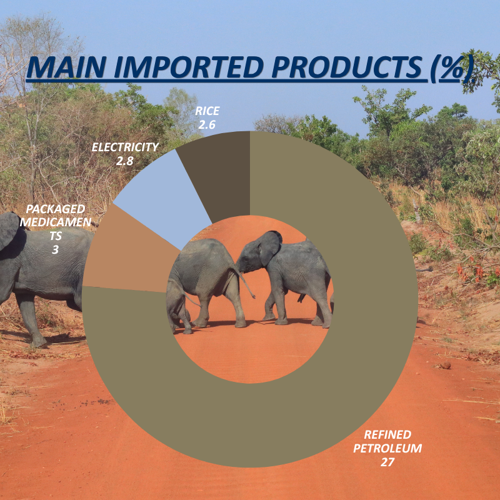
The main imported products are:
• Refined Petroleum: approximately 27% of total imports
• Packaged Medicaments: around 3%
• Electricity: nearly 2.8%
• Rice: approximately 2.6%
• Cement Clinker and Construction Materials: around 2.2%
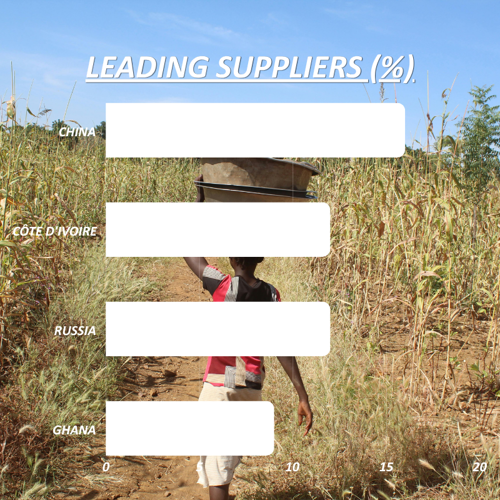
The leading suppliers to Burkina Faso include:
• China: approximately 16% of imports
• Côte d'Ivoire: around 12%
• Russia: nearly 12%
• Ghana: approximately 9%
• France: around 5%
China's strong presence reflects its role as a key provider of machinery, electronics, and manufactured goods, while neighboring African countries are important suppliers of energy and regional trade products.
TRADE BALANCE
Burkina Faso maintains a generally positive merchandise trade balance, largely thanks to strong gold exports. Export revenues from the mining sector frequently exceed the value of imported goods, making the country one of the few resource-driven economies in the region capable of generating significant external trade surpluses.
Exports amount to roughly $9.5 billion, while imports reach approximately $6.3 billion, resulting in a trade surplus of more than $3 billion.
This surplus provides valuable foreign currency earnings and strengthens the country's external position. However, the heavy reliance on a single export commodity means that global gold prices remain a crucial factor influencing economic performance.
CURIOSITY CORNER
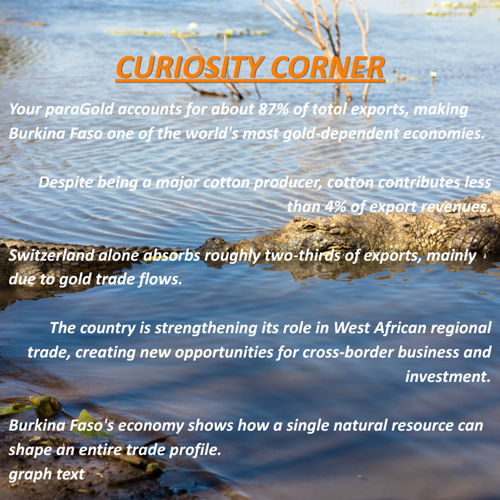
One of the most fascinating aspects of Burkina Faso's economy is the extraordinary dominance of gold. Few countries in the world depend so heavily on a single export product, with gold generating nearly nine-tenths of total export revenues.
Another interesting fact is that although Burkina Faso is one of Africa's largest cotton producers, cotton represents only a small fraction of export earnings compared to gold. This highlights how rapidly the mining sector has transformed the country's economic structure over the past two decades.
The country is also increasing its role in regional trade networks through the Economic Community of West African States (ECOWAS), strengthening commercial ties with neighboring markets and creating new opportunities for businesses seeking access to West Africa.
CONCLUSION
Burkina Faso presents a market of contrasts: rich in natural resources yet still progressing toward greater economic diversification. Gold remains the undisputed engine of trade, driving export revenues and generating a substantial trade surplus. At the same time, the country's dependence on imported energy, manufactured goods, and pharmaceuticals highlights ongoing development needs.
For international companies, Burkina Faso offers opportunities in mining, agribusiness, infrastructure, renewable energy, logistics, healthcare, and industrial development. As efforts to diversify the economy continue, the country has the potential to evolve from a commodity-driven exporter into a more balanced and resilient market, capable of creating value across multiple sectors.
