PRODUCT CLASSIFICATION
Ground nuts, commonly known as peanuts, are among the world’s most widely traded oilseed crops and an essential source of plant-based protein, healthy fats, vitamins, and minerals. Despite being popularly grouped with tree nuts, ground nuts are actually legumes that grow underground. Their versatility makes them a staple ingredient in snacks, confectionery products, peanut butter, edible oils, animal feed, and an increasing range of plant-based food products.
From a trade perspective, ground nuts belong to the Vegetable Products section and are classified under HS Chapter 12: Oil seeds, oleaginous fruits, grains, straw and fodder, specifically under HS4 1202 - Ground nuts, not roasted or otherwise cooked, whether or not shelled or broken. Their broad range of applications and strong demand across food manufacturing industries make them a key commodity in international agricultural trade.
Global trade in ground nuts is valued at approximately $4.82 billion, representing about 0.021% of total world trade. Trade has expanded steadily in recent years, supported by growing consumption of protein-rich foods, the rising popularity of peanut-based products, and increasing demand from both developed and emerging markets.
Among internationally traded products, ground nuts rank 559th worldwide by trade value. According to the Product Complexity Index (PCI), they score-2.13, placing them among the least complex traded goods. This reflects the relatively straightforward nature of their cultivation and processing, while highlighting how a simple agricultural commodity can still generate significant economic value on a global scale.
EXPORT
Ground nut exports are led by a combination of large-scale agricultural producers with favorable climates and well-established export infrastructures.
The leading exporters are:
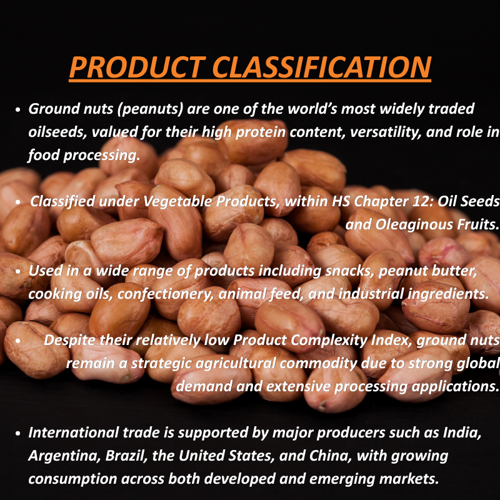
• Argentina - $929M
• India - $883M
• United States - $671M
Argentina holds the leading position in global exports thanks to its highly efficient peanut industry, advanced processing facilities, and strong presence in international food markets. India benefits from extensive cultivation areas and a large agricultural workforce, while the United States combines high productivity with advanced farming technologies and strong global distribution networks.
Based on total export value, these countries account for approximately:
• Argentina: 19.3% of global ground nut exports
• India: 18.3%
• United States: 13.9%
Together, the top three exporters represent roughly 51.5% of worldwide ground nut trade, demonstrating a relatively concentrated global supply structure. Calculated from OEC trade data.
Countries with the highest share of ground nuts in their overall export portfolios are:
• Sudan - 11.0%
• Gambia - 7.73%
• Senegal - 4.58%
These figures underline the strategic importance of ground nuts for several African economies, where the crop serves as a major source of export earnings and rural employment.
The largest trade surpluses are recorded by:
• Argentina - $926M
• India - $883M
• United States - $666M
These substantial surpluses reflect strong production capacities, competitive export sectors, and sustained international demand.
IMPORT
Ground nut imports are mainly driven by countries with large consumer markets, significant food-processing industries, and strong demand for vegetable proteins and snack products.
The top importers are:
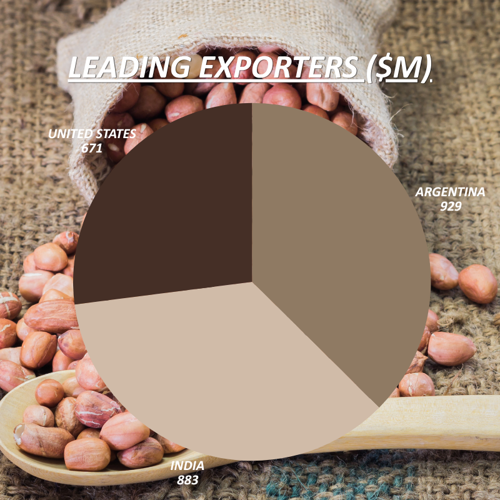
• China - $742M
• Netherlands - $622M
• Indonesia - $414M
China is the world's largest importer, fueled by its vast food manufacturing sector and growing consumer demand. The Netherlands acts as a major European trade gateway, importing large volumes for domestic consumption and re-export across the continent. Indonesia's demand is supported by its large population and extensive use of peanuts in traditional cuisine and food production.
In terms of global import shares, these countries account for approximately:
• China: 15.4% of world imports
• Netherlands: 12.9%
• Indonesia: 8.6%
Combined, they represent nearly 37% of global ground nut imports, highlighting their central role in international demand. Calculated from OEC trade data.
The largest trade deficits are registered by:
• Netherlands - -$417M
• Indonesia - -$411M
• China - -$258M
These deficits reflect strong internal demand that exceeds domestic supply, reinforcing the importance of global supply chains for maintaining stable market availability.
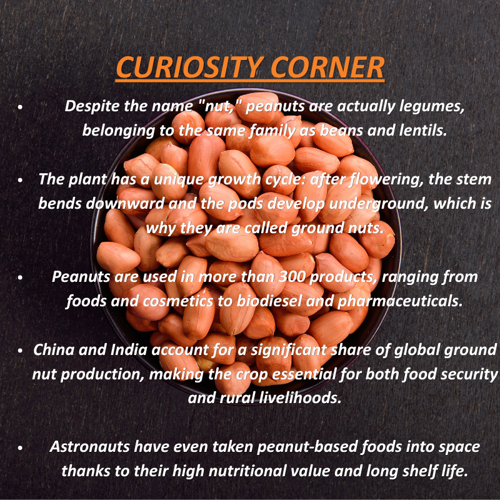
CURIOSITY CORNER: THE SURPRISING WORLD OF GROUND NUTS
Although peanuts are commonly called nuts, they are actually legumes, making them close relatives of beans, lentils, and peas. What makes them particularly unique is that, after flowering above ground, the plant pushes its fertilized ovary into the soil, where the pods develop underground. Few commercially important crops share this remarkable characteristic.
Ground nuts have a long and fascinating history. Originally cultivated in South America thousands of years ago, they spread throughout the world via Spanish and Portuguese trade routes. Today, they are consumed on every continent and appear in countless culinary traditions, from African stews and Asian sauces to American peanut butter and European confectionery products.
Nutritionally, ground nuts are powerhouses. They provide high-quality plant protein, heart-healthy unsaturated fats, vitamin E, magnesium, and antioxidants. Their affordability and nutritional density have made them an important food-security crop in many developing countries.
Another interesting fact is that ground nuts contribute to sustainable agriculture through nitrogen fixation. Like other legumes, they help enrich the soil naturally by converting atmospheric nitrogen into forms that plants can use, reducing the need for synthetic fertilizers and supporting healthier crop rotations.
CONCLUSION
Ground nuts are far more than a simple agricultural commodity. Their combination of nutritional value, versatility, and economic importance has made them a cornerstone of global food systems and international trade. With a global market worth nearly $5 billion, the sector continues to benefit from growing demand for protein-rich foods, vegetable oils, snack products, and plant-based ingredients.
Major exporters such as Argentina, India, and the United States dominate global supply, while large consumer markets including China, the Netherlands, and Indonesia drive international demand. Despite their low product complexity, ground nuts demonstrate how a relatively straightforward crop can generate significant trade flows, support rural livelihoods, and connect producers and consumers across the world.
As interest in sustainable agriculture and affordable plant-based nutrition continues to expand, ground nuts are likely to remain one of the most relevant and widely traded agricultural products in the global economy.
