
OVERVIEW
Indonesia is the largest economy in Southeast Asia and one of the world's most dynamic emerging markets. As an archipelago of more than 17,000 islands and a population exceeding 270 million people, the country serves as a strategic bridge between the Indian and Pacific Oceans. Its geographical position, abundant natural resources, expanding middle class, and growing industrial base have transformed Indonesia into a key player in international trade.
The country combines a strong commodities sector with an increasingly diversified manufacturing industry. While natural resources continue to play a crucial role in export performance, Indonesia has steadily expanded its presence in sectors such as metals processing, automotive manufacturing, electronics, and chemicals. This mix of traditional strengths and industrial development makes Indonesia an increasingly attractive destination for international businesses seeking opportunities in Asia.
ECONOMIC PROFILE AND COMPLEXITY
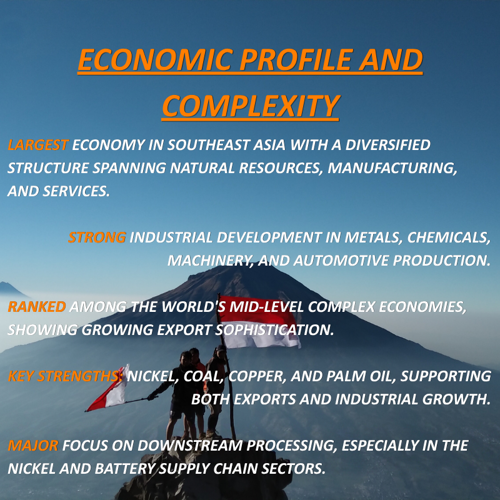
Indonesia ranks among the world's largest economies and has built a solid industrial foundation supported by natural resources, manufacturing capabilities, and domestic consumption. The country's economic structure is diversified across agriculture, industry, mining, services, and manufacturing, reducing dependence on any single sector.
According to the Economic Complexity Index (ECI), Indonesia ranks among the world's mid-level complex economies, reflecting its ability to export a broad range of products while continuing to move up the value chain. The country's growing expertise in metal processing, chemicals, machinery, and manufactured goods highlights its transition from a commodity-based exporter toward a more sophisticated industrial economy.
One of Indonesia's greatest strengths lies in its vast reserves of nickel, coal, copper, and palm oil. Government initiatives aimed at encouraging downstream processing have helped create greater value from raw materials before export, particularly in the nickel sector, which plays a critical role in global electric vehicle battery supply chains.
EXPORTS
Indonesia is a major exporter of both natural resources and industrial products. Total exports exceed $290 billion, demonstrating the country's importance in global trade networks.
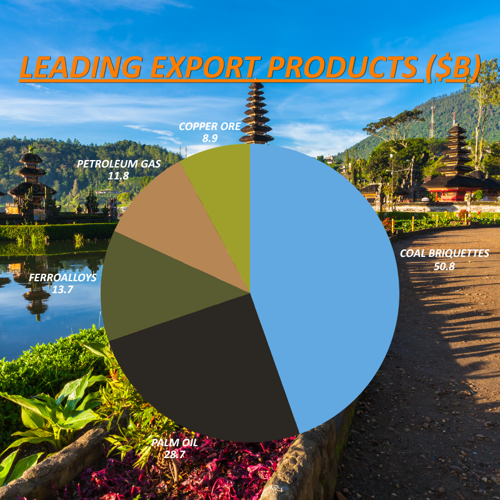
The country's leading export products include:
• Coal Briquettes: approximately $50.8 billion, representing around 17% of total exports.
• Palm Oil: approximately $28.7 billion, equal to nearly 10% of exports.
• Ferroalloys: approximately $13.7 billion.
• Petroleum Gas: approximately $11.8 billion.
• Copper Ore: approximately $8.9 billion.
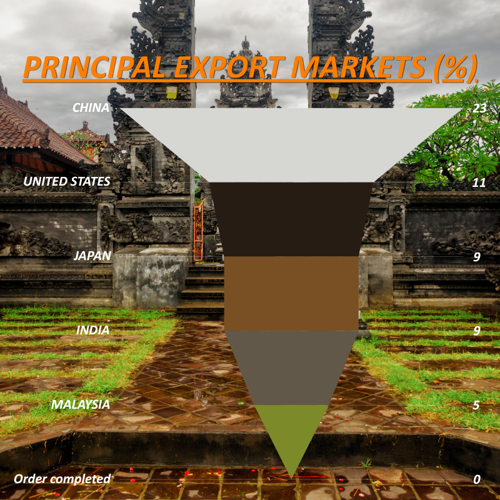
Indonesia's export destinations are heavily concentrated in Asia and the Pacific region. The principal export markets are:
• China: about 23% of total exports.
• United States: around 11%.
• Japan: roughly 9%.
• India: approximately 9%.
• Malaysia: about 5%.
Indonesia is also one of the world's leading suppliers of palm oil, ferroalloys, lignite, stearic acid, and nickel-based products, highlighting its strategic role in global manufacturing and energy supply chains.
IMPORTS
Indonesia's expanding economy requires substantial imports of energy products, industrial inputs, machinery, and advanced technology. Total imports amount to more than $230 billion, supporting industrial production and domestic consumption.
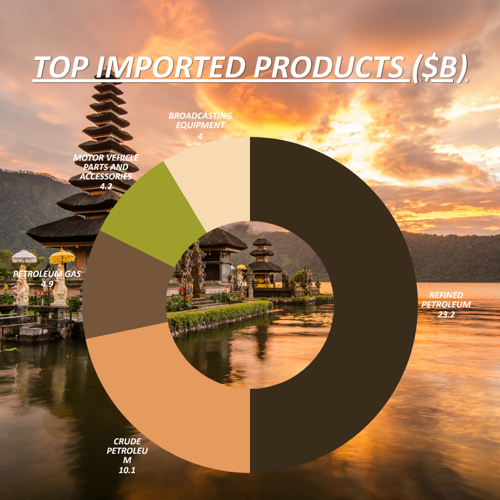
The country's top imported products are:
• Refined Petroleum: approximately $23.2 billion, nearly 10% of total imports.
• Crude Petroleum: about $10.1 billion.
• Petroleum Gas: approximately $4.9 billion.
• Motor Vehicle Parts and Accessories: around $4.2 billion.
• Broadcasting Equipment: roughly $4 billion.
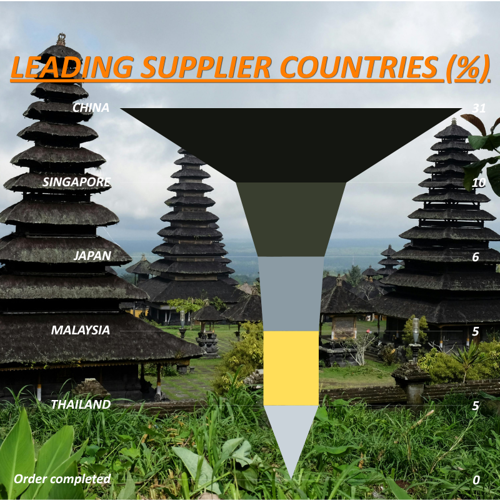
Indonesia relies heavily on imports from major Asian manufacturing hubs. The leading supplier countries are:
• China: approximately 31% of total imports.
• Singapore: around 10%.
• Japan: about 6%.
• Malaysia: roughly 5%.
• Thailand: around 5%. The strong presence of machinery, technology, and energy-related imports reflects Indonesia's ongoing industrialization and the development of higher-value manufacturing activities.
TRADE BALANCE
One of Indonesia's most notable economic features is its ability to generate a positive trade balance. Export revenues consistently exceed import expenditures, creating a trade surplus that supports economic stability and strengthens foreign exchange reserves.
The surplus is largely driven by strong global demand for commodities such as coal, palm oil, nickel-related products, and other mineral resources. At the same time, the country continues to invest in industrial upgrading by importing machinery, technology, and refined energy products. This combination allows Indonesia to benefit from its natural resource wealth while gradually moving toward more sophisticated forms of production.
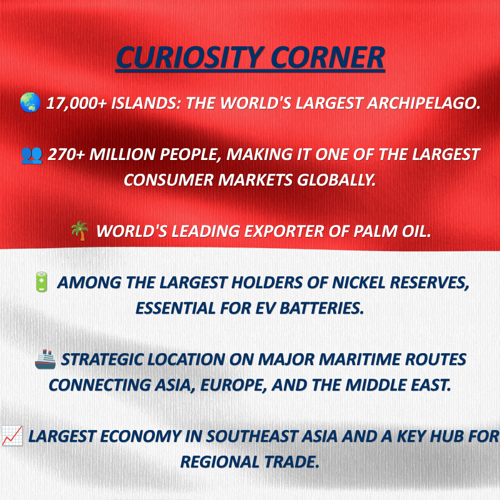
CURIOSITY CORNER
Indonesia offers several fascinating facts that help explain its growing importance in the global economy:
• Indonesia is the largest archipelago in the world, with more than 17,000 islands.
• It is the largest economy in Southeast Asia.
• The country is one of the world's leading producers and exporters of palm oil.
• Indonesia possesses some of the world's most significant nickel reserves, making it a crucial player in the electric vehicle battery industry.
• It is home to one of the largest consumer markets globally, with a population exceeding 270 million people.
• The country's strategic location places it directly on some of the world's busiest maritime trade routes connecting Asia, Europe, and the Middle East.
CONCLUSION
Indonesia has evolved into one of the most influential economies in Asia, combining abundant natural resources with an increasingly diversified industrial base. Strong export performance, a strategic geographic position, and a vast domestic market continue to attract international investors and trading partners.
While commodities remain a fundamental pillar of economic success, Indonesia's growing capabilities in manufacturing, metals processing, and technology-related industries suggest a promising future. For companies seeking opportunities in fast-growing markets, Indonesia stands out as a country that successfully balances resource wealth, industrial development, and global trade connectivity, making it one of the most compelling business destinations in the Asia-Pacific region.
