OVERVIEW
Guinea is one of West Africa’s most resource-rich nations, strategically located along the Atlantic coast and endowed with vast mineral reserves, fertile agricultural land, and a young workforce. While the country remains a developing economy, it plays a surprisingly significant role in global commodity markets thanks to its abundant natural resources, particularly bauxite, the primary ore used in aluminum production.
The country has increasingly strengthened its position within international trade networks, exporting large volumes of raw materials to major industrial economies. Its economic landscape is characterized by a strong dependence on extractive industries, making global commodity prices and foreign investment important drivers of growth. At the same time, Guinea continues to import a wide range of manufactured goods, machinery, fuels, and food products necessary to support domestic consumption and infrastructure development.
With a GDP of approximately $25 billion, Guinea represents one of the emerging economies of Sub-Saharan Africa, offering both opportunities and challenges for international businesses and investors.
ECONOMIC PROFILE AND COMPLEXITY
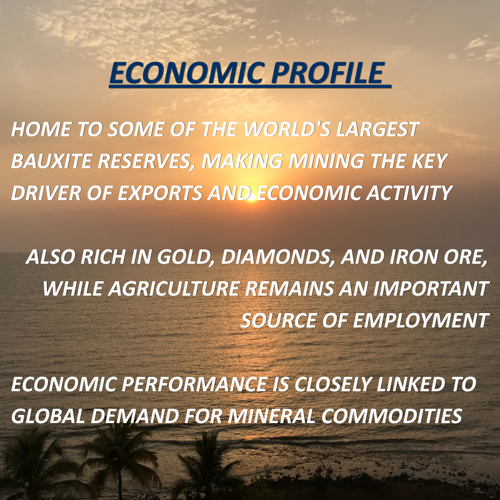
Guinea’s economy is heavily concentrated in the extraction and export of natural resources. Mining contributes a substantial share of economic activity, with bauxite standing as the country's dominant export commodity. The nation possesses some of the world's largest reserves of this mineral, giving it strategic importance within global aluminum supply chains.
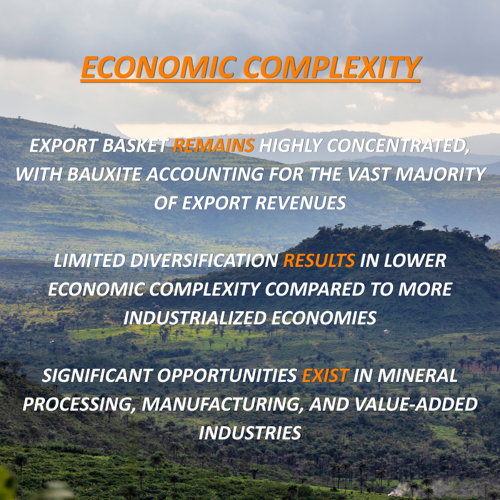
Despite its wealth in natural resources, Guinea ranks among the least diversified economies globally. According to the Economic Complexity Index (ECI), the country is positioned near the bottom of international rankings, reflecting a production structure that remains heavily reliant on a limited range of low-complexity products. An ECI score of approximately-2.5 highlights the challenges associated with industrial diversification and value-added manufacturing.
This dependence creates both strengths and vulnerabilities. On one hand, Guinea benefits from strong international demand for its minerals. On the other, fluctuations in commodity prices can have a considerable impact on export earnings and economic stability.
In recent years, investment in mining infrastructure, transportation networks, and logistics has helped improve Guinea’s integration into global markets. These developments may contribute to a gradual expansion of industrial capabilities and broader economic diversification in the future.
EXPORTS
Exports are the backbone of Guinea’s economy, generating billions of dollars in foreign exchange revenue and connecting the country to major international markets.
Total exports exceed $9.6 billion, with mineral products accounting for the overwhelming majority of outbound trade. The export basket is highly concentrated, making Guinea a textbook example of a commodity-driven economy.
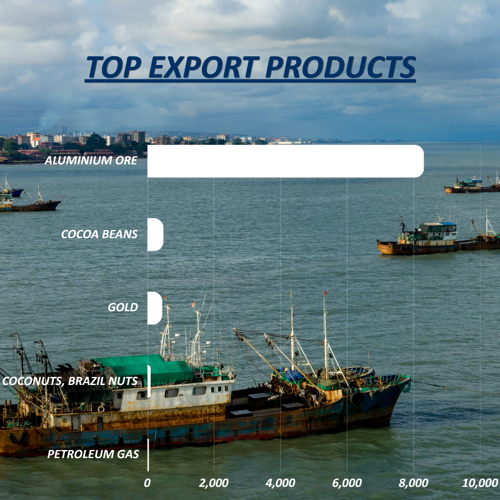
TOP EXPORT PRODUCTS
• Aluminium Ore (Bauxite): $8.31 billion
• Cocoa Beans: $485 million
• Gold: $448 million
• Coconuts, Brazil Nuts and Cashews: $97.9 million
• Petroleum Gas: $48.5 million
Bauxite alone represents approximately 86% of total exports, underlining the country’s extraordinary dependence on a single commodity. Guinea is also recognized as the world’s largest exporter of aluminium ore, making it a critical supplier for global aluminum production.
MAIN EXPORT DESTINATIONS
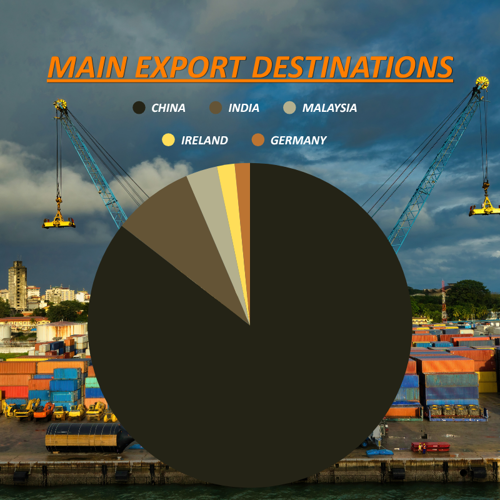
• China: $7.64 billion
• India: $723 million
• Malaysia: $280 million
• Ireland: $157 million
• Germany: $135 million
China is by far Guinea’s most important trading partner, absorbing roughly 80% of the country's exports. The relationship is largely driven by China’s massive demand for bauxite to feed its aluminum industry. This strong trade connection has made Guinea increasingly important within global industrial supply chains.
IMPORTS
While exports are dominated by raw materials, Guinea’s imports paint a different picture, reflecting the needs of a developing economy investing in infrastructure, industrial projects, transportation, and food security.
Total imports amount to approximately $7.8 billion, covering a wide range of products from machinery to consumer goods.
TOP IMPORT PRODUCTS
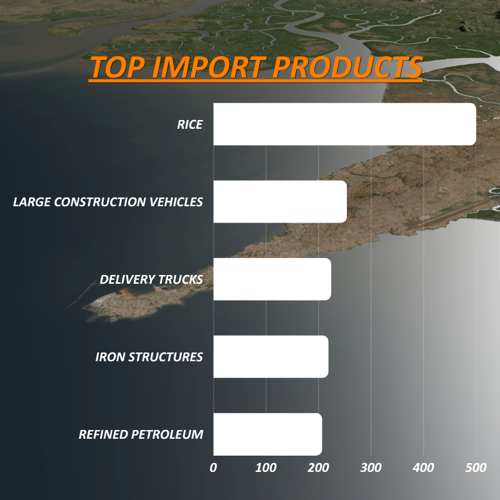
• Rice: $500 million
• Large Construction Vehicles: $254 million
• Delivery Trucks: $224 million
• Iron Structures: $219 million
• Refined Petroleum: $207 million
The prominence of construction equipment, trucks, and iron structures highlights the importance of mining projects and infrastructure development throughout the country. Meanwhile, significant rice imports demonstrate Guinea’s continued dependence on foreign suppliers to satisfy domestic food demand.
MAIN IMPORT PARTNERS
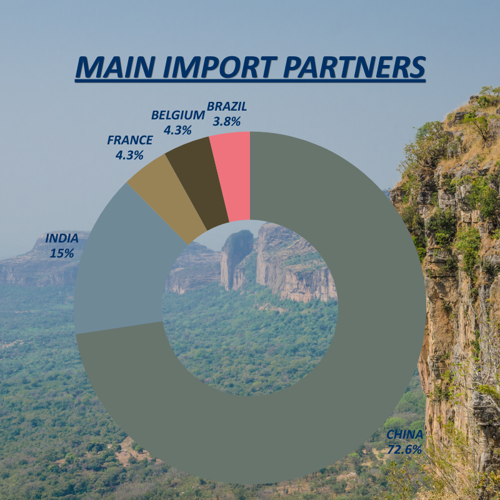
• China: $3.93 billion
• India: $813 million
• France: $234 million
• Belgium: $232 million
• Brazil: $203 million
China again emerges as the dominant trade partner, supplying approximately half of Guinea’s imported goods, further strengthening the economic ties between the two countries.
TRADE BALANCE
One of Guinea’s most notable economic characteristics is its positive trade balance.
With exports valued at approximately $9.6 billion and imports around $7.8 billion, the country records a trade surplus of nearly $1.9 billion.
The strongest positive trade relationships are found with:
• China: +$3.71 billion
• Malaysia: +$229 million
• Ireland: +$122 million
Conversely, Guinea records trade deficits with several countries, including:
• France: -$219 million
• Belgium: -$209 million
• Brazil: -$203 million
• Senegal: -$186 million
• Morocco: -$183 million
The overall surplus is largely fueled by mineral exports, particularly bauxite shipments. This highlights how critical mining remains to the country's external economic position and foreign exchange earnings.
CURIOSITY CORNER
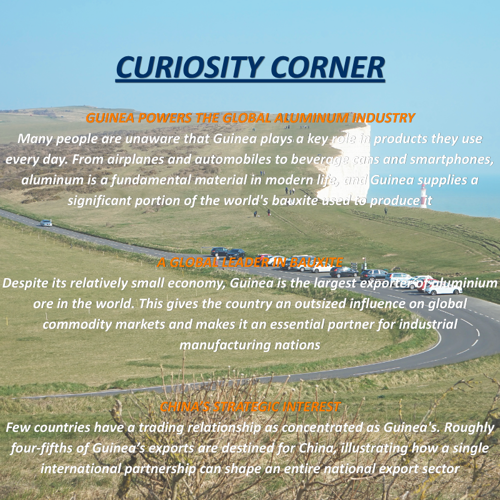
GUINEA POWERS THE GLOBAL ALUMINUM INDUSTRY
Many people are unaware that Guinea plays a key role in products they use every day. From airplanes and automobiles to beverage cans and smartphones, aluminum is a fundamental material in modern life, and Guinea supplies a significant portion of the world's bauxite used to produce it.
A GLOBAL LEADER IN BAUXITE
Despite its relatively small economy, Guinea is the largest exporter of aluminium ore in the world. This gives the country an outsized influence on global commodity markets and makes it an essential partner for industrial manufacturing nations.
CHINA’S STRATEGIC INTEREST
Few countries have a trading relationship as concentrated as Guinea's. Roughly four-fifths of Guinea’s exports are destined for China, illustrating how a single international partnership can shape an entire national export sector.
CONCLUSION
Guinea presents a fascinating case of a resource-driven economy with substantial influence in global commodity markets. Its vast mineral wealth, particularly in bauxite, has enabled the country to become a key player in international trade despite its relatively modest economic size.
The country’s strong export performance and positive trade balance demonstrate the value of its natural resources, while its dependence on a limited range of products highlights the importance of future diversification. Investments in infrastructure, industrial capacity, and value-added processing could help Guinea unlock even greater economic potential in the years ahead.
For businesses monitoring emerging markets, Guinea offers a compelling mix of strategic resources, growing trade connections, and long-term development opportunities, making it a country worth watching in the evolving landscape of global commerce.