PRODUCT CLASSIFICATION
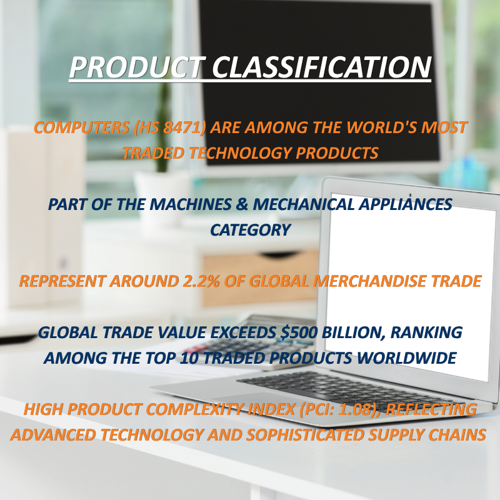
Computers are among the most important products in the modern global economy. From personal laptops and desktop workstations to enterprise servers and data-processing systems, computers form the backbone of digital transformation, enabling communication, automation, artificial intelligence, cloud computing, and e-commerce. Virtually every industry today depends on computer technology, making this product category one of the most strategic in international trade.
From a trade perspective, computers belong to the Machines section and are classified under HS 8471: Automatic data processing machines and units thereof. This category includes laptops, desktop computers, processing units, storage systems, and other computer-related hardware.
Global trade in computers exceeds $500 billion, making it one of the world's most traded products. Computers account for approximately 2.2% of total global merchandise trade, highlighting their central role in the international economy. Unlike many traditional manufactured goods, computers combine advanced engineering, globalized supply chains, and continuous technological innovation.
Among all products traded worldwide, computers rank among the top 10 most traded goods, reflecting the growing importance of digital infrastructure across businesses, governments, and households. According to the Product Complexity Index (PCI), computers score 1.08, placing them among the more technologically sophisticated products in international commerce.
EXPORT
The global computer export market is highly concentrated, with a limited number of economies serving as manufacturing and assembly hubs for the world.
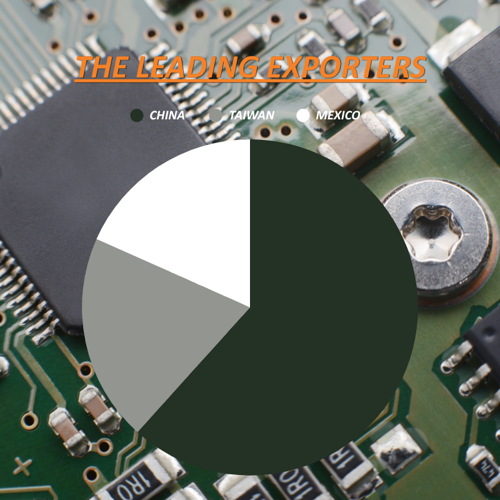
The leading exporters are:
• China – approximately 37% of global computer exports
• Chinese Taipei (Taiwan) – approximately 12%
• Mexico – approximately 11%
China dominates the industry thanks to its vast manufacturing ecosystem, extensive supplier networks, highly developed electronics clusters, and strong integration into global value chains. The country produces everything from consumer laptops to enterprise-grade computing equipment, serving markets across every continent.
Taiwan occupies a unique position within global technology supply chains. Beyond exporting finished products, Taiwanese companies are responsible for a significant share of the world's advanced computing components, processors, and motherboard technologies. Mexico, meanwhile, benefits from its strategic proximity to the United States and its role as a major assembly and export platform for North America.
Countries with the highest share of computers within their overall export portfolios include:
• Montserrat – 32.5%
• Taiwan – 11.4%
• Mexico – 8.72%
These figures demonstrate how critical computer manufacturing is to the economic structure of certain export-oriented economies.
The largest trade surpluses are recorded by:
• China – approximately $165B
• Taiwan – approximately $51.6B
• Mexico – approximately $45.2B
These surpluses reflect strong production capabilities, competitive manufacturing costs, advanced technological expertise, and deep integration into international electronics supply chains.
IMPORT
Demand for computers is driven by digitalization, business investment, education, cloud infrastructure, and consumer electronics markets.
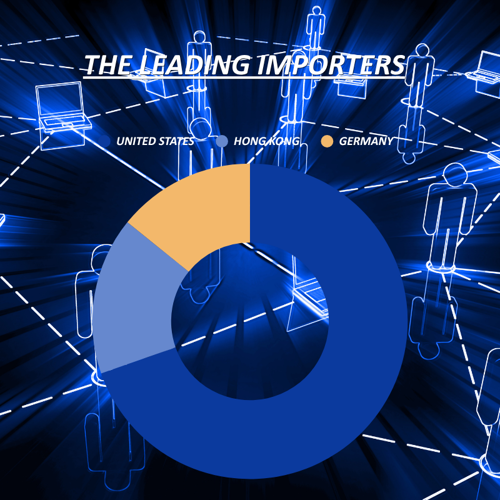
The leading importers are:
• United States – around 28% of global computer imports
• Hong Kong – approximately 6.5%
• Germany – approximately 5.7%
The United States remains the world's largest computer importer due to its substantial consumer market, large corporate sector, and ongoing investments in digital infrastructure. Germany serves as one of Europe's primary technology markets, while Hong Kong functions as a major regional distribution and re-export hub within Asia.
The largest trade deficits are registered by:
• United States – approximately–$108B
• Hong Kong – approximately–$28.8B
• Japan – approximately–$16.5B
These deficits highlight the dependence of major technology-consuming economies on imported computer hardware, despite their strength in software, services, and innovation.
MARKET INSIGHTS
Within the broader computer category, some product segments account for the majority of global trade value.
The most important subcategories are:
• Portable computers (laptops and notebooks) – approximately 35% of total computer trade
• Computer processors and processing units – approximately 30%
• Computer storage devices – approximately 12%
This distribution illustrates the continued dominance of portable computing devices, driven by remote working, hybrid education, business mobility, and digital connectivity.
At the same time, growing demand for artificial intelligence, cloud computing, and data centers is increasing the importance of high-performance processors and specialized computing hardware.
CURIOSITY CORNER: THE HIDDEN STORY BEHIND COMPUTERS
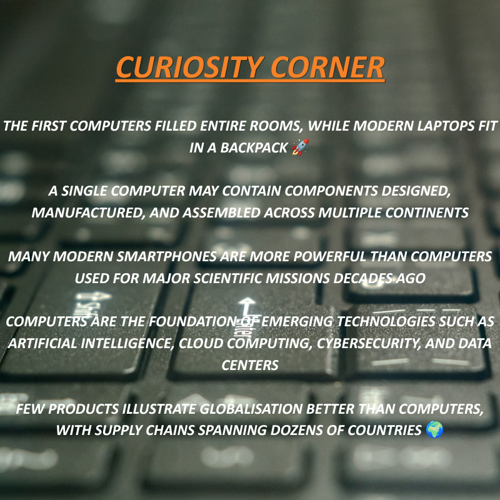
Today's computers may seem like everyday tools, but their evolution has been extraordinary. The first electronic computers occupied entire rooms, consumed enormous amounts of electricity, and possessed less processing power than a modern smartphone.
One of the most remarkable transformations in computing history is the dramatic decline in size and increase in performance. A laptop weighing less than two kilograms can now perform billions of calculations per second, enabling tasks that would have required supercomputers just a few decades ago.
Another fascinating aspect is the global journey of a single computer. A device purchased in Europe or North America may contain processors designed in the United States, chips manufactured in Taiwan, memory components produced in South Korea, assembly operations completed in China or Mexico, and software developed by teams spread across multiple continents. Few products illustrate globalization more clearly than computers.
Moreover, computers have become essential not only for work and entertainment but also for emerging technologies such as artificial intelligence, autonomous systems, cybersecurity, advanced manufacturing, and scientific research. As a result, computer hardware is increasingly viewed as a strategic asset by governments and businesses alike.
CONCLUSION
The global computer trade demonstrates the central role that digital technologies play in the modern economy. With trade values exceeding half a trillion dollars and representing more than 2% of global merchandise trade, computers remain one of the world's most significant and technologically advanced product categories.
Production is concentrated in major manufacturing hubs such as China, Taiwan, and Mexico, while demand is led by large consumer and business markets including the United States, Germany, and Hong Kong. The industry's strong growth reflects the ongoing expansion of digital infrastructure, cloud services, artificial intelligence applications, and connected devices worldwide.
As economies become increasingly digital, computers are expected to remain at the center of global commerce, serving as the hardware foundation for innovation, productivity, and technological progress across every sector of society.